Rachel Mann was one of the first Byte the Book members, having taken the City University Novel Studio course with Justine a few years ago. Here she talks about the process of writing and publishing her novel, On Blackberry Hill.
Since the publication of my first novel, On Blackberry Hill, this past summer, many people have asked me: How long did it take to write? I find this seemingly simple question hard to answer. Maybe what they mean is: How did you do it? This is what people really want to know, isn’t it? How does one write a novel?
There are as many ways to write a novel as there are novelists. Here’s how I did it. In the winter of 2008, I was working as an editor in educational publishing in New York, when my husband accepted a job relocation to London. With two children under five, I decided to focus on helping them adjust, while also taking the opportunity to do something I had long wished to pursue: creative writing. Enrolling on City’s Novel Studio course (then called the Certificate in Novel Writing) felt like signing up to climb Everest. I had never written a story longer than ten pages.
The course began with a focus on reading novels of all genres, and on the fundamentals of strong stories. I felt excited and ready to undertake the task of writing my own novel, as I began to evaluate writing from a writer’s perspective, not just from a reader’s. The tutors broke up the monumental process into manageable chunks, guiding us through small goals. As Anne Lamott explains in her influential book, writing is accomplished “bird by bird.” In other words: one image, one scene, one sentence at a time. The camaraderie and the ritual of meeting with other writers for hours each week really drove my commitment to spend the time necessary to complete the novel.
I decided to set my novel in an American summer camp, a setting deeply familiar to me, but foreign to every one of my classmates. Having a thoughtful audience for my earliest drafts helped to push me to make the story accessible to a wide range of readers. I finished the course with an outline and 50 pages. We had a reading for friends, family, agents and publishers, which pushed us to think of our novels as real products, not just class exercises. By the following spring, I had a complete first draft.
So what happened next? Life. My family moved back to New York, and we had a third child. I networked, went to conferences, wrote new pieces, and revised and revised my novel. There were long stretches of time when I didn’t look at the manuscript at all, as other pressing concerns took hold. In the end, it was my Novel Studio classmate and friend Justine Solomons, founder of Byte the Book, who helped me to publish the novel at long last.
As you see, writing a novel, at least for me, was a meandering process that took almost 8 years from first scribbles to printed book. It’s been so rewarding to hear reader feedback, from old friends to other writers, to young readers who relate to the teenage characters. Writing and completing a work is its own reward, but having readers respond to one’s writing is a greater thrill yet.
I remain grateful to the community of my City Novel Studio course, many of whom gathered together to share and critique writing even after the course ended. We continue to share and celebrate one another’s successes to this day.
Girl Friday’s newly released podcast, From the Margins, is an NPR-style narrative exploring the “story behind the story.” With themes ranging from pitching your project to how parenthood affects craft to the curious problem of writing what actually happened, the content is by turns hilarious and tear-jerking and sure to delight writers and book lovers alike. Listen here or you can download it for free on iTunes.
Follow on Facebook
Twitter: @GirlFridayProd
Instagram: @girlfridayproductions
A two-year collaborative research project, exploring the developing relationship between digital technology and literature was formally launched last week, against the iconic backdrop of The Thames.The Ambient Literature project will see a team from the universities of Bath Spa, Birmingham and the West of England (UWE) investigate the design and delivery of location-based reading experiences using pervasive technology, which responds to the reader and uses digital media as a bridge between story and place.Funded by a grant from the Arts and Humanities Research Council (AHRC), the academics will combine expertise on the traditional format of the book with research into the future of literature delivery with the aim of continuing the exploration of the relationship between technology and story-telling.The project will develop this new knowledge by commissioning three writers to create original stories that will further explore new experiential forms with help from software partner Calvium.Speaking about the project, Dr Tom Abba, project leader from UWE, commented: “Kate Pullinger, James Attlee and Duncan Speakman have each been asked to create something especially for this form. Each of these works will respond to the presence of a reader, and aim to show how we can redefine the rules of the reading experience through the use of technology.“Our intention is to develop a whole new writing technique, specifically for this space, which is essentially a new literary genre. It’s a new arena with lots of potential, and a very exciting project to be embarking on.”Guests at the launch event - hosted by publishers Hachette - were also offered a preview of the forms of storytelling the project is addressing. Experiment i, a contained,ambient story, drew guests into a fictional history of Carmelite House, the location for the event.For more information about the project go to www.ambientlit.comPress contact:Niki Goddard, Speed Communications01179064515Further information:Writer biographiesKate PullingerKate Pullinger writes fiction. Her recent works include the novel Landing Gear. In the summer of 2014, 22,000 people wrote letters to the digital war memorial she created with Neil Bartlett, Letter to an Unknown Soldier. Inanimate Alice recently won Honourable Mention for the Robert Coover Award; she is currently working on a serialised media-rich novel for smartphones, Jellybone, with the start-up oolipo.com. She is Professor of Creative Writing and Digital Media at Bath Spa University.Duncan SpeakmanDuncan Speakman is an artist based in Ghent. Originally trained as a sound engineer at the Liverpool Institute for Performing Arts, his work examines how we use technology to locate ourselves in personal and political environments. Seeking out the poetics of the everyday, he creates socially relevant experiences that engage audiences emotionally and physically in public spaces. He is the founder of the artists collective Circumstance. Recent commissions include work for the Times Museum in Guangzhou, UkMX in Mexico City and the Saitama Triennial in Tokyo.James AttleeJames Attlee lives in Oxford and works in art publishing in London. He is the author of Station to Station, Isolarion: A Different Oxford Journey and the co-author, with Lisa Le Feuvre, of Gordon Matta-Clark: The Space Between.About the projectFunded by the Arts & Humanities Research Council, Ambient Literature is led by Professor Jon Dovey and Dr Tom Abba at UWE, working with Bath Spa’s Professor Kate Pullinger and Professor Ian Gadd and Birmingham University’s Dr Matt Hayler. Calvium Ltd is providing the technical infrastructure for the practice-led outcomes.The Arts and Humanities Research Council (AHRC) funds world-class, independent researchers in a wide range of subjects: ancient history, modern dance, archaeology, digital content, philosophy, English literature, design, the creative and performing arts, and much more. This financial year the AHRC will spend approximately £98m to fund research and postgraduate training in collaboration with a number of partners. The quality and range of research supported by this investment of public funds not only provides social and cultural benefits but also contributes to the economic success of the UK. For further information on the AHRC, please go to: www.ahrc.ac.uk
Maeve runs Sea View Lodge in Morecambe. Nearly eighty years old, Maeve has lived there all her life. A guest house that once catered to civil servants in the war, builders afterwards and now specialises in accommodating travellers with disabilities, Sea View Lodge is filled with a history that Maeve has done her best to keep locked in the shed.
One day Vincent, a friend from her youth, turns up wanting a room and that history begins to break its chains.
Maeve once had a twin, a twin with various disabilities that at that time in England meant Edie was labelled as ‘subnormal’, at best ‘unfortunate’. The history Maeve has locked away is all about how her family fought to care for Edie against all the advice of the time that recommended sending her into institutional care to allow them to focus on their healthy child.
Whilst the third section of the book had me in tears through most of it, there is nothing sentimental or politically cautious about Emma Claire Sweeney’s writing. Maeve writes the whole novel to Edie and yet for years she hasn’t mentioned her name to anyone. This is a woman making the best of a bad hand whose resentment and anger acts as a barrier and for whom intimacy is difficult. Whose life then is set out for us to judge? Whose life has more value? Which twin has had the raw deal?
Intersected with Maeve’s narrative are passages of Edie’s words - mostly remembered lyrics, poems and repeated phrases that reveal a deeper knowledge of her sister’s situation regardless of Maeve’s excellent school reports and exam results - and letters and reports from doctors, social workers and others regarding the welfare of Edie and Maeve’s other charges at Sea View Lodge, as well as builder’s reports and personal letters.
The telling of the novel is beautifully crafted, each passage cleverly timed to build our intrigue and understanding of the wider work. This is intelligent and polished writing telling stories about those whose voices are all too often unheard. Not only will you want to stay up all night reading for the contemporary and historical plot, you won’t fail to appreciate the delicate elegance of the writing. Owl Song at Dawn is a book that should go straight onto bestseller and prize-winning lists. Published by Legend Press on 1st July 2016, get ahead of the crowd and read it now.

If you would like to find out more about Owl Song at Dawn and its author, have a look at my interview with Emma Claire Sweeney.
Words by Chris Russell, photos by Nicole Kavanaugh.
For its June event, Byte The Book turned its attention to the dynamic and ever-changing world of crime and thriller publishing. Amid the occasional quip about Brexit and the imminent England match, a panel of industry experts discussed markets, self-publishing and the extraordinary power of data.

Justine with Ruth Sorby from Worldreader, an organisation Byte the Book promoted through this event.
Chair Cathy Rentzenbrink (author and contributing editor at The Bookseller) began by pointing out that, thanks to the enduring popularity of Enid Blyton, crime (or, at least, mystery) novels are often the first books that young readers fall in love with. And these obsessions frequently last into adulthood, if sales figures are anything to go by. Sixteen million crime novels are sold annually in the UK alone, revealed Hachette’s publishing director Alex Clarke, generating nearly a hundred million pounds’ worth of profit, close to a third of the global total. It’s a unique section of the market, too, he added. It has more sub-divisions than any other genre, and its audience is a vibrant mix of male and female, young and old. Tellingly, since the turn of the millennium, crime and thriller publishing has spawned many of the industry’s biggest hits, from Gone Girl and The Da Vinci Code to the mega-selling The Girl On The Train.

Our fabulous judges from left to right:Cathy Rentzenbrink (chair),Oli Munson,Alex Clarke and Mark Dawson.
At this point, literary agent Oli Munson picked up the thread, suggesting that whilst certain elements of The Girl On The Train’s marketing campaign undeniably gave it a leg-up, no one could have predicted it would go stratospheric (nobody ever can, he argued). That said, in a world where information is the new currency, most are now cottoning on to the fact that author fanbases can be steadily built, piece by piece, reader by reader, if careful attention is paid to consumer data. Crime author and self-publishing phenomenon Mark Dawson, who completed the panel, is cast-iron proof of this. After a lukewarm experience with a traditional publisher, Mark turned to self-publishing, writing twenty-one books in five years and building up his income from next-to- nothing to a projected seven-figure revenue in 2016. He’s an outlier, of course (for every Mark Dawson there are endless thousands of self-published writers making virtually nothing), but his story remains an encouraging talisman for the oft-touted “authorpreneur”. If, like Mark, you are prepared to work tirelessly, to produce professional novels that are indistinguishable from their traditionally-published counterparts and to painstakingly nurture your fanbase through the use of reader data, there are audiences out there for the taking. Crime readers are loyal, and they know what they like, and this makes them appealingly simple to market to. Using Facebook ads, for instance, Mark is able to directly target fans of, say, the TV show 24, and since his research tells him that those people will enjoy his books, he is able to glean far more value from this relatively cheap form of advertising than he would from the altogether less-focussed “billboard in a train station” model favoured by mainstream publishers.

A riveted audience in the luxurious studio, The Club at The Cafe Royal
Many in the industry are now growing tired of the age-old “self versus trad” debate, and as Alex stressed, The Big Five have an enormous amount to learn from self-published authors. In fact, the relationship between the two camps is now becoming a form of symbiosis, and soon, it’s very likely most of us will cease entirely to make the distinction. “Whether you’re an author or a publisher,” said Oli, “you ignore self-publishing at your peril.”

And, of course, Byte the Book networking in full swing
And so, while at the start of the discussion Cathy was posing the tongue-in- cheek question “Does crime pay?”, by the time the microphones were turned off, most people were in agreement. In the right circumstances, it indisputably does.
If you enjoyed this report and want to keep up with the latest happenings in publishing as well as network with publishers and authors alike keep yourself posted by visiting our events page here. You can join us from £30 a quarter here
More photos can be found on our Facebook Page
Words by Rebekah Lattin-Rawstrone, photos by Nicole Kavanaugh.
Everyone knows that Byte the Book is the place to come and talk about technology in publishing and media. If you have a creative project Byte the Book can help you think about how to realise and fund it. Tuesday’s event took this specialism to another level offering an expert panel and a Dragons’ Den style series of pitches. Not only were the panel and pitchers a sizzling bunch of talent, so was the evening, with everyone in their summer gear and windows open onto a bustling Dean Street.
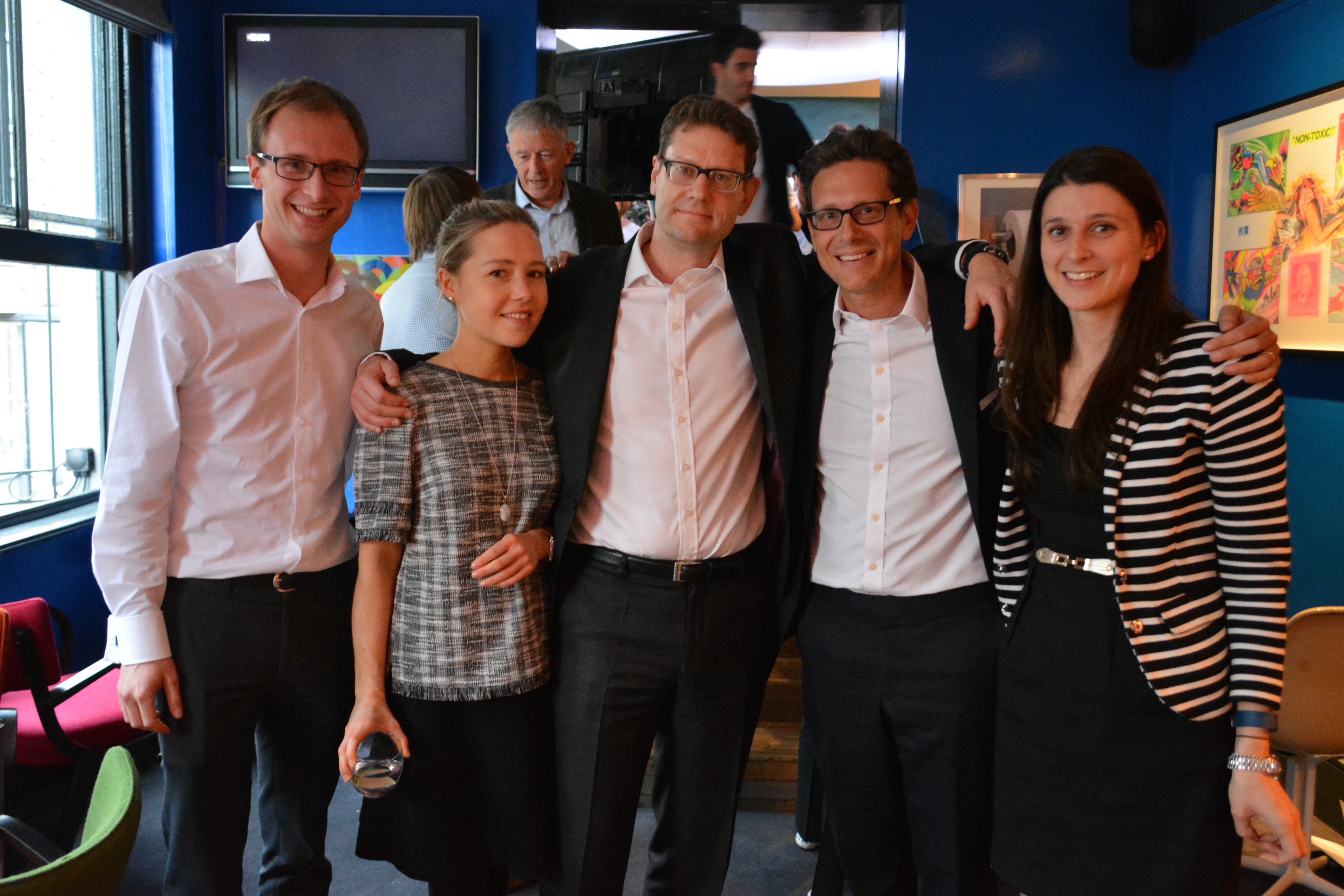
Our sponsors Harbottle & Lewis from left to right, Sam Purkiss, Charlotte Pym, Tim Parker, Tony Littner and Sophie Giblin.
Ruth Jones, Director of Business Development at Ingram Content Group, chaired the panel, introducing them and asking each panelist one pertinent investment question to whet our appetite for the pitches.
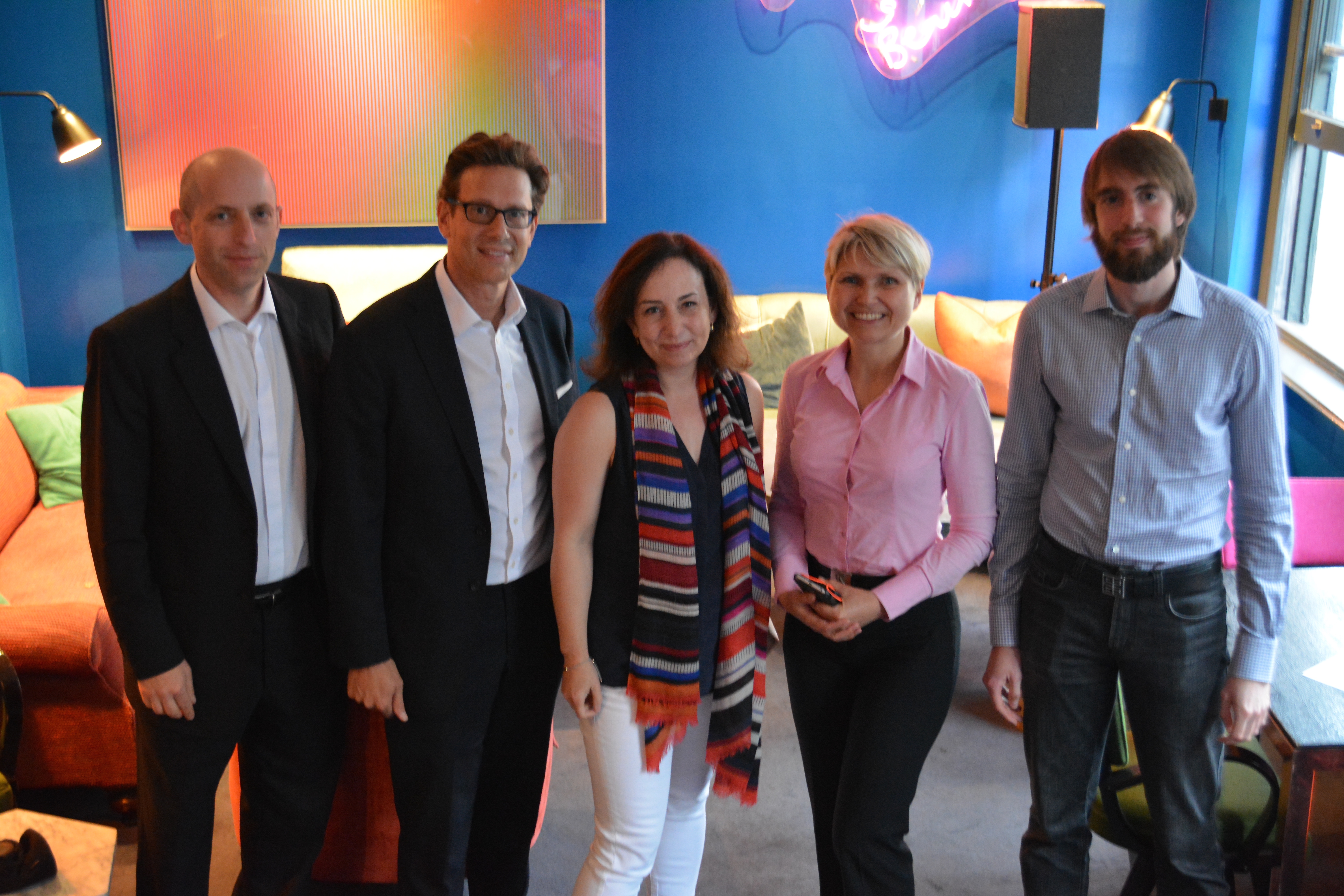
Our fabulous judges from left to right: Michael Spalter, Tony Littner, Ruth Jones (Chair), Ilona Simpson and Ricardo Fayet.
Michael Spalter, Entrepreneur and Angel Investor, was asked what he looked for when investing. Though he needed to see the spreadsheets and check that the product was protectable and scalable, Michael said he wanted to invest in something he would enjoy being a part of and was particularly interested in fields he wouldn’t have the skills to work in himself.
Tony Littner, Head of Start-Ups and Venture Capital at Harbottle & Lewis the sponsors of the evening, was asked what legal pitfalls people needed to be aware of when seeking investors. Tony felt that psychological rather than legal pitfalls were the more pertinent as you needed to decide whether you could work with your investor. Could you have them in the boardroom? Would they be on your side? For Tony, more difficulties arose from clashes in personality between founders and investors than from legal issues.
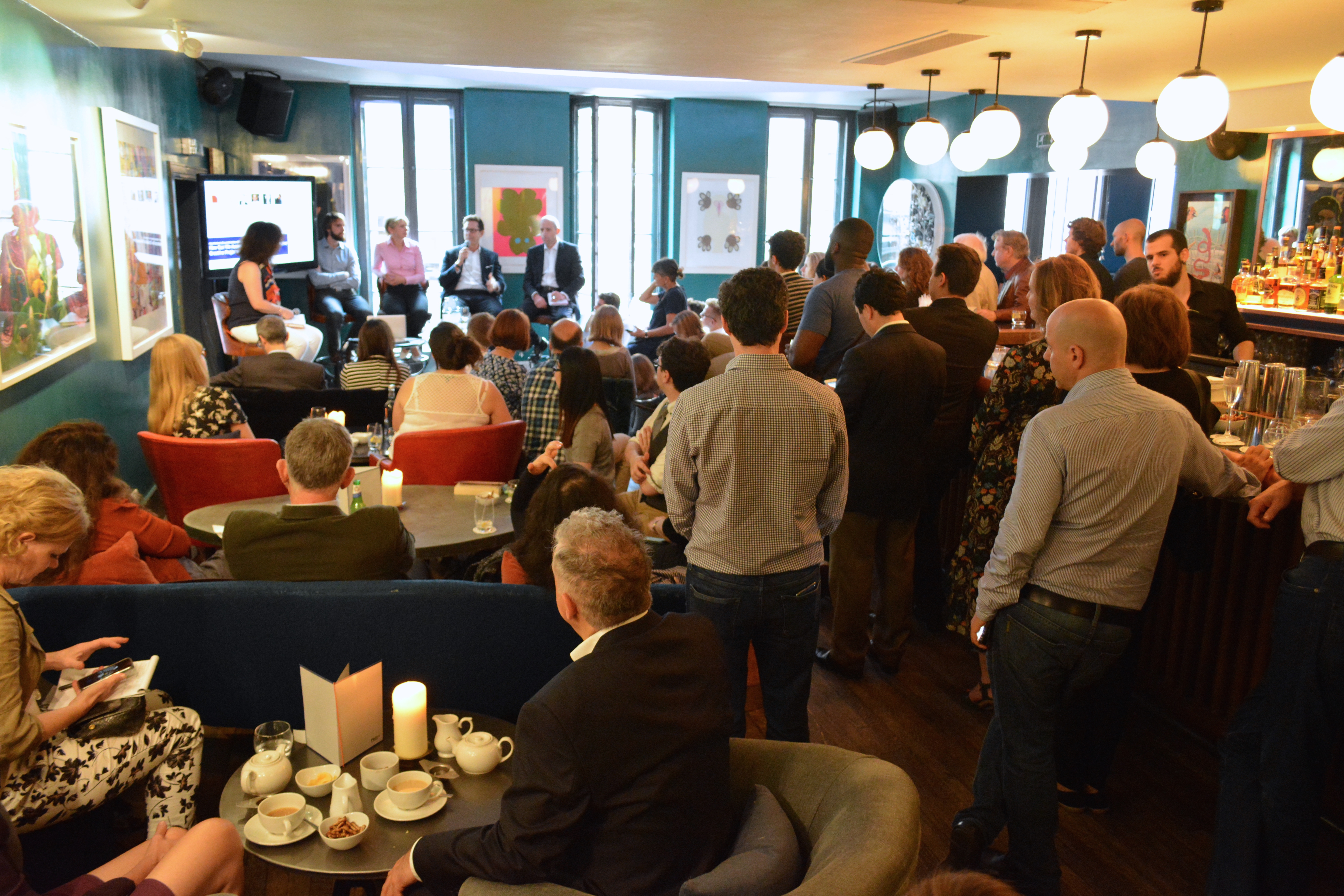
Busy but happy to be back in the more spacious Soho Bar.
Ilona Simpson of Ariadne Capital was asked when, in the development of your idea, it was best to look for funding and she made it clear that having a minimal viable product with key customers was essential. She went on to explain that Ariadne Capital looks at businesses who are changing the dynamics, melting the boundaries, between industries. To which Ruth added that investors needed to be sure that the product was solving a problem that people actually wanted to be solved.
Ricardo Fayet, Co-founder of Reedsy, was asked what it felt like to have investors. Of course, Ricardo said that having investors felt good. However, he did stress the differences between investors. Some provide nothing but money and others provide additional services. Each relationship with an investor is different.
Having introduced the topic, Justine got out her timer, and the pitchers were ready to begin. With only 5 minutes to pitch each project, then 5 minutes for questions from the panel, the atmosphere was charged.
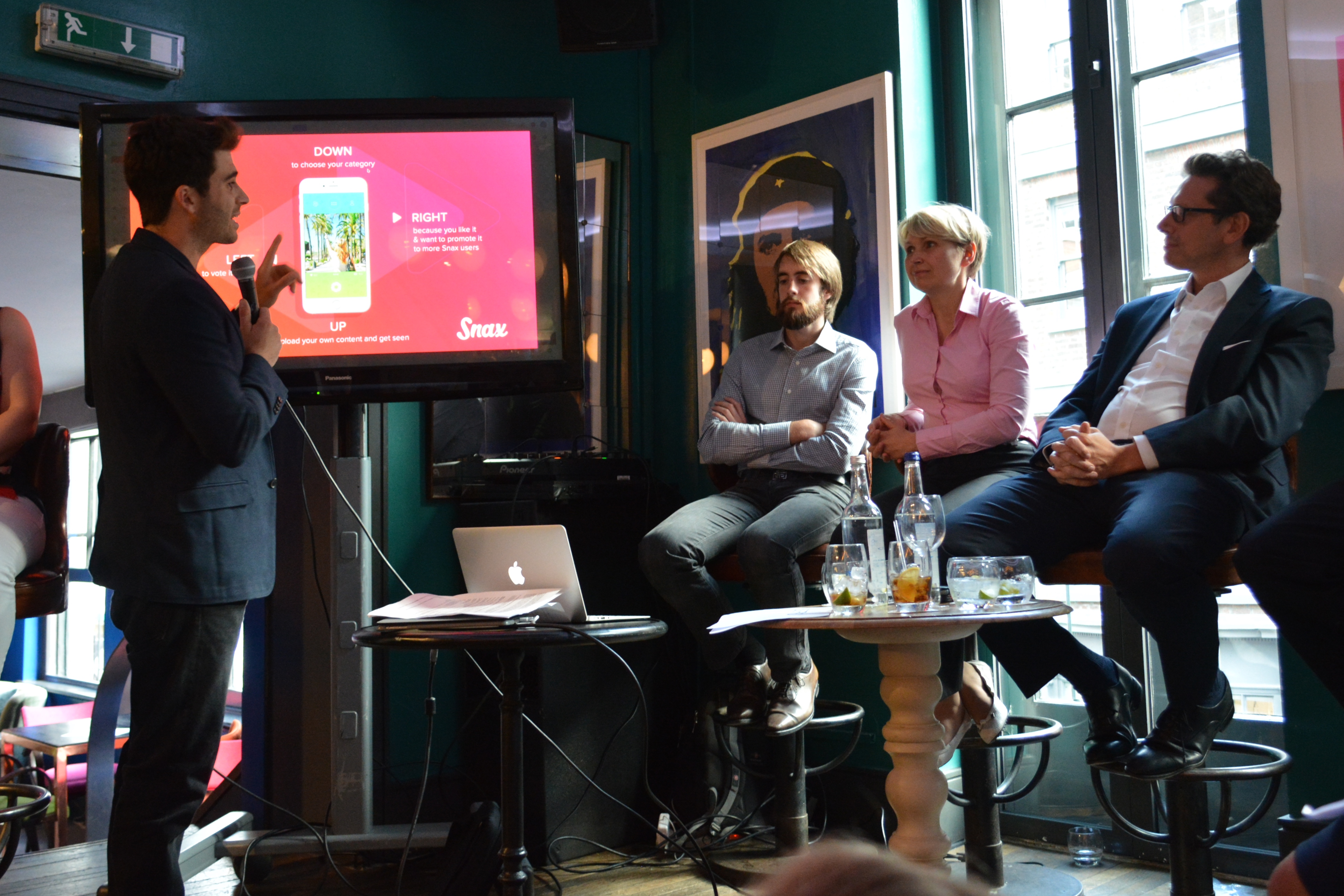
Nico Cary of Snaxapp facing the dragons.
Nico Cary, Co-founder of Snaxapp went first, showing us the importance of entrepreneur experience with his previous company Sportlobster, and wanting to give us a product that would once again make content king. Social media doesn’t guarantee views of content, snaxapp will. Adverts and sponsored channels would create revenue.
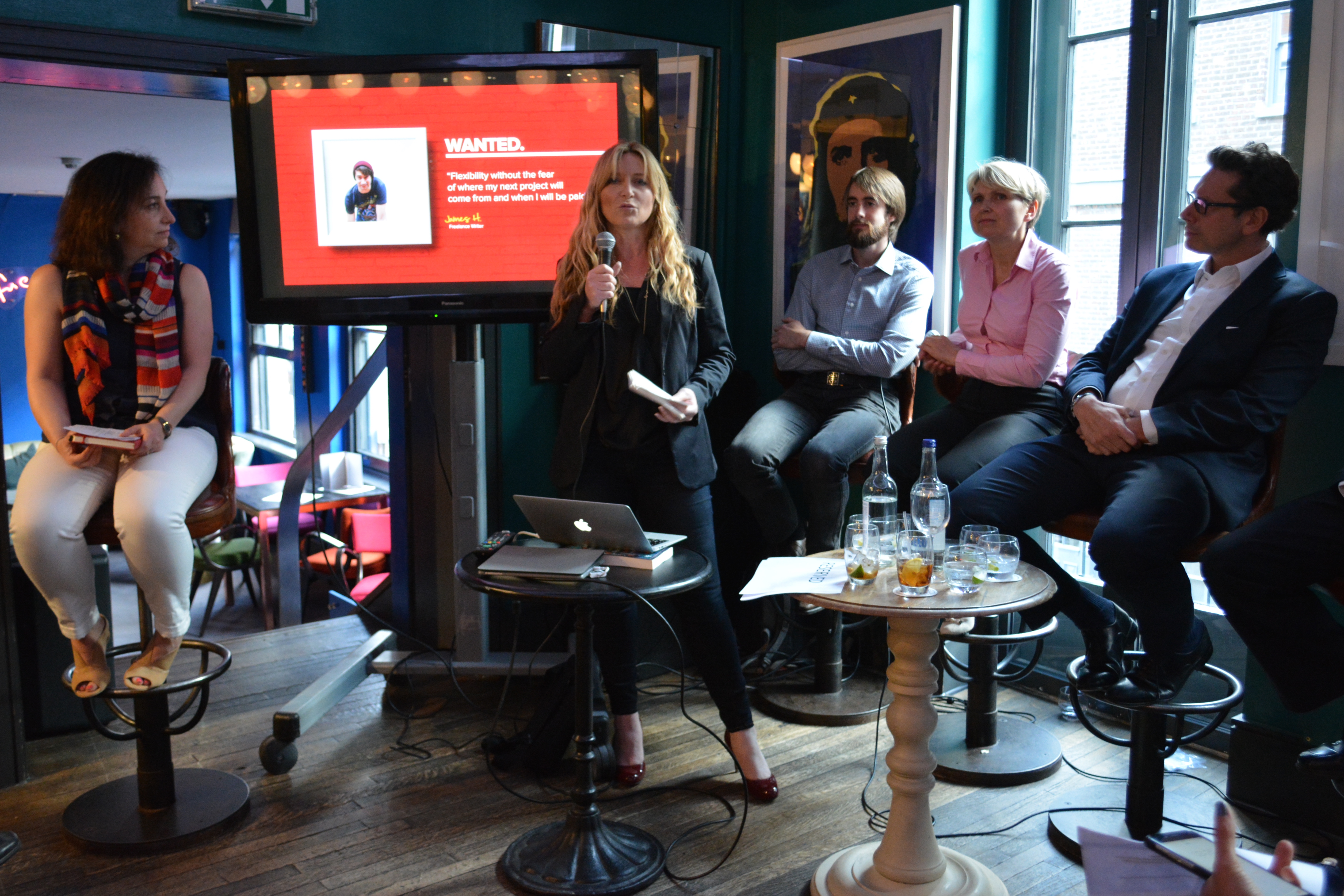
Madeleine Weightman of The Work Crowd delivers her pitch.
Nico made way for Madeleine Weightman, Co-founder of The Work Crowd an app connecting businesses to local expert freelancers in marketing, communications and PR, financed through a 10% charge of all work freelancers receive through the app. The Work Crowd is market specific offering freelancers the benefits of a community network and businesses access to expert freelancers in their local area.
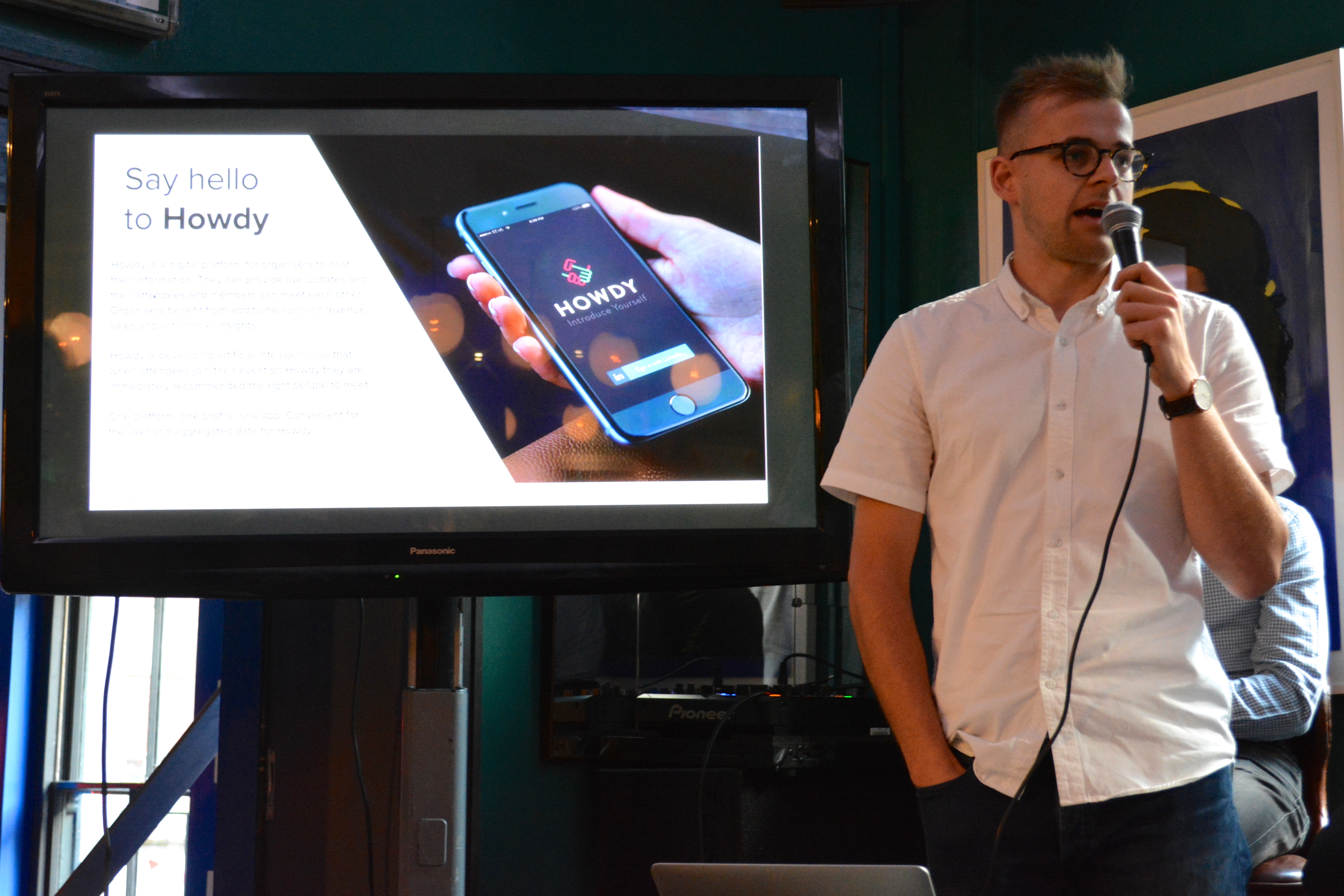
Tristan Abbot of Howdy says Howdy.
Next up was Tristan Abbot, Co-founder of Howdy, a community and events organiser networking app. Byte the Book partnered up with Howdy for this event allowing attendees to connect with each other through the app. The event will remain open for the next week if you still want to connect! Whilst many event organisers offer networking apps for single events, Howdy is developing advanced artificial intelligence to recommend people and events to users across a whole network of events and communities.
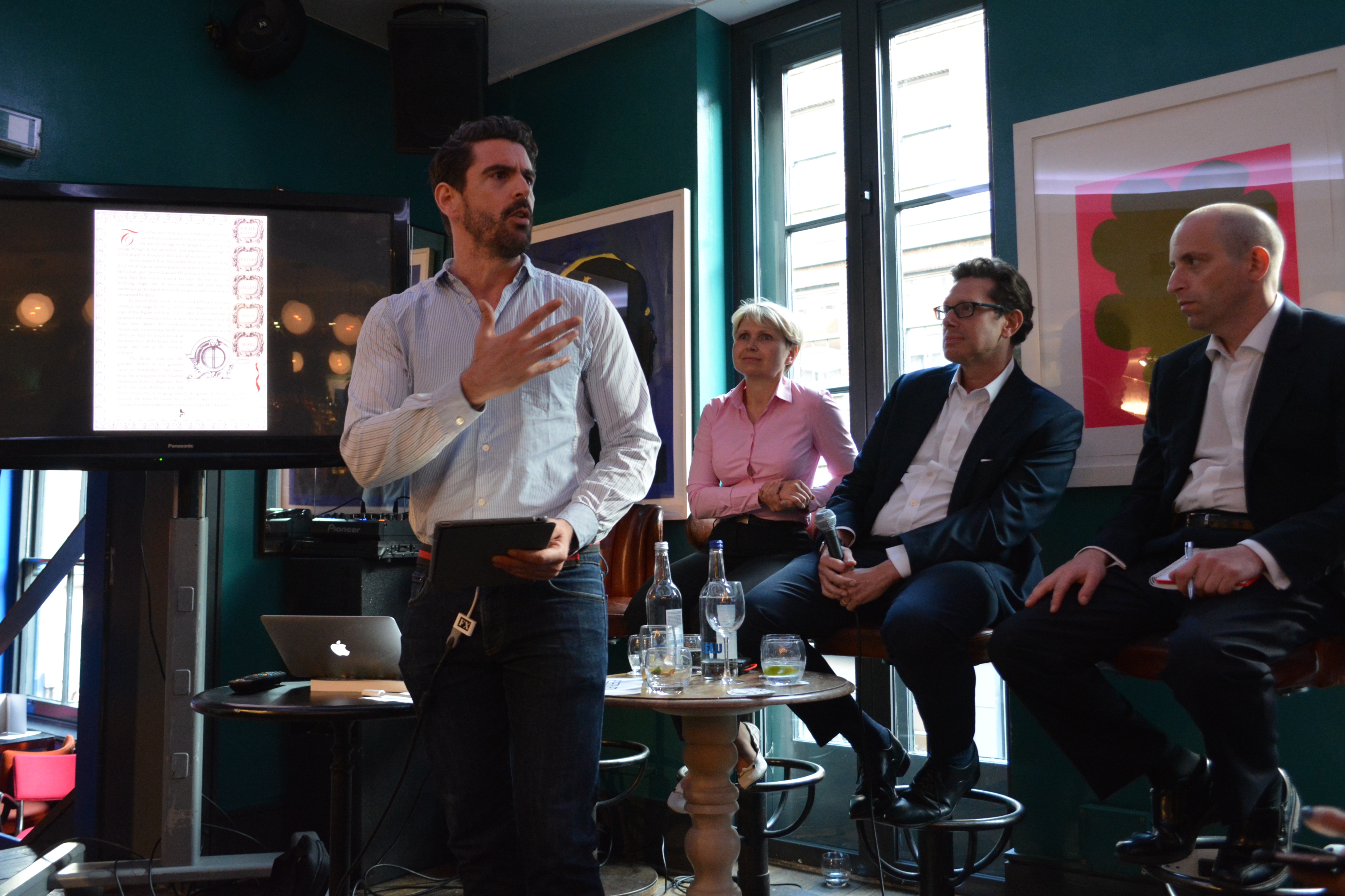
Richard Mason of Orson & Co shows us how to do an Orson.
Finally Richard Mason, author and Co-founder of Orson & Co, talked to us about the revolutionary touch-screen reading experience of Orson books in which a storyteller can deliver their story through text, audio, images and references in beautiful high-definition quality creating a reading experience unlike any other. He promised that soon everyone would be wanting to ‘do an Orson’ with their stories and that it would be Orson books we would all be reading on the move.
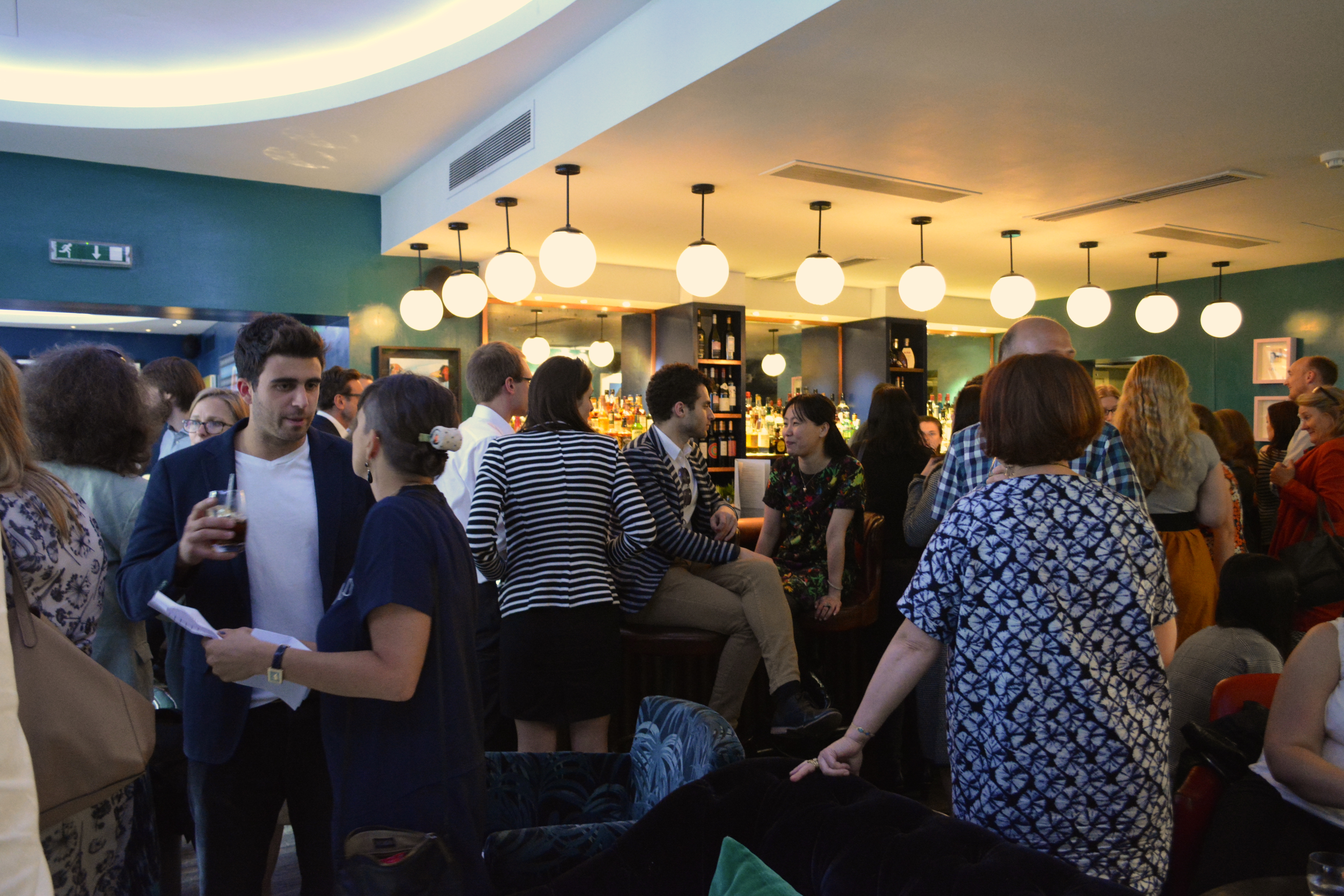
Byte the Book - it's all about the networking (and hair accessories...).
What a night. The pitchers and panel were inundated after the formal proceedings and there was enough creative energy to fuel these and many more new projects. There was a real buzz of entrepreneurial spirit. I’m already looking forward to next year’s pitching night. By then Tuesday’s pitching companies will surely have become household names.
If you enjoyed this report and want to keep up with the latest happenings in publishing as well as network with publishers and authors alike keep yourself posted by visiting our events page here. You can join us from £30 a quarter here
More photos can be found on our Facebook Page
I was lucky enough to be given Love across a broken map by Farhana Shaikh of Dahlia Publishing. Through Byte the Book and the Authors’ Licensing & Collecting Society, I’d been invited to the All Party Writers Group (APWG) Summer Drinks Reception at the House of Lords. The APWG helps to raise matters that affect writers at a parliamentary level and the theme for this reception was the lack of diversity in the publishing and TV industry. Farhana was in the queue with us to get into the House of Lords and we finally chatted, beyond brief introductions, over a cup of tea having just listened to Baroness Floella Benjamin and Shai Hussain talk about their vision for a diverse publishing and TV industry in which every voice could be represented without stereotype or prejudice.
Baroness Floella Benjamin was a particularly hard act to follow because her fervour for representing our country of diverse peoples in our stories on and off screen was very moving. Don’t we want to project a world in which young people feel included, their voices valued and opinions sought? Shai Hussain had to follow her passion with a story of his own, asking the publishing and TV industries to listen to stories that stand outside typical patterns and that are written by people whose voices have yet to be given a chance to shine.
When Farhana said she ran a small publishing company, Dahlia Publishing, which manages The Asian Writer and Leicester Writes, and that they had a new book coming out that week, Love across a broken map, I quickly offered to review it. How do small presses, often those most interested in publishing diverse writing in all its forms, get their books noticed? How do they get the big reviews? As we know from the recent series of Literary Salons held by Something Rhymed, even getting books written by women, let alone any other diverse group, read and reviewed in mainstream newspapers is a struggle. #readdiverse2016 is a good place to start, but as with #readwomen2015 what happens the following year? Why aren’t good books, why isn’t good writing, rising to the surface as it really should?
Reading with the hope of bringing diverse voices to light is a good thing, but I’m even more delighted to review Love across a broken map: Short Stories from The Whole Kahani because it is an exceedingly good collection of very interesting stories with stylistic punch. Though The Whole Kahani is a collective of British fiction writers of South Asian origin, their writing isn’t only for readers of South Asian origin, these stories are for everyone. These are tales of love, as the title would suggest but not necessarily all romantic love.
‘Watermelon Seeds’ by C.G. Menon explores the love of early childhood and is definitely a stand out story for me. Its language is poetic and inventive, creating a dazzling world of childhood imagination. ‘The Nine-Headed Ravan’ by Radhika Kapur asks us to question when desireful friendship becomes full passionate love, and why romantic love should be the only love we value.
The confusing nature of finding romance is explored in ‘Three Singers’ by Kavita A. Jindal where business interest is easily confused with romantic desire, and in ‘We Are All Made of Stars’ by Rohan Kar where hoping to pin love on astrology is no easy road.
Several stories look at characters who have given up on love: ‘Rocky Romeo’ by Dimmi Khan takes a man back from his image into his inner self; ‘Naz’ by Iman Qureshi forces a disaffected character to think again; ‘Soul Sisters’ by Reshma Ruia tells us of a lonely reader whose longing to be in conversation with her favourite writer takes her down unexpected paths. In ‘To London’ by Mona Dash, the city itself is brought alive with clandestine romance, becoming a place of desire in its own right. For Dash’s character the experience of having loved intensely makes the routine of life bearable. ‘It was because I had known love’s glittering body that I could live the rest of my life without its temptation.’ (p67).
Navigating family, friendship and love is complicated. ‘Entwined Destinies’ by Shibani Lal explores the sacrifice of wanting to fulfil parental expectation, though this isn’t a story about being forced to be a doctor or a lawyer. The story has a quiet elegance, an elegiac quality that is very moving.
And then the collection ends with ‘By Hand’ by Farrah Yusuf and the death of a tenant. If there were any prejudice about difference left, here pity can only be directed at the solitary life of the retired, white British, school teacher.
Love across a broken map is one of the best anthologies I’ve read in a long time and it should really be being picked up by Sabotage Reviews and the Saboteur Awards and hopefully others interested in reading good, challenging fiction from independent presses. If, as you read this review, you can think of anywhere or anyone for whom this collection would appeal, send them in the direction of Dahlia Publishing. Or get in touch with me (rebekah@bytethebook.com) and tell me about other books you think I should be reviewing.
The challenge that the All Party Writers Group Reception posed was to take new steps to get the work of diverse writers out into the mainstream. Beginning by championing a collection and a publishing company trying to take talented voices into the mainstream is a good place to start. Buy Love across a broken map: Short Stories from The Whole Kahani and see for yourself.