Words by Chris Russell, photos by Keith Forster.
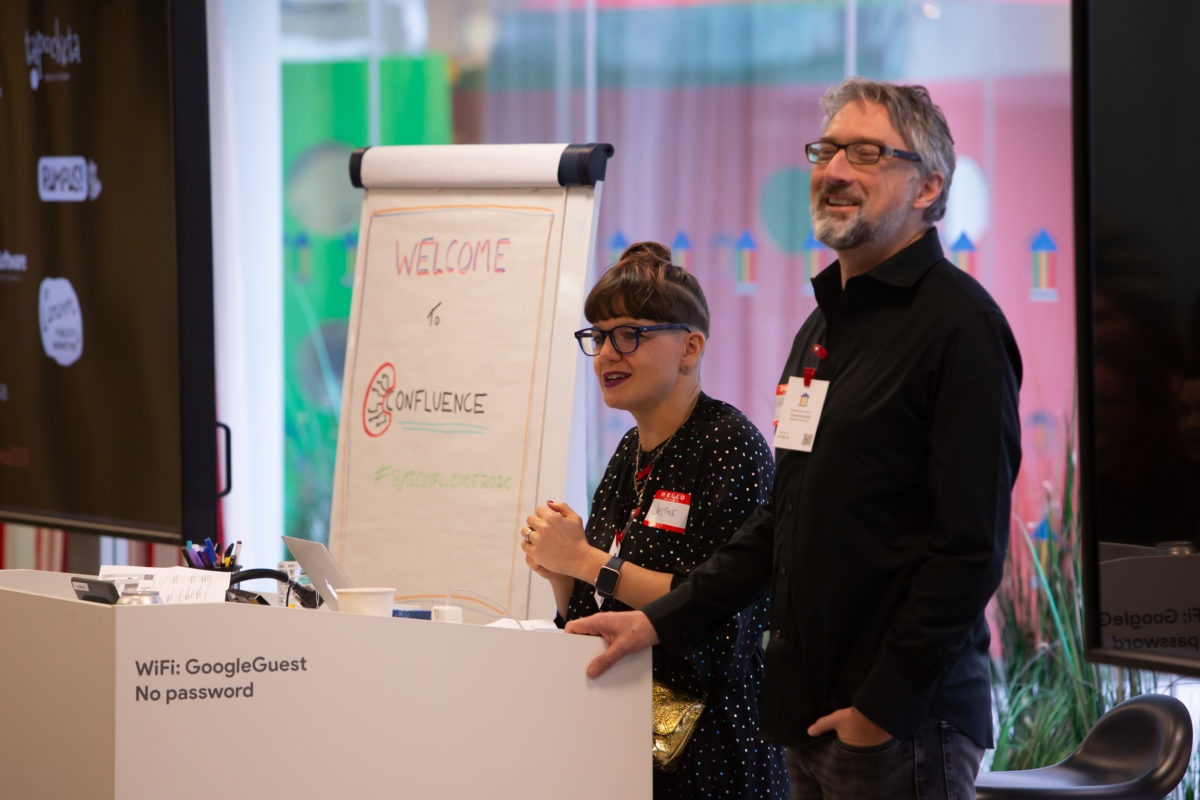
Byte The Book founder Justine Solomons and Programme Director, Michael Kowalski welcoming everyone to Byte Confluence 2020.
Byte The Book’s much-anticipated Confluence returned to Academy London on 7th February, and the mood was palpable from the start. “I’m so excited, I can’t speak,” said Byte founder Justine Solomons in her welcome speech, setting the tone for a full day of talks, workshops and networking covering everything from audio and AI to data, games and graphic novels, supported by a fabulous list of partners: Ingram Spark, Vearsa, Shorthand, Rumpus Animation, Banjo Robinson, Bookswarm, Cameron Publicity & Marketing, Circular Software, Hybert Design, Tapocketa and our very generous hosts Academy London, Google.

Maja Thomas, opening our ears to audio
The floor was opened by Maja Thomas, Chief Innovation Officer at Hachette, whose presentation Voice Of The Future addressed the unstoppable power of audio. “Earshare is the new marketshare,” she began, revealing that digital audiobooks have become the fastest growing arm of the publishing industry at a time when other formats have plateaued. She pointed to the form’s practical nature as the key to its success: “Audio not only helps people finish more books, it allows them to carry out other activities while doing so.” Podcasts are, of course, a major component in the rise of audio, with consumption more than doubling over the last four years, and part of their appeal is their power to effectively — but cheaply — test intellectual property on an audience. “It’s like a beta-testing space for IP,” she said, citing the popularity of true-crime story Dirty John, which began life as a podcast and eventually spawned a high-profile Netflix series starring Connie Britton.

The brilliant David Mansfield, author of The Monday Revolution inspiring the crowd
Maja concluded with some forecasts for the future, predicting that podcasts will continue to become slicker and more professional, with more premium content moving behind paywalls. She also foresaw a rise in the application of AI interactivity, asserting that “rather than spending our time typing on keyboards on tapping on phones, we will simply talk to an omnipresent AI”. Smart speakers will help to alleviate loneliness, telling us stories and even talking dirty (“You can now flirt with your Braun coffee maker instead of your brawny barista,” she joked), and when we check into hotel rooms, we will be asked if we’re hungry, too hot or would like to hear some music. “Voice is enabling a fundamental shift in human behaviour,” stressed Maja, “similar in impact to the one from web to mobile. Voice frees us from screens.” Conversely, there are plenty of developments that we should be worried about, from the reality-bending phenomenon of ‘deep fakes’ to the ever more invasive behaviour of the big tech companies. “Before, Amazon knew when you bought the popcorn. Now, with Alexa, they can hear when you’re eating the popcorn.”

Andrew Stuck from The Museum of Walking, soundpieces on the Boundaries Stage
As Maja completed her opening address, Confluence split across its three main spaces: the Business Stage, the Boundaries Stage and the Dark Stage. On Boundaries, Andrew Stuck from the Museum Of Walking told stories of audio-related experimentation dating back to the mid-Nineties. Since long before the technology was able to do justice to his imagination, Andrew has been experimenting with operatic audio tours, immersive poetry events, sound walks and more. “I’m a grandaddy of podcasts,” he said, “I’ve been doing it since we had dial-up modems.” This led to a discussion on the mysterious relationship between walking and creativity, with Andrew citing research by the academic Jody Rosenblatt-Naderi who found that it takes eleven minutes for a person to achieve so-called ‘metronome walking’, where the brain “enters a state of being, and your mind is cleared”.

An audience on the Business Stage that can't quite get enough.
Back on the Business Stage, Sally Foote from Go Compare explored how brands can maximise the success of their products by listening to the stories their customers tell them. “The number one reason products fail,” she asserted, “is lack of customer research and product testing.” The Colgate frozen lasagna, for instance, tanked because apparently it hadn’t occurred to anyone to ask whether people actually wanted their toothpaste provider to furnish them with Italian ready meals (they didn’t). “But it’s not quite as simple as just asking questions,” elucidated Sally. “I’m sure Colgate did some level of market testing, but I’ve seen myself how easy it is to misunderstand what customers are telling you, or simply to ask the wrong questions.” So what, then, is the answer? “You have to test your understanding of the problem before you test the solution,” explainedSally, citing an example from her time at Photobox, when the AI looked at automating the creation of photo albums to save their customers time. “The software functionality we created, called SmartFill, worked brilliantly… but our customers had no desire to use it. They actually wanted to spend time curating and arranging photos — it was only the boring stuff we needed to automate.” Crucially, Sally concluded, your customers may not always be able to articulate what they’re thinking, so it’s part of a brand’s job to interpret consumer feedback and respond accordingly. “Don’t be lazy. Your customers won’t give you the answers; you have to take the stories they tell you and work them out for yourself.”

Sharing information in the Partner Zone where sponsors could demonstrate product and discuss business opportunities.
New technologies were, unsurprisingly, a much-talked about topic at Confluence 2020, with writer and editor Yen Ooi discussing the rising popularity of gaming, specifically the ‘gamification’ of society. “Gamification is a new term in business,” she said, “but the concept has actually been around as long as there’s been desperate parents with toddlers. It’s how you get them to brush their teeth (‘Who can do it the fastest?’) or eat their dinner (‘Here comes the spoon train!’).” Essentially it’s the process of making tedious activities fun, in pursuit of the common good — such as in the case of Stockholm’s ‘Piano Stairs’, a touch-activated stairway which draws people away from the subway escalator and ‘tricks’ them into exercising. An inspired idea, but not one without its drawbacks. “You always have to consider who the potential victims might be,” advised Yen. “In the case of the Piano Stairs, the victims are those who can’t climb stairs, for health or mobility reasons, and who may end up feeling left out.”
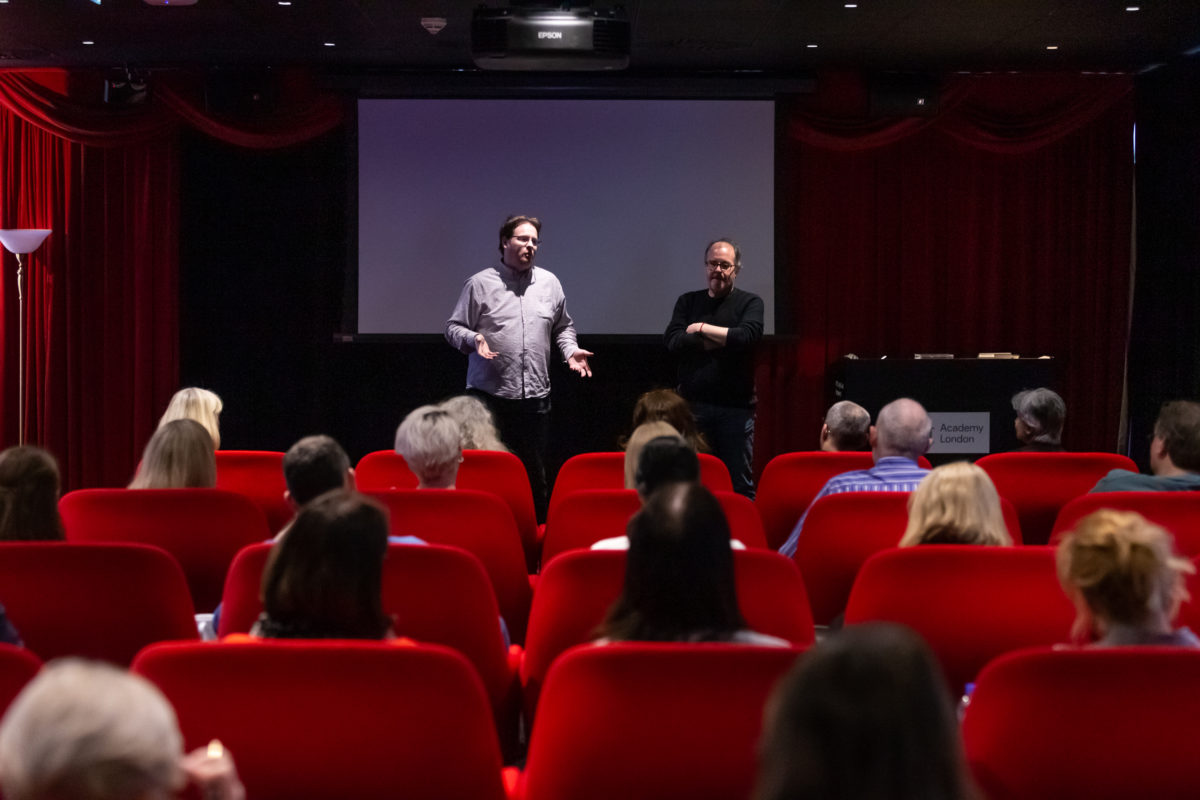
Peter Noble and Neil Gardner teaching us about Audio books on the Dark Stage.
Meanwhile, author of Rage Inside The Machine Robert Elliott Smith examined the misuse and misunderstanding of science in the media, from The New Yorker’s questionable claim that AI-generated journalism can now pass as human to The Atlantic’s spurious assertion that Google’s AlphaGo ‘imitates human intuition’ (it doesn’t, contested Robert). We see books being released such as David J. Gunkel’s Robot Rights, which seems to overlook the fact that many marginalised groups of human beings are yet to enjoy equal rights, while the ways in which the digital world is immiserating workers in the real world — from poor conditions in Amazon’s warehouses to Deliveroo’s so-called ‘dark kitchens’ — are almost too many to number. Ultimately, said Robert, AI is a tool, and we mustn’t forget that. “We couldn’t build houses without hammers and nails, but we don’t credit them with the architecture.” Finally, when asked by an audience member whether we should be afraid of where AI is heading, Robert’s answer was grave. “Yes, absolutely. We should be terribly afraid. Look at where algorithmic media has got us in politics. We have to realise the difference between human intelligence and quantitative intelligence, and we have to do it soon.”

Robert Elliott Smith giving his talk on AI and prejudice: A science/fiction story based entirely on real events.
Despite this hint of gloom, the overall mood of the day was overwhelmingly upbeat. On the Dark Stage, podcaster Sam Delaney’s boundless energy and DIY ethos inspired a room-full of would-be casters. “When we started our podcast,” he said, “we thought we’d just say what we wanted as if no one was listening, and it was that spirit that made us popular. Now we’re doing national tours in big venues and selling merchandise, which is crazy considering this started as the least thought-through thing I’ve ever done.” Perhaps the most exciting element of the podcasting phenomenon is that an idea can go from conception to production to distribution in a matter of days, with vanishingly small start-up costs. “It’s like the spirit of fanzines in the old days,” reflected Sam, “because you can get your content online so quickly. It’s all about spontaneity. Don’t hang around.” Back in the world of traditional media, programme commissioner Kate Ansell offered some amusing insights into the world of BBC commissioning, based on her experience working on flagship shows such as Panorama and One Born Every Minute. “My CV’s a bit random,” she said, “but then so is daytime commissioning… so the BBC thought I was the perfect fit.” When asked how she picks which shows to commission, and whether she ever feels inundated by content, Kate pointed out that it is simply her job to fill a gap, and it is normally very obvious which shows will fit and which won’t. “It’s the thing we don’t have that we want,” she said, in reference to how the success of a particular format often inspires a flood of copycat pitches. “Not the thing we already have.”

Dan Kieran looking back on the stories we tell about ourselves that define who we become.
Confluence was brought to a close by Dan Kieran, CEO of Unbound, with his thought-provoking presentation The Surfboard: Rewriting The Story Of Your Life. “We are the stories we tell ourselves we are,” Dan began, “so we can change the story of who we can become.” He went on to discuss his fear of flying, which has been with him since childhood, revealing how his phobia forced him into a lifelong love affair with ‘slow travel’, from taking a train to Poland to crossing England in a milk float. “We don’t travel anymore, we just arrive. But when you slow down and are forced to view things in a different way, you have a richer experience.” He explained how our brains are physically restructured by our behaviours, comparing our repeated thoughts to a person crossing a cornfield, over and over, until the path becomes a ditch and it is no longer possible to travel outside of it. He eventually conquered his fear of flying through cognitive behavioural therapy, and the chance discovery that the design of surfboards was based on airplane wings prompted him to take a course in surfboard craftsmanship in Cornwall, despite the fact that he had never surfed in his life. Over a seven-day period, he worked obsessively on his board, learning new skills and finessing his creation until it became a work of art. “Conquering my fear of flying was abstract,” he said, “but the surfboard was a physical thing. I look at it now and see how much I cared about it, how it literally changed my mind. It’s undeniable evidence that I’m capable of re-writing the story about myself. It’s there, and I can touch it.”

The Reciprocity Wall, where Confluence attendees were encouraged to stick up requests for help and to offer answers and help in response to those requests. A sticky-note networking tool of kindness.
With that, the presentations were done, the bar was open and the networking continued into the evening. From technology to the art of self-discovery, Confluence had been a whistle-stop tour across not just the book world, and the industries that surround it, but around the very concept of storytelling itself.

Refreshments and networking in the Tiki Bar.
Thank you to all of our wonderful speakers and our amazing partners. What a fabulous day.

If you enjoyed this report and want to keep up with the latest happenings in publishing as well as network with publishers and authors alike keep yourself posted by visiting our events page here. You can join us from £36 a quarter here.
More photos can be found on our Facebook Page.
In this month's Byte Experts, we hear from Amy Ellis, Rights and Licensing Manager at Publishers' Licensing Services, as she shares her advice on getting permission to reuse content.
Reusing content 101
We live in a world where previously created works are constantly reused, remixed and reimagined to create new and innovative art and literature. What most people may not realise is that permission is needed in order to reuse and reproduce content without infringing copyright law. That includes getting permission for content produced and released for free, for charity, or even reusing your own work (if you’ve given a publisher exclusive publishing rights to your work).
My role as Rights and Licensing Manager at PLS is to help make the process of requesting permission as easy as possible, dispelling the myth that permissions are confusing, frustrating, and time consuming.
When do you need permission to reuse content?
If you’re reusing content created or published by someone else, you will most likely need permission to do so from the rights holder of the work.
Reuse can include quoting from a written work, reproducing images, performing a play, adapting a work, or translating a work into another language, to name a few types of reuse. I’ve seen published content being used in all kinds of ways: from quoting in academic texts and new novels to reinterpreting poems into modern dance performances and installation art.
Top tip: For published works, the rights holder of the work is most likely the publisher (but could also be the author or the author’s agent). If you’re seeking permission, we recommend asking the publisher in the first instance, who can refer you on if the rights are held by someone else.
When do you NOT need permission to reuse content?
There are some instances where you don’t need to ask permission from the rights holder of a work to reuse it:
- 1. The work is out of copyright
- 2. The work is published under a Creative Commons Licence
- 3. The work is publisher under an Open Government Licence
- 4. A copyright exception applies
If you’re unsure about whether your reuse falls into one of these categories, the Intellectual Property Office website is an invaluable resource for copyright queries. They also run a help desk that can be reached via email and phone for enquires.
Top tip: If you’re reusing content covered by a Creative Commons Licence, remember to check that the licence allows for commercial use as not all CC licences allow commercial use.
How do you get permission from a publisher?
Getting permission to reuse content has historically been a labour intensive process for both those seeking permission and for the publishers responding to licensing requests.
The process involves finding the right publisher to contact, the right person at that organisation, knowing what information to provide to the publisher, back and forth answering questions about how the work is to be reused, negotiating, and finally, where permission is being given, the publisher issues a licence and the requestor makes a payment for any fees due. This process is time consuming as well: we’ve seen wait times of up to six months for some publishers to respond to requests, which is at odds with the right-click world we now live in.
As a response to this, PLS developed PLS Permissions Request, a free service powered by PLSclear.com that is designed to help speed up the permissions process while making it more transparent.
To make a request, search for the title or ISBN/ISSN of the work you want to reuse in PLSclear, fill in the bespoke Request Wizard permissions form, and submit the request. Your request is sent directly to the right permissions contact at the right publisher who can then respond to your request. Some publishers have even automated responses to requests so you may receive a response immediately.
Top tip: I still recommend submitting your permission requests a few weeks in advance of your deadline. Some publishers have longer response times in order to check the rights they hold for titles and this also leaves some ‘wiggle room’ for negotiating over rights or the price of the licence.
Making it easier
Since its release, PLSclear has become a ‘one-stop-shop’ for clearing permissions from publishers and is about to become even easier to use. PLS have been listening to feedback from authors and publishers about our system and we are updating and streamlining our Request Wizard permissions form (effective 10 February). The upgrade will simplify the questions, include more in context help, and an upgraded help section for additional guidance for new PLSclear users. Our goal is to make permissions accessible for anyone no matter how much knowledge they have of copyright or publishing.
We also have a bank of author resources available now that includes answers to common questions we hear from authors and editorial teams, a checklist of the information you need to know before you can make a permission request, and a guide for using PLSclear.
Top tip: If you need extra help, we run a friendly help desk out of our London offices from 9:00 – 17:00 Monday to Friday that is happy to help via phone or email. Our contact details can be found at PLSclear.com.
==============================================================================
Amy is responsible for managing the growth of PLS Permissions service. She ensures the service is running smoothly for all users and stays in line with industry needs. She also contributes to the future development of PLSclear and PLS’s rights management initiatives.
She has a BA in Creative Writing from Longwood University in the USA and an MA in Digital Publishing from Oxford Brookes University. Her favourite book is “The Goldfinch” by Donna Tartt.
Words by Chris Russell, photos by Craig Simmonds.
To kick off the new decade, Byte The Book gathered a panel of industry experts at Covent Garden’s h Club for a discussion on how we can inspire the next generation of publishing leaders, sponsored by Ingram Content Group. Oreham Consulting’s Emma House chaired, with the panel comprising Perminder Mann (CEO of Bonnier Books), Alex Watson (Future Talent & Development Partner, Penguin Random House), Alice Curry (Founder, Lantana Publishing) and Will Atkinson (MD, Atlantic Books).

Our fabulous panel (from left to right): Emma House (chair), Perminder Mann, Alex Watson, Alice Curry and Will Atkinson.
What skills and attributes, began Emma, do leaders need in the modern publishing industry? “You have to be a good listener,” said Perminder, explaining that she spends a significant portion of her day listening to her colleagues and acting on their feedback. “Listen to the people around you, to the market, to retailers and readers.” Alex underlined the importance of resilience, pointing out that “things aren’t always going to go right, especially as you progress to more senior roles”. She also advised young people coming into the industry to be inquisitive and open to learning. “More and more,” she revealed, “we’re interested in what people are doing outside their jobs. Side hustles, blogging. How are you leading yourself?” Alice praised flexibility, adaptability and an entrepreneurial mindset — “the ability to spot a problem and figure out how to fix it” — while Will offered an interesting take on Perminder’s point about listening skills. “Sometimes,” he suggested, “not listening is an important skill. We’re all jolly nice in publishing but occasionally you have to strike out on your own, and that’s the lonely bit. That’s when your nerve is really tested.”

Representatives of our wonderful sponsors, Ingram Content Group from left to right, Jessica Nelson, Ben Hughes and Elizabeth Bond
Once we know what we’re looking for, how do we go about creating and nurturing the leaders of the future? “Mentoring, coaching and training can teach people so much,” said Alex, citing an internal PRH training initiative called ‘Fresh Perspectives’ that encourages employees to drop ideas and suggestions in a box, with the best ones eventually being actioned by the company. Several panellists also spoke of so-called “reverse mentoring”, with Perminder extolling the virtues of taking her junior colleagues out to lunch — which she does regularly — and picking their brains (this is particularly useful in the digital domain, where younger employees are often savvier than their seniors). Alice, meanwhile, emphasised the crucial importance of diversity in every corner of the industry. She founded Lantana with the strapline, “All children deserve to see themselves in the books they read”, and stressed that this philosophy underpins everything the company does. This resonated deeply with Perminder, a child of first-generation Indian immigrants who didn’t own a book until the age of twenty-one and, for most of her career, never even contemplated becoming a CEO. “No one at the top looked like I did,” she said,
“so it didn’t even occur to me.”

An attentive audience at the h Club
To close the discussion, Emma asked the panel for things they’d learned over the course of their careers that they wish they’d known when starting out. “You have to be curious every day,” replied Will, “and if you can surround yourself with curious people, that’s wonderful.” Alice revealed that she had no idea what she was doing when she started Lantana, and has since come to view this as a strength, despite being unnerved by it at the time. “Sometimes you really do have to trust your gut,” she reflected. On a related note, Alex recalled the anxiety she felt during the early stages of her career, when many people in publishing suffer from Imposter Syndrome, and said she would tell her younger self to worry less. “If you want to learn something new, tell a colleague. People will want to help you.”

Questions from the audience - one here from Dr Lisa Gill
Perminder talked of a time in her life, shortly after accepting the role of CEO, when she found herself assuming a persona at work. “I tried for two or three months to be someone I wasn’t, but it was making me unhappy. Then my husband said to me: ‘You got here by being you … so why change that now?’” Succinctly, she concluded: “My advice is to be yourself. It’s the only form of sustainable behaviour.”

Lots of fun networking at Byte The Book, as always
If you enjoyed this report and want to keep up with the latest happenings in publishing as well as network with publishers and authors alike keep yourself posted by visiting our events page here. You can join us from £36 a quarter here.
More photos can be found on our Facebook Page.
Rebekah Lattin-Rawstrone reviews and recommends Such a Fun Age by Kiley Reid.
This isn’t an easy book to read. Such a Fun Age looks at two women caring for Briar, a little girl just on the cusp of her third birthday as the novel opens. Emira is a young black woman who babysits for Briar three times a week. Alix Chamberlain, a rich white woman with her own business, is Briar’s mum.
The novel starts with an incident. Alix’s husband is a local news anchor. He makes a throwaway remark that is unintentionally, but nonetheless, racist during his broadcast and in response their window is egged – the glass smashed on impact – late at night. They decide to call the police and don’t want their two-year-old to witness the police coming so they call their sitter and ask her to take Briar for a little while.
Emira is at a birthday party for a friend and is dressed for a night out. She explains she’s had a drink and isn’t dressed for babysitting, but Alix is desperate and so she goes right over and takes Briar to the local grocery store that, thankfully, is still open. Briar likes to look at nuts and smell tea bags and Emira is happy to indulge her.
Emira arrives with her friend Zara and with Briar’s encouragement all three girls have a little dance in the store to a song on Zara’s phone. A man at the supermarket claps and Zara heads off, leaving Emira and Briar to themselves.
Then the security guard comes and questions Emira. He doesn’t believe that she should be out this late with a young child clearly not her own and he’s worried about the child’s safety. An older white woman reported their dancing to him and even though Emira reassures him of who she is, the woman and the guard talk over her, addressing all their questions to the two-year-old, clearly believing that a black woman in a revealing outfit shouldn’t be in charge of a white girl at this time of night.
The man who had clapped their dancing, films the whole altercation on his phone, as Emira finally has to call Mr Chamberlain, ‘an old white guy’ to sort it all out. The man who filmed the incident claims – as do the Chamberlains – that Emira should sue the store for being racially prejudiced. He says Emira can have the film, share it, get compensation, but Emira doesn’t want the spotlight and wants to just shrug off the night’s events. In response, the man sends her the film and deletes it from his own phone. That video is hers to do with as she wishes.
That night, that white man with the phone, and that video become the fulcrum point for the whole of the unfolding narrative that painfully unravels Alix’s privilege, not only of race but of affluence. It makes for awkward and difficult reading. Emira loves Briar. So does Alix. But their ability to express that love, to nurture and encourage Briar, their priorities in regard to her growth, are put sharply under the spotlight. Around this centre stage shadows from that night and from the more distant past begin to deepen. What happened in Alix’s past? Why is she so desperate suddenly to befriend her sitter? Who is the white man from the grocery store and why is he significant? Did he really delete that video?
The plot is gripping; the unravelling of racial and financial prejudice is meticulous and cleverly nuanced. It’s not easy to read but the pace of the unfolding plot keeps you going. I can’t say I enjoyed reading it, but it does explore the complexity of money and race in American society in ways that make you want to check your own privilege more closely. It is also as generous as it is searing – no mean feat. You can buy your copy here.
If you would like to read more of Rebekah's reviews, head to her blog to find out what she's been reading.
Rebekah Lattin-Rawstrone reviews and recommends Nudibranch by Irenosen Okojie.
Metamorphosis is the word I would use to summarise this collection, the second one from Irenosen Okojie. Everything is poised to become something else, to be shifted under the imaginative eye of an author who isn’t afraid to stretch our conception of reality and pull it into new shapes. Her language is full of unusual simile, revealing how the ordinary world is steeped in myth and fairytale.
There is something of Angela Carter in the transformations, in the interest in circus, witches, wolves, belief and desire. Monks carry living saints’ tongues in their pockets, waiting to pay for their sins with the hammer and nails of religious fervour. Women form themselves from water, from clams to tempt men, or contort themselves to stay alive. Children and love are always one step away from possible destruction. Nothing feels certain or stable, but the possibility of flux. Nudibranch is almost a philosophical tract on the mutability of life.
Sometimes stories settle in a present that opens into the surreal. Sometimes we slip into a near distant future where pain can be measured or stillborns reawakened as cyborg babies unable to grow and fed on pesticides. Peppered with hard scientific fact, the world of Nudibranch rips open new eyes for its readers. Nudibranch is exciting, fresh, angry, vivid, imaginative and routed to the stories of our past in ways that sometimes baffle but always delight. If you haven’t read it, just follow Ben Okri’s advice on Irenosen Okojie: ‘Read her for the risk, for the heart, for the imagination.’ Go on, you can still get it in time for Christmas here.
If you would like to read more of Rebekah's reviews, head to her blog to find out what she's been reading.
Words by Chris Russell, photos by Craig Simmonds.
Byte The Book returned to the h Club for its November event sponsored by Harbottle & Lewis, which grappled with the compelling topic of artificial intelligence. Journalist Mark Piesing chaired the four-strong panel, comprising fashion director Candice Fragis, author Robert Elliott Smith, lawyer Alex Hardy and tech entrepreneur Taylan Kamis.

Our wonderful panel from left to right: Mark Piesing (Chair), Candice Fragis, Robert Elliott
Smith, Alex Hardy (representing our sponsors, Harbottle & Lewis, thanks to them) and Taylan Kamis.
Mark began by asking the panel for a broad definition of the term ‘artificial intelligence’. Robert Elliott Smith, whose new novel Rage Inside The Machine explores the unprecedented power of algorithms, boasts thirty years’ experience in AI but confessed that he’s not a fan of the terminology. “The accepted definition of ‘artificial intelligence’ changes all the time,” he began, “and what we mean by it today is very different from what we meant in the Seventies. It’s a moving target. These days, of course, everything gets called AI because it’s a trendy term.” He went on to confess that he prefers the phrase ‘pseudo-intelligence’ — borrowed from Neal Stephenson’s sci-fi novel The Diamond Age — because it clearly differentiates AI from human intelligence. “AI is extremely useful to us,” he concluded, “but it actually has very little in common with human intelligence. Most people don’t realise that.”
An engaged audience
So, continued Mark, what are some of the newest forms of AI operating in today’s marketplace? “Avatars are becoming huge business,” said Candice Fragis, whose fashion app DREST has turned heads as the world’s first interactive luxury styling platform. “In Asia, there are avatar influencers who have more followers than their human counterparts, and we’re seeing fashion brands spending enormous amounts of money on them. Kids in Korea don’t discern between humans and avatars — they just see a style that appeals to them, and think: ‘I want to look like that.’”
Taylan Kamis, meanwhile, introduced his company DeepZen, a producer and co-publisher of machine-read audiobooks. A typical audiobook, he revealed, takes six weeks to produce and costs around £5000, meaning that only a fraction of physical books are ever made available in audio format (and ninety per cent of those are in English). When DeepZen’s research told them that consumers would listen more if a greater variety of books were produced at a lower price point, they began to employ real-life actors and “clone their voices”, creating AI readers that very closely replicate human emotion and intonation. The result, as evidenced on the DeepZen website, is quite uncanny.

Questions from the floor
Looking ahead, what do we have to fear from the apparently unstoppable march of artificial intelligence? Taylan himself addressed this, admitting that the gut instinct of many in the industry is to worry that DeepZen’s audiobooks are “taking people’s jobs”. But he doesn’t see it that way. “You have to work with creative people,” he insisted, adding that “you shouldn’t be walking behind copyright laws”. Case in point: it is technically possible for DeepZen to bypass humans altogether in creating their AI voices, but they choose to use real actors as a foundation, and those actors receive ongoing royalties for their cloned voices (which means they can make money for work they technically didn’t have to carry out in the first place). At this point, Alex Hardy of entertainment law firm Harbottle & Lewis picked up the baton, explaining that our legal system has a great deal of catching up to do when it comes to technology. “There are so many questions around AI in a legal sense, especially in the creative sector,” she reflected. “Take copyright law. Have machine-made works been ‘created’, in the accepted sense of the word? What’s their value? Should they be treated in the same way as works made by humans?” She
admitted that the ethics of the technology are still very murky, and we don’t yet understand, say, the liability of an AI programme that infringes someone’s artistic copyright. She added, however, that being overly fearful of AI isn’t necessarily in the interest of creators: “It could be argued that, as an author, you ought to let as many machines as possible read your work. Otherwise, aren’t you taking yourself
out of the conversation?”

And more questions. What a provoking topic.
Next, the panel discussed where AI may be heading in the future, and where its limitations might lie. There was agreement on the ultimate superiority of human intuition, with Candice commenting that “machines don’t have gut instinct. You need people to curate and inspire, to show the consumers the products they didn’t know they wanted”. Robert agreed, offering up a warning from the past: “When the
industrial revolution replaced handicrafts with mass-production, crafted products became the domain of the rich, and this may happen again. When the story you read to your child, or the care you receive when you’re old, becomes two-tiered — human-made for the wealthy; crappy and synthetic for the poor — that’s a world you’ve got to worry about.”
Finally, Taylan closed the conversation with a thought-provoking comment on the ubiquity of artificial intelligence. “You might not be aware of this,” he said, “but you’re interacting with AI every single day. Instagram learns about your favourite topics and feeds you more of them. When you order an Uber, there’s an algorithm at work that uses all manner of information to find you a driver. You’re not directly
exposed to it, because it’s behind an app, but it’s there, and it’s impacting your daily life.” The future, in other words, is already here — it’s up to us to make sure we don’t get left behind.

We mustn't forget the networking, always a focus at Byte The Book
If you enjoyed this report and want to keep up with the latest happenings in publishing as well as network with publishers and authors alike keep yourself posted by visiting our events page here. You can join us from £36 a quarter here.
More photos can be found on our Facebook Page.
Rebekah Lattin-Rawstrone reviews and recommends Die, My Love by Ariana Harwicz
I deliberately read this novel slowly. Easily devoured in a few hours, if this is the kind of writing you like, you don’t want it to end. Reading Die, My Love was like finding a voice you’ve heard calling at a distance out walking somewhere, in woods or at a crowded beach. It’s a voice that feels both deeply familiar and painfully new. It’s raw and wild and angry and filled with a passion and desire that is both recognisable and selfish. It is a voice that speaks what many dare not.
I love this kind of short, sharp book. There is so much echoing in each brief section that, despite the length, the feelings and experiences linger.
A woman has a child and doesn’t know how to shape her life around the new relationship, around what the child needs of her or what her partner needs of her. A foreigner in a rural landscape she is alien to everything and finds solace only in the red tooth of nature or in finding the man who lives down the road.
It is intense. She does enact the extremes of her feelings. She is sent off to a mental institution to find some sense of calm. But it is also funny and true to the strange way in which people’s feelings for each other exist on multiple levels.
Reading Die, My Love felt like finding a writer I wish I’d read before. How nice to have more of Ariana Harwicz to read. How thankful we should be to presses like Charco Press for gifting us translations of books written in languages we can’t read. Sarah Moses and Carolina Orloff have given this translation real power. I can’t wait to read more of Harwicz’s work.
f you would like to read more of Rebekah's reviews, head to her blog to find out what she's been reading.
Rebekah Lattin-Rawstrone reviews and recommends The Faculty of Indifference by Byte The Book Member, Guy Ware.
Robert Exley works at the Faculty, a counter-terrorism branch of government in which his father also served. His wife, once a member of the Faculty herself and a supposedly more promising one, is dead. She was hit by a bus years ago and Robert lives with their son, Stephen, who asks him every night how his day was - ‘If I told you I’d have to kill you’ being the standard response - and who writes a diary in code on his mother’s old typewriter, leaving the pages temptingly on display for Robert to decode. This diary is the only way in which Stephen ever fully communicates with his father - assuming he wanted his father to read it all along, for the novel makes it clear, nothing should be assumed.
Divided into two halves, the four or five years before he meets a prisoner in the basement, and four or five years later when he does, the novel is also divided into before Stephen goes to university and when he returns. In the first section we hear Stephen’s imagined telling of his grandfather’s life as a beacon keeper. For his diary morphs into a fictionalised biography rather than a daily account of his life. This telling is somehow implicated in a particular case Robert is handed by a colleague that leads to the incarceration of that prisoner in the basement.
And in amongst all of this is Cioran’s theory on the faculty of indifference, something Robert’s wife Mary was particularly interested in and which returns to Robert’s thoughts often: ‘The slightest deviation from indifference, she said, the smallest flicker of interest is a compromise that shatters the bonds of common humanity. You are free to torture and kill without compunction.’ It’s a faculty because it isn’t a given, like brown eyes, but ‘something you have to cultivate’ (page 61). The idea sits neatly with their line of work, with Beckett’s Endgame - a play Ware quotes as being of particular influence in the acknowledgements - and with Stephen’s imagined grandfather who writes a play that mocks his beacon keeping lifestyle and that forces two of his colleagues into rubbish bins - the Beckett links are veritably screaming here - even though they can’t see to read their scripts and when they take candles into the bins with them they set fire to their eyebrows and cough with the smoke (this had me laughing out loud).
These kind of clever allusions to philosophy and literature, the quotes from The Oresteia, the sense of endless watching and waiting for something that might never happen, the slow decline of days, and the inevitability of conflict, make The Faculty of Indifference both startlingly clever (why is Stephen called Stephen; one wonders if it is a reference to the Joyce's wandering Daedalus) and sometimes overwhelming. The Faculty employs people to find meaning in a series of potentially random events and it sets the reader off too. What does Robert’s itchy leg mean? What about the knocking on the walls that Stephen hears? Isn’t fiction how we join all the dots? Isn’t the creative imagination an act that takes us beyond the boundaries of indifference?
Nicholas Lezard wrote of Guy Ware’s debut novel, The Fat of Fed Beasts, that it was ‘fleshing out the shadowy metaphysical hints of Beckett’s novels’, something he obviously continues to do in The Faculty of Indifference where the dance of meaning is always in discussion and the labyrinthine mechanics of the Faculty and, by extension, life, pit order and chaos, pattern and fiction, god and myth, consciousness and instinct, the black and white of a game of Go, against each other at every turn. And while you may say that this sets up a series of binary opposites, the novel manages to squeak out of the binary trope by constantly turning expectation upon its head. The Faculty of Indifference is both funny, diverting, exhausting and baffling all at once. Whatever your tastes, Guy Ware is a writer whose name should be part of the contemporary literary discussion. His is a post-modernism that pushes the past into our increasingly confusing world. Only just published this September, you can buy it on Amazon here or direct from Salt here.
If you would like to read more of Rebekah's reviews, head to her blog to find out what she's been reading.
Congratulations to Tracey Sinclair for winning the Byte Shorts 2019 Competition with her story 'War of Words' (click on the link to read her winning story). She received a £50 Amazon token as her prize. We were delighted to announce her win at our event on the 23rd September 2019, not only the birthday of our founder Justine Solomons, but also, amazingly, Tracey Sinclair. What a day and a great month for Tracey whose novels, Doll and No Love Is This have just been republished on Kindle. Congratulations again, Tracey.
The competition was a celebration of our first year of running Byte Shorts in which we asked members to send in submissions for the monthly competition to be published on the site and in our newsletter. With our short list published here, we asked you to vote on your favourite to win the overall competition and it was a tight run race. Congratulations are also due to our runner-up Kate Ansell who received a £25 Amazon token for her story 'Emily Meets A Man Who Looks Like Hitler'.
One year in to Byte Shorts, we are ready to take the competition in new directions. We are opening up the competition to all writers, members and non-members, with bigger prizes up for grabs. Watch this space for more news as our plans are confirmed.
Words by Chris Russell, photos by Keith James.
Many authors dream of seeing their work on the big screen, but what is the actual day-to-
day reality of adapting for film, television and web? Chaired by film critic Jason Solomons,
September’s Byte The Book, sponsored by ALCS, brought together four writers, producers and filmmakers to lift the lid on the world of page-to-screen adaptations.

Our fabulous panel, from left to right: Shai Hussein, Lucy Brydon, Emma Jane Unsworth, Mia Bays and Jason Solomons (chair).
Jason turned first to writer Emma Jane Unsworth, whose novel Animals has been made
into a film starring Holiday Grainger and Alia Shawkat. “You did what authors are normally
told not to do,” began Jason, “and adapted your own work. How did that happen?” Emma
described herself as “very lucky”, having been asked at her first production meeting
whether she wanted to write the screenplay, and accepting on instinct. She agreed that
authors are often counselled against this, and even actively avoid it (“because if it’s crap,
they can say ‘it’s nothing to do with me!’”), but went on to explain that “I’m very visual, and
I think filmically when I’m writing anyway”. When asked for her advice to other authors
facing the same challenge, she talked about the differences between the solitary,
autonomous act of novel-writing and the collaborative nature of film, and how important it
is to know where you’re willing to compromise. “If you know where your red lines are, you’ll
know what you’re not prepared to move on. Work out the beating heart of your story, and
stick to it.”

Thanks to our wonderful sponsors ALCS (from left to right, Faye Bird, Alice Donovan, Alison Baxter and Esther Jones)
Film producer Mia Bays was able to shed some light on the writer-producer relationship
from the other direction, suggesting that the best way to produce is “to ask questions”. “If
you simply give the writer a to-do list of things you don’t like,” she continued, “it doesn’t
feel collaborative. But if you ask ‘Why does the character do this?’, you’re opening a
discussion and leaving the writer to make the decisions.” This is particularly important, she
added, when the writer has a personal emotional investment in the story — which is
almost always — because they may find it extremely hard to acquiesce on elements of the
story that are based on lived experience. “It can get very tense,” said Mia, “and you need a
lot of patience. You almost become a psychotherapist!” Writer and filmmaker Lucy Brydon
echoed this point, being herself at the tail-end of the process of bringing her emotionally-
charged short film Sick(er), recently renamed Body of Water, to the screen. The story tackles adult anorexia and from the very beginning she found herself having difficult conversations with her executives. “They wanted me to transfer the anorexia from the adult character to the teenage one,” she revealed, “to fit more neatly with the mainstream media narrative. I tried it out, and ultimately it didn’t work, but it was important that I did try, because collaboration is fundamental to film-making. That’s the great thing
about it.”

A packed Byte The Book audience enjoying the panel.
Despite all the talk of the stark differences between novel- and screen-writing, Shai
Hussein — the writer, DJ and filmmaker behind the comedy web series ‘Three Shades Of
Brown’ — pointed out that certain narrative principles straddle the divide. “I’ve recently
been adapting a screenplay into a novel,” he said, “and so many of the fundamentals are
the same.” It is certainly true that a novel gives the writer a much deeper freedom to
explore characters and settings; however, stressed Shai, “if a scene, beat or line of
dialogue isn’t driving the plot forward, it has to go, regardless of the format”.

As always, a great networking crowd at Byte The Book
The discussion closed with a few final nuggets of wisdom from each panellist. Shai, who
had spoken candidly of the ups and downs of directing and marketing an independent web
series, advocated a carpé diem mentality. “If you want to create your own materials,” he
said, “don't wait too long for permission.” Emma underlined the importance of constant self-improvement, pointing out that writing in one format can teach you valuable lessons
for another. “My weakness has always been structure,” she confessed, “but screenplays
are very mathematic, and writing Animals has massively improved my structural skills.”
Lucy re-emphasised the importance of team-building, commenting that “it takes a village to
raise a film”, while Mia addressed the thorny issue of commerciality. “If someone tells you
that your idea is ‘not commercial’,” she reflected, “ask them exactly what they mean.
Because at the end of the day, authenticity sells. Simple as that.”

Happy Birthday to Byte The Book founder, Justine Solomons who also announced that Tracey Sinclair won this year's Byte Shorts Competition with Kate Ansell placed second. Click here for further details.
If you enjoyed this report and want to keep up with the latest happenings in publishing as well as network with publishers and authors alike keep yourself posted by visiting our events page here. You can join us from £36 a quarter here.
More photos can be found on our Facebook Page.