
Posted by Maleeha Mir on 1 October 2026, in Event reports, News
Photos by Daniel Solomons, Words by Chris Russell
You can listen to the complete audio recording of this event via this link.
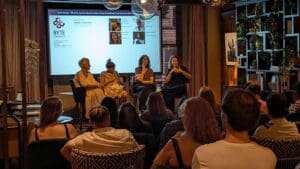
On an unseasonably balmy evening in late September, Byte the Book brought together a trio of experts at Soho’s Century Club to discuss a few home truths about the publishing industry, approached from an author’s perspective. The panel comprised Clare Christian, Director of Operations at Kevin Anderson & Associates, Catherine Kurtz, artist and author of Feast (Dialogue Books, 2026) and Abi Fellows, an agent at DHH Literary.
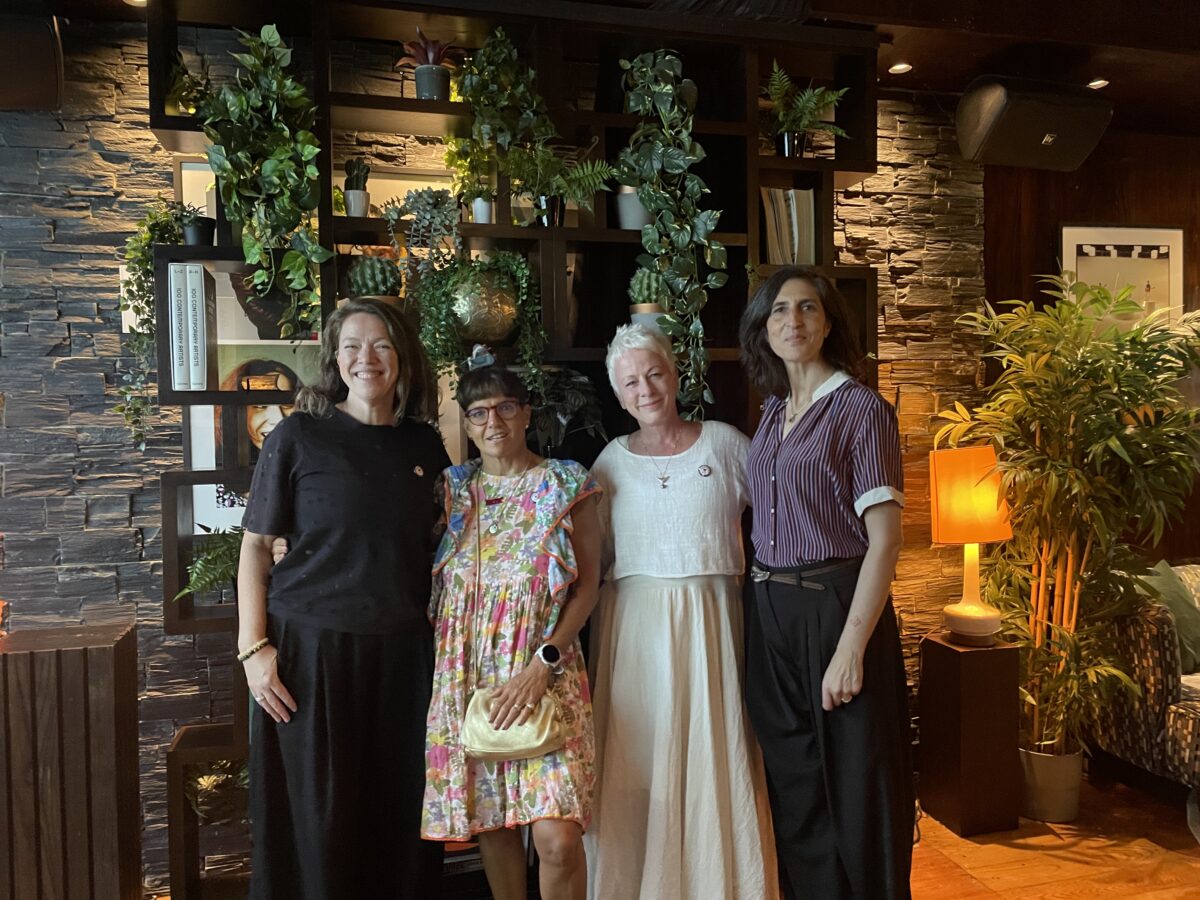
 Our panel from left to right: Clare Christian, Justine Solomons, Catherine Kurtz and Abi Fellows.
The relationships between writers and their agents and editors were first under the microscope, and Catherine began by establishing a hierarchy between the three parties. “Your agent is your primary collaborator,” she said, “whereas editors come and go. You might move publishing houses any number of times, but your agent is your bestie”. Abi echoed this sentiment, stating that the agent-author dynamic is “such a close partnership; hopefully the most consistent in an author’s career”. This closeness makes the literary agent most writers’ first port-of-call when it comes to assessing the merits of any given book deal. “I’d never sign an author without first asking what their intentions are,” commented Abi, revealing a rigorous approach to agenting that enables her to align herself entirely with her authors’ goals. She’s even advised clients to walk away from offers when she felt that the publisher’s editorial direction wasn’t a perfect match. As Catherine put it: “You are the authority on your own work”.
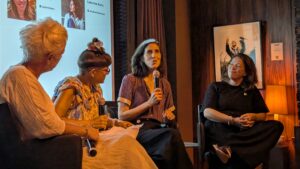
Next, the discussion turned to social media, the challenges of self-promotion and the perennial question of whether publishers genuinely require their writers to have thousands of followers. Clare answered with refreshing honesty, stating “I like a big number!” – but she also acknowledged that platform is more pivotal in the non-fiction space, where an author needs to be regarded as a public authority on their subject. “For fiction,” she suggested, “what’s great is other people talking about your book, and you have no control over that. You just have to keep your fingers crossed”. Catherine agreed on the distinction between fiction and non-fiction marketing, and as a time-starved author with multiple day jobs, underlined the pitfalls of spending valuable writing time stressing over social media. “It’s good to be there,” she said, “and I do post, but I also know people who’ve spent enormous amounts of time and effort on Instagram and it’s made no difference”. Crucially, argued Abi, engagement is more important than follower count. She reflected that “ten years ago, publishers were handing out huge deals to influencers with armies of followers, but their investments didn’t always translate into sales”. She even cited a client of hers whose publisher had actively helped them grow their fanbase pre-publication, so being new to socials is by no means an insurmountable barrier.
-
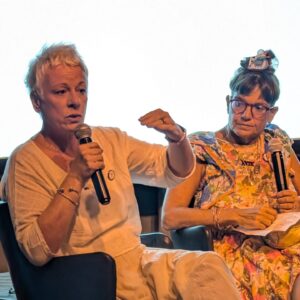
Abi Fellows highlights the importance of the author-agent relationship and supporting authors in building long, successful careers.
It was Catherine who closed the floor by reading the riot act on the very notion of artificial intelligence (not surprising, perhaps, given her lifelong career as a painter). “I think it’s extraordinary that we’ve got into this position at all,” she argued, visibly animated. “It’s making us more stupid every day… so just don’t use it. Why the hell would we get machines to write for us? Creatives are the ones who need to be fighting this fight. It’s not creative, and it’s not intelligent”. Catherine’s uncompromising stance on AI pointed towards the central theme of the evening: trust. An author must trust their agent, their editor and their own instincts, and as an industry, we must trust each other to produce the kind of work that a machine never could. Work that interrogates the human condition, and connects us to each other in an ever more disconnected world.
Thank you to Kevin Anderson & Associates for sponsoring our event and to the Century Club for hosting us!
You can find many more photos from this panel from our online album 'Tome Truths: What Do Authors Need to Know About Publishing?' here!
If you're not already a member of Byte The Book you can join us from £30 a month here.