Words by Chris Russell,photos by Katrina Hopewell.
If there’s one driving force behind the ever-evolving landscape of book publishing, it’s technology. Like many aspects of the business, distribution has been revolutionised by recent tech innovations, and at April’s Byte The Book, sponsored by ipage and Ingram, a panel of speakers from across the industry gathered to discuss the impact this is having on authors, publishers and booksellers.
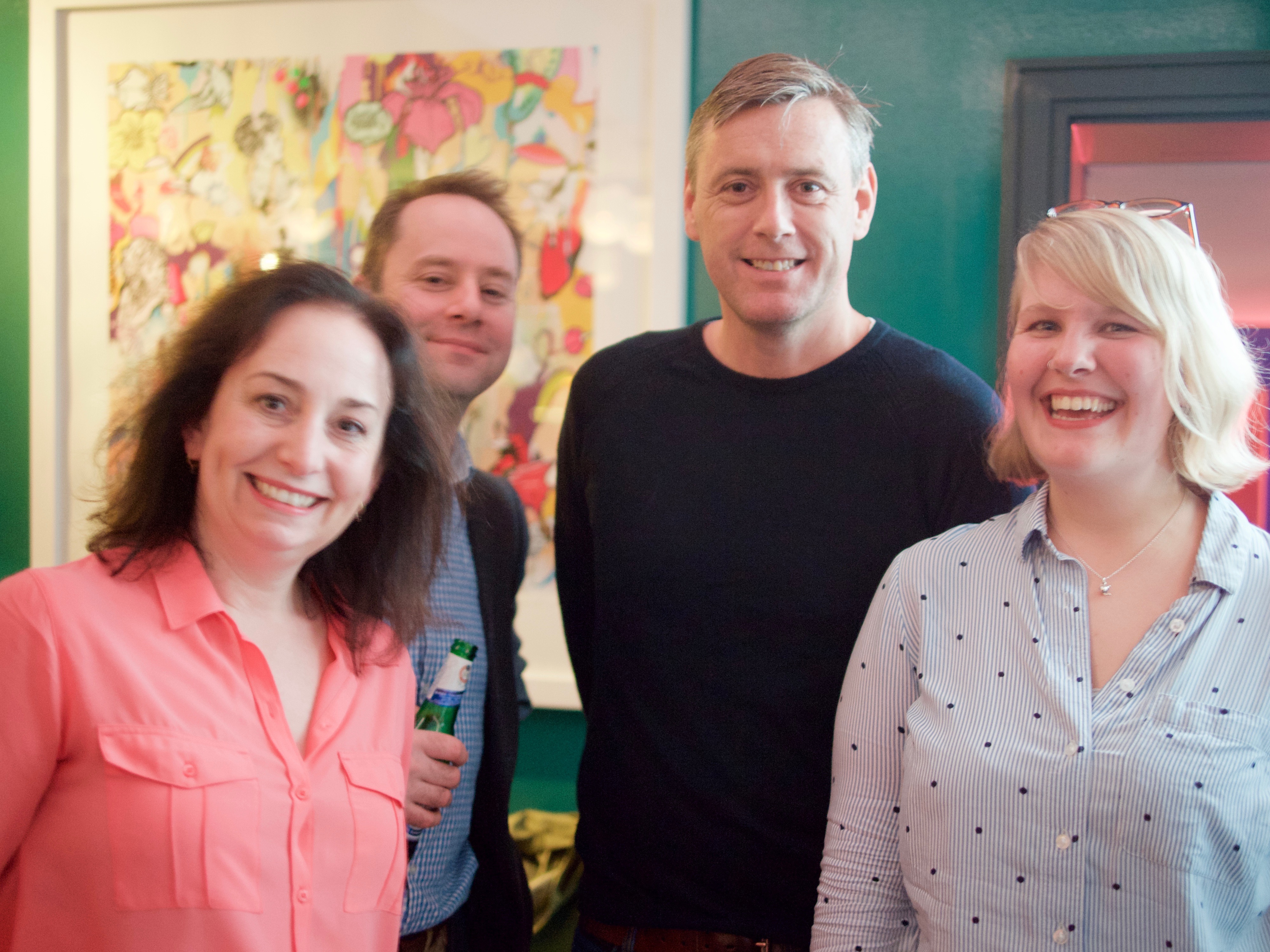
Our sponsors, pictured from left to right: Ruth Jones, Andrew Bromley (also a panelist), Darragh Deering and Saskia Watts
Byte The Book founder Justine Solomons chaired the event, opening the floor with a telling observation: “Authors are really driving the industry now.” Few appreciate this better than Orna Ross, a self-published writer who formed the Alliance Of Independent Authors five years ago and has since seen many thousands of members sign up worldwide. ALLi has three different membership tiers: authors about to self-publish, authors who have already self-published and established authors who have sold more than 50,000 books over a two-year period. Interestingly, revealed Orna, it is the last of these categories that is growing the fastest, and this is an indication of just how lucrative self-publishing can be for those who are prepared to put the work in. The indie approach may not be for every author, Orna conceded, but the level of control it affords a writer over their own career makes it an attractive prospect for those who find the traditional publishing route restrictive.

Our panel, from left to right: Tereze Brikmane, Andrew Bromley and Orna Ross
One technological advance that has proved a major game-changer for self-publishers is print-on-demand. Andrew Bromley, Marketing Manager at Ingram, spoke about the process on behalf of Ingram Spark, arguably the biggest print service provider for indie authors besides Amazon’s CreateSpace. POD, said Andrew, has grown massively in popularity in recent years, partly due to the fact that it cuts out the wholesaler and allows authors to send their books directly to the stores, making for very favourable margins. What’s more, as the technology continually improves, Ingram Spark are finding new ways to reduce costs without ever compromising on quality. “Papers are being developed specifically for POD printers now,” explained Andrew, “so they’re reacting better to the printing process.” In other words, as the years go by, the gap between traditional printing and print-on-demand is only going to shrink.

A rapt audience engaging in the #bytethebook debate
The panel was completed by bookseller Tereze Brikmane, manager of the innovative children’s bookshop Tales On Moon Lane. Tales was recently shortlisted for The Bookseller’s Independent Bookshop Of The Year award, and it’s easy to see why. Beyond functioning as a thriving physical store, Tales supply school libraries, run business enterprise days for young people, source authors for school events (on and around World Book Day, they typically entertain ten thousand children over a three-week period) and programme literary festivals. As for independent authors, rather uniquely, the shop runs its own online platform for self-publishers called Can’t Put It Down, designed to provide writers with a social support network and readers with a more diverse range of books. They even take open submissions from indie authors over e-mail.
There's always time for networking at Byte The Book
As the discussion drew to a close, Byte Consultancy’s Marzia Ghiselli asked the panel to reveal which technology or tool had revolutionised their business the most. Hand-held scanners, responded Tereze, hinting at the difficulties smaller stores traditionally have with tracking stock. Print-on-demand, said Andrew, perhaps unsurprisingly. And finally, Orna chose eBooks - the very technology that kicked off the self-publishing revolution in the first place.
In short, one thing was clear: while publishers have historically been criticised for living in the Stone Age, for many corners of the industry, technology is no longer a dirty word.
If you enjoyed this report and want to keep up with the latest happenings in publishing as well as network with publishers and authors alike keep yourself posted by visiting our events page here. You can join us from £30 a quarter here
More photos can be found on our Facebook Page
Byte the Book member, Heather O'Connell, teaches the Authorpreneur short course at City, University of London and knows all about the importance of turning writing into business…
Do you dream of being a writer, you know full time, without the distractions of that annoying day job? Have you made a plan? Have you been frantically beavering away on your first book or have you had one published and still have that annoying day job?
Each year we see the average author’s earnings fall a little more and we hear rumours of ‘other skills’ we will need to snag that lucrative publishing deal or take the leap and successfully self-publish.
And with every new innovation or article it seems more difficult to achieve the dream. We need to be a have a head for business, be PR and marketing whizzes, and be all over social media… oh, and find time to write. We need to be an Authorpreneur not just an author.
For many of us the very idea is enough to have us running back to our writing sheds and coffee shops but succeeding in the modern landscape isn’t as daunting as it sounds. Yes, you will be a portmanteau but you don’t suddenly have to start wearing power suits and killer heels, you just need to think like an entrepreneur and an author.
And that is easier than you might think. We are already imaginative, creative and determined, no one ever finished a book without determination. That’s at least half the battle.
And the rest? Well that’s a mixture of understanding the industry and ourselves, knowing what needs to be done, and deciding what you want and can do and finding other people to do the rest…
Follow my top ten tips for becoming an authorpreneur and you’ll be one step closer to making your writing a business:
- Think like a publisher not a writer: stop thinking about the work and start thinking about the market for your work.
- Know what you want to achieve: to succeed you need to be clear about your aims. Do you want to publish for pleasure, become a best seller, or publish to further your existing business?
- Now find out what you need to do to achieve these aims.
- Examine your strengths and weaknesses. Understand which elements you can do and which you can’t. Then find experts who can help you fill in the gaps.
- Be realistic: set achievable goals and pace yourself.
- Build your platform to reach your target audience.
- Understand your USP. What is special/interesting about you? Why will people buy your book and not another one in the same genre/on the same subject?
- Know the market. Understand who will buy your book and get to know them.
- Know where your readers hang out – which social media do they use etc?
- Have fun! Writing’s a lonely business, and starting up on your own can be hard. All the more reason to enjoy what you’re doing when you can!
For more information on Heather, have a look at her Byte the Book Hub entry. You can find out more about the Authorpreneur course here. Classes start on the 2nd May 2017.
What students of the Authorpreneur course say:
‘City’s Authorpreneur course provides perceptive, up-to-date and actionable insights into today’s publishing world from someone with real in-depth experience of the industry. The participants were working in widely different areas which meant the sessions covered a very broad spectrum of book types. Heather’s realistic no-nonsense approach made us all think about what we were doing as well as supplying a huge range of ideas on how we could do it better and what other options might be worth pursuing. Challenging and great fun.’ Peter Kelly, 2016
‘Heather is a brilliant tutor and very knowledgeable about the industry, so it was well worth the time and investment in this course. Very engaging experience; I learned a lot and enjoyed meeting others with similar interests.’ Tania Diggory, 2016
New Byte the Book member, indexer, editor and Advanced Professional Member of the Society of Indexers Paula Clarke Bain, tells us about the importance of the index and the inaugural National Indexing Day.
The Society of Indexers is celebrating its diamond anniversary in 2017 and has designated Thursday 30 March as the inaugural National Indexing Day, marking 60 years since our formal constitution. Book indexing is an essential but little-understood part of the publishing industry. Who are these indexers and what exactly do we do?
The oldest printed indexes are found in two editions of St Augustine’s De arte praedicandi (‘On the art of preaching’), published in the 1460s soon after the invention of the Gutenberg printing press. Handwritten indexes date back much further. Records from the papal court at Avignon show that by the early 1300s people were being paid to compose indexes. There is further evidence suggesting that the 3000-year-old ancient book of hexagrams I Ching (Book of Changes) from China contains the world’s oldest index. It is an ancient art.
The Society of Indexers, based in Sheffield, currently has about 400 members, working for authors and publishers in more than 100 subjects from accountancy to zoology. We have come a long way from handwritten indexes and the days of filing index cards in shoeboxes. Today’s indexers use sophisticated indexing software to create standalone back-of-the-book indexes or embedded/linked indexes within the main text itself.
In the digital age, indexes are just as essential in ebooks; a full-text search or Ctrl-F cannot think like the reader. A good book index is made neither by magic nor machine; an index is not just an automated alphabetical list of keywords. Computers can’t read, so they can’t index. They don’t cope well with homographs, synonyms or judging between significant and passing mentions of a topic. Context is key; it all depends. Professional book indexers are trained to analyse each text, identify the important concepts and allow for alternative reader approaches. A good index is like a road map back into the main text. A bad index can be less than useless. And a non-fiction book with no index at all is a crying shame.
To help you find the best indexers in the business, the Society of Indexers has an ‘Indexers Available’ online directory which lists approved accredited indexers who have passed its distance-learning ‘Training in Indexing’ course. It also runs local groups, workshops and an annual conference and publishes The Indexer international journal.
There will be much ado about indexing in Oxford this June. As the Society of Indexers finish celebrating our diamond anniversary conference and gala dinner at St Anne’s College on 21 June, index scholars and lovers will gather at the Bodleian Library for a two-day symposium on the Book Index (22–23 June) organised by Dr Dennis Duncan.
We hope that the launch of National Indexing Day on Thursday 30 March will provide a useful opportunity to promote the profession of indexing. We will be encouraging people to share gems of best indexing practice on social media with the hashtag #indexday. Please do join in if you appreciate a good book index. It’s high time for the diamond indexers to shine.
Further information
For further information about the Society of Indexers and to find an indexer, see www.indexers.org.uk or follow us on Twitter @indexers.
For more information on the Book Index symposium, see https://indexconference.wordpress.com.
To get in touch with Paula Clarke Bain see her details on our Hub.
Justine's Assistant at Byte the Book, Rebekah Lattin-Rawstrone, tells us about her new venture with City University, City Writes.
I've been a teacher for City University's Writing Short Courses on and off for over 10 years and felt it was time all the wonderful writing I've encountered had a space to be heard. This is how City Writes came about.
The idea is to hold a reading event once a term that will host one published writer, either an alumni from a City Short Writing Course or a lecturer, and three or four other writers who are currently taking, or have taken a City Short Writing Course. These other writers are chosen through a short fiction competition (further details can be found here), giving those at the start of their writing journey a chance to read alongside professionals, as well as providing a platform for all the talent flowing from the City Writing Short Courses.
Our launch event is Wednesday 29th March and you can book tickets here. I'm delighted that the Byte the Book member, Emma Claire Sweeney, whose highly acclaimed debut novel Owl Song at Dawn was published by Legend Press last year, will be providing the professional reading alongside four competition winners: Lesley Jones, Evleen Mann, C. G. Menon, and Eileen Church Riley.
The event starts at 6.30pm in Northampton Suite C at City University and drinks are included in the £10 ticket price. Please do come along and enjoy a night of readings that will take you from Morecombe Bay to Nevada and several places in-between. You can book tickets here.
Words by Chris Russell,photos by Katrina Hopewell.
The Library Club, with its stylish modern art and exposed brick walls, hosted Byte The Book’s March event on the topic of how publishers can maximise content revenue, sponsored by Ixxus and Copyright Clearance Center. Chair Steve Odart, CEO of Ixxus, led a discussion between Peter Buckley (Technology Director at DK), Tom Whitwell (consultant at Fluxx and ex-Head of Digital at The Times) and Kristen Kliemann (former Director of Global Rights at John Wiley, now President of Kliemann Consulting).
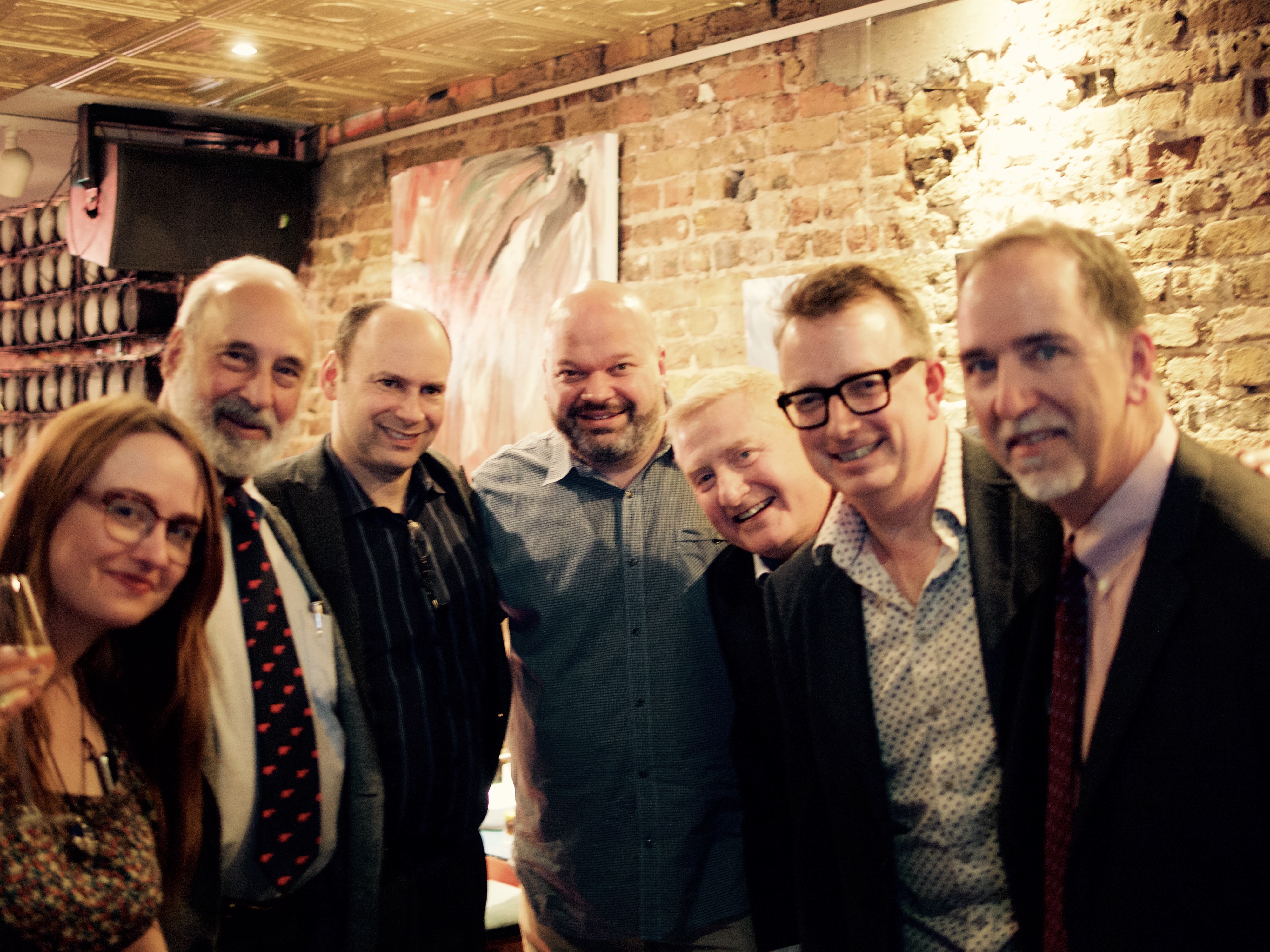
Our sponsors, pictured from left to right: Nat Guest, Dick Rudick, Roy Kaufman, Steve Odart, Jake Kelleher, Carl Robinson and Miles McNamee
Social media and digital platforms, began Steve, have “empowered the consumer.” The internet allows readers to find content for themselves, to personalise and curate it, and this has irrevocably altered the publisher-reader relationship. So how, he asked, is the mainstream publishing industry responding to this fundamental shift? Peter’s response was that, while his company DK have generally been on the forefront of digital content creation (they were one of the first publishers to create interactive DVDs in the 1990s, for instance), as the dust has settled they still find that they’re selling more books than apps. Essentially, he reflected, surviving in this brave-new-digital world is about “being true to what you’re good at, and understanding the power and value of your brand.” This doesn’t mean you stop innovating, of course, but the key is to keep your innovation within a context that makes sense to your existing customer base.
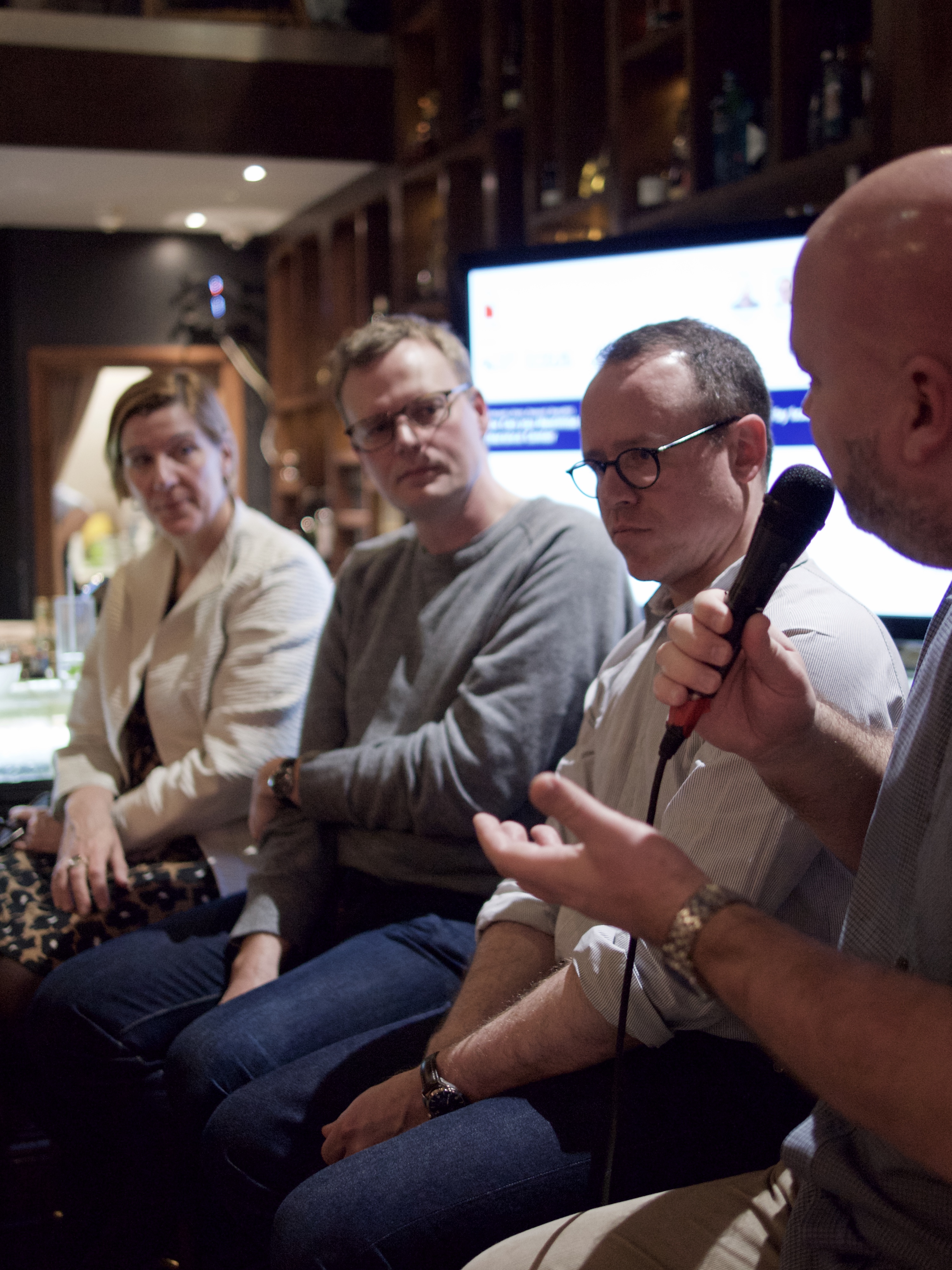
Our panel, from left to right: Kristen Kliemann, Tom Whitwell, Peter Buckley and Steve Odart (Chair).
Tom Whitwell expanded on the topic of audience, drilling down on the reasons why The Times has succeeded as a subscription newspaper while other publications have failed. “You have to view your content through the eyes of your customers,” he began, going on to point out the differences between readers of his (former) paper and those of, say, the Daily Mail. When the digital revolution decimated the traditional news industry, the Mail - in an attempt to ape the appeal of Facebook and Twitter - dramatically increased the number of articles it was producing, covering anything and everything that its readers might conceivably click on. But at The Times, explained David, they shied away from volume of content and instead opted to “sell the experience of reading a newspaper, for fifteen minutes to half an hour every morning.” This experience, as it turned out, was one for which their readers were willing to pay a premium, and this led David to a simple conclusion. The question publishers should ask themselves isn’t “How can we sell all this content we have?” but “What do our customers want?”

Never a dull moment for the crowd.
Kristen picked up this thread of consumer-focussed thinking, commenting that “people have questions that need to be answered … people want to learn things.” What’s more, she added, a traditional hardback book isn’t always the best way to learn those things. For instance, if you were in medical school and were struggling to memorise the bones in the hand, an audio chant that you could listen to as you fell asleep might be many times more effective than a textbook. She also spoke extensively about the importance of rights, explaining that, as core revenues shrink, it can be in rights and licensing where the slack is taken up. “Each different rights deal might be teeny tiny,” she said, “but they can add up to millions … so it’s worth the effort.”

There's always time for networking after the panel discussion.
When Steve asked for takeaway comments from each speaker, Tom responded by urging publishers to “find a real problem, and solve it.” “Stay true to your real brand values,” added Kristen, “the values you’ve had right from the beginning.” Finally, Peter reminded the audience that new and unpredictable ways of maximising content revenue were only going to multiply in the decades to come. “It won’t be long before we’re publishing to driverless cars,” he said, “where people are suddenly going to find themselves with a whole load of new reading time they’ve never had before.” And when you consider that’s a concept that would have been entirely inconceivable only a few years ago, it becomes increasingly obvious that the future of publishing is, in reality, right on our doorstep.
If you enjoyed this report and want to keep up with the latest happenings in publishing as well as network with publishers and authors alike keep yourself posted by visiting our events page here. You can join us from £30 a quarter here
More photos can be found on our Facebook Page
Words by Chris Russell, photos by Miguel Villar.
Crowdfunding was under the spotlight for Byte The Book’s February event, overseen by chair of London Book Fair David Roche, himself an author with reader-endorsed publisher Unbound. Joining David on the panel was Alex Somervell of One Third Stories, Adam Gomolin of Inkshares, Paul English of Wet Zebra and Neil Griffiths of the Republic Of Consciousness Prize. The event was sponsored by the Authors' Licensing and Collecting Society (ALCS), making sure writers are paid their due.

Our sponsors ALCS, pictured from left to right: Sandra Kukreja, Jonathan Fryer, Barbara Hayes, Luke Alcott and Maggie Gee.
David kicked off the discussion with a simple question: “Why is crowdfunding necessary?” Paul’s answer was about trust. “It’s needed,” he explained, “when we lose trust in a process, or in people.” In other words, when cracks begin to show in the traditional, established way of doing things, the readers themselves step in to be part of — and hopefully improve — the process. Neil Griffiths, who set up the Republic Of Consciousness Prize to recognise the work of the UK’s small presses (“the literary equivalent of micro-breweries,” as he put it), answered the question with a couple of brief anecdotes. He quoted, firstly, an anonymous literary agent who had told him that “we’re not very good at spotting outliers”; and secondly, a publisher who had revealed to him that “we publish over five hundred books a year, and we plan to get behind five to eight of them.” If your book isn’t one of those five to eight titles, or you’re one of the aforementioned outliers, asked Neil, what do you do? You turn to crowdfunding.

Our panel from left to right: Alex Somervell, Neil Griffiths, David Roche (Chair), Paul English and Adam Gomolin.
Adam Gomolin described his Californian crowdfunding company Inkshares as “a studio for books,” rather than a publisher. He summed up the appeal of crowd curation in simple terms: “There’s nothing complicated about crowdfunding: it’s just asking readers what they like. Why wouldn’t you do that? Why would you ever guess?” When asked about the key to success, he pointed to the Inkshares community. You have to build a community of readers, he explained — at least a hundred thousand people — who read “with passion, care and candour.” And how do you find those hundred thousand people? “There’s no secret in publishing, just hard work. There’s no substitute for hard work.” He went on to point out that many fellow entrepreneurs who launched start-ups around the same time as Inkshares have since fallen by the wayside, as they simply didn’t spend enough time on business development. “The core problem with publishing is that everyone wants to accomplish something, but they don’t necessarily want to go through the pain of accomplishing it.”

A rapt audience at the Cafe Royal.
Alex Somervell, whose start-up One Third Stories publishes children’s books that start in one language and end in another, echoed Adam’s emphasis on finding a community. But, he stressed, this doesn’t necessarily mean you need an enormous pre-existing network or thousands of wealthy friends to get a foot on the crowdfunding ladder. When One Third Stories first began, Alex had only recently graduated from university, and the vast majority of his friends were either unemployed or working on minimum wage. Kickstarter, he explained, gave the project discoverability, enabling himself and his business partner to rack up £35,000 in pre-orders and, in doing so, get their company off the ground.

There's always time to network afterwards. In the foreground, Alex Somervell talks with animation to member Sarah Towle.
David wrapped up the discussion by asking each panellist for one succinct takeaway on the topic. “Now, more than ever,” said Alex, “you have the opportunity to reach beyond your friends and family.” Be really honest with yourself, added Neil. Advocate for your narrative, said Adam, and not yourself. Challenge the model, suggested Paul, and never accept the limitations given to you. And finally, to close the floor, David offered one simple, yet perennially important, word:
“Perseverance.”

Perseverance and a Byte the Book tattoo for inspiration.
If you enjoyed this report and want to keep up with the latest happenings in publishing as well as network with publishers and authors alike keep yourself posted by visiting our events page here. You can join us from £30 a quarter here
More photos can be found on our Facebook Page
Ryan Morison, Director of Erudition Digital, and member of Byte the Book, offers his thoughts on DRM and shares his alternative anti-piracy solution, Custos for eBooks.
As with any major innovation, the advent of the digital age has brought with it both opportunities and risks. For book publishers, the upsides were heavily offset by the risk of increased piracy on a global scale. As a result, most publishers resorted to using digital rights management (DRM) technologies to protect eBooks against piracy.
What is DRM?
The most widely used form of DRM used by publishers (often referred to as “hard DRM”) works by restricting eBook access to legitimate users. This usually involves use of a proprietary reading application and association of purchased eBooks with a user’s account with a retailer to prevent illicit copying and sharing.
Other forms of DRM such as “social DRM” and watermarking also exist but although they have less of an impact on the reader, they offer limited protection as they’re only effective once pirated eBooks are found and are not as widely used by themselves (in many cases they are a complement to hard DRM rather than an alternative). This article will focus primarily on the “hard” variant because of its pervasiveness.
What’s the problem?
For readers, hard DRM means being tied to the apps of the respective retailer for each of their purchases and in some instances, performing extra steps to register their purchases. Imagine only permitting readers to read print books from certain retailers in certain rooms of their houses – this is in principle what DRM does! Added to this, there’s also the risk of losing access to one’s purchases if the retailer or app vendor becomes defunct (as has happened before).
What’s the impact? (Alternative: The medicine is worse than the disease?)
There is significant negative sentiment regarding DRM because it punishes honest users and can often be removed with freely available tools thus rendering it ineffective. The additional burden it imposes on readers creates a strong disincentive to purchase from more than one retailer. This entrenches the dominance of a few large retailers and stifles competition in the eBook retail market. It also makes it difficult for publishers to succeed with alternative routes to market such as direct sales - why buy direct from a publisher if it means installing and registering apps for each individual publisher?
Will publishers drop it?
In summary, DRM has significant drawbacks for publishers and their readers whilst only providing limited protection. The obvious question that follows is: why is it still being used? Although some are dropping it, it’s still largely the default means of protection for most publishers. This is because it’s a big step from hard DRM to none at all or to limited alternatives and publishers have an obligation (often contractual) to protect the work of their authors.
What is needed is a “middle road” alternative to hard DRM which addresses its downsides while providing better protection than alternatives. This is the objective of my company’s new anti-piracy solution, Custos for eBooks which provides a more efficient method of detecting infringements without impacting honest readers in any way. It is our hope that this will provide a viable alternative form of protection for publishers and in so doing contribute towards a more competitive eBook market.
For more information, contact Ryan Morison.
Byte the Book Member, Jon Watt, Country Manager of Type & Tell UK, shares five reasons why now is the best time to self-publish.
Who is the most successful self-publishing author of all time? This was a question thrown out to the floor at a recent literary festival and it took almost three minutes, during which time names such as E.L. James and Hugh Howey were shouted and rejected, before some clever soul finally offered up J.K. Rowling.
Many of us are not used to thinking of the Harry Potter author as a self-publisher, but by keeping a hold of the digital rights to the Harry Potter series and then publishing them through her own Pottermore company, she became a self-publisher – albeit a rather exceptional one.
Whoever you are, arguably there has never been a better time to self-publish.
Here are five reasons why:
1. Quality of printing – Recent advances in digital printing technology mean that individual books can now be produced quickly and to a standard that is almost indistinguishable from traditional lithographic printing.
2. Cheaper POD costs – The cost of printing single unit orders has dropped by approximately 15-20% in the last five years, allowing self-published authors to price their physical books more competitively without affecting their margin and royalty.
3. Global POD distribution – The digitization of book information means that it is now possible for metadata and book files to reach retailers around the world at the click of a button.
4. Social media marketing – Facebook and Google have become two of the most effective channels for reaching readers – and they are open to everyone. It is the democratization of advertising. Those with big budgets will always have the advantage of being able to buy greater coverage, but it is now possible to have a very effective book advertising campaign for a few pounds.
5. Flexible ebook pricing – Price is the most effective selling tool for books and, in this area, self-publishing authors don’t just have parity with traditional published authors, they have the advantage. Self-publishing authors retain control of their own price levers. This allows authors to make fast price changes; whether that’s for particular retailers or in different countries; whether for a limited period or long-term; whether raising the price or releasing a book for free.
The digitization of the whole book production process is allowing authors to enjoy more control over their project than they ever have before. In short, they’ve never had it so good.
Type & Tell is a new self-publishing service provider offering writers everything from editorial and design assistance, through to global POD distribution and printing – and all with free typesetting and 100% author royalties.
Type & Tell is launching on the 13th March at the London Book Fair – Stand 1f50e in the Writer’s Block. Sign up to learn more www.typeandtell.com
Throughout February Type & Tell is looking for writers who would like to produce a free book while testing out and offering feedback on the service. For more information, contact Jon Watt.
Words by Chris Russell, photos by Katrina Hopewell.
Pan Macmillan’s Sara Lloyd chaired Byte The Book’s opening event of 2017, which tackled the ever-increasing importance of data and explored how it can be used to maximise sales. Nuggets of publishing wisdom were provided by a three-strong panel: Google’s Phil Miles, Vearsa’s Gareth Cuddy and self-publishing phenomenon Mark Dawson.

Our sponsors Vearsa, pictured from left to right: Maurice O'Connor, Roger Miah, Michael O'Gorman and Gareth Cuddy.
Gareth Cuddy, CEO of the cutting-edge publishing technology company Vearsa, opened the floor by pointing out that a paucity of data is one of the biggest problems in the publishing world. Data is often “lumped into someone’s job title” (typically someone in sales) and often that person doesn’t possess the skillset to deal with it. However, the secret to success, he explained, is for publishers to focus specifically on what they want to achieve from their data analysis. Determine your goal first, he advised (are you looking to generate more sales, for instance, or drive a particular genre or author?), and then work your way back through the data to find the answers.
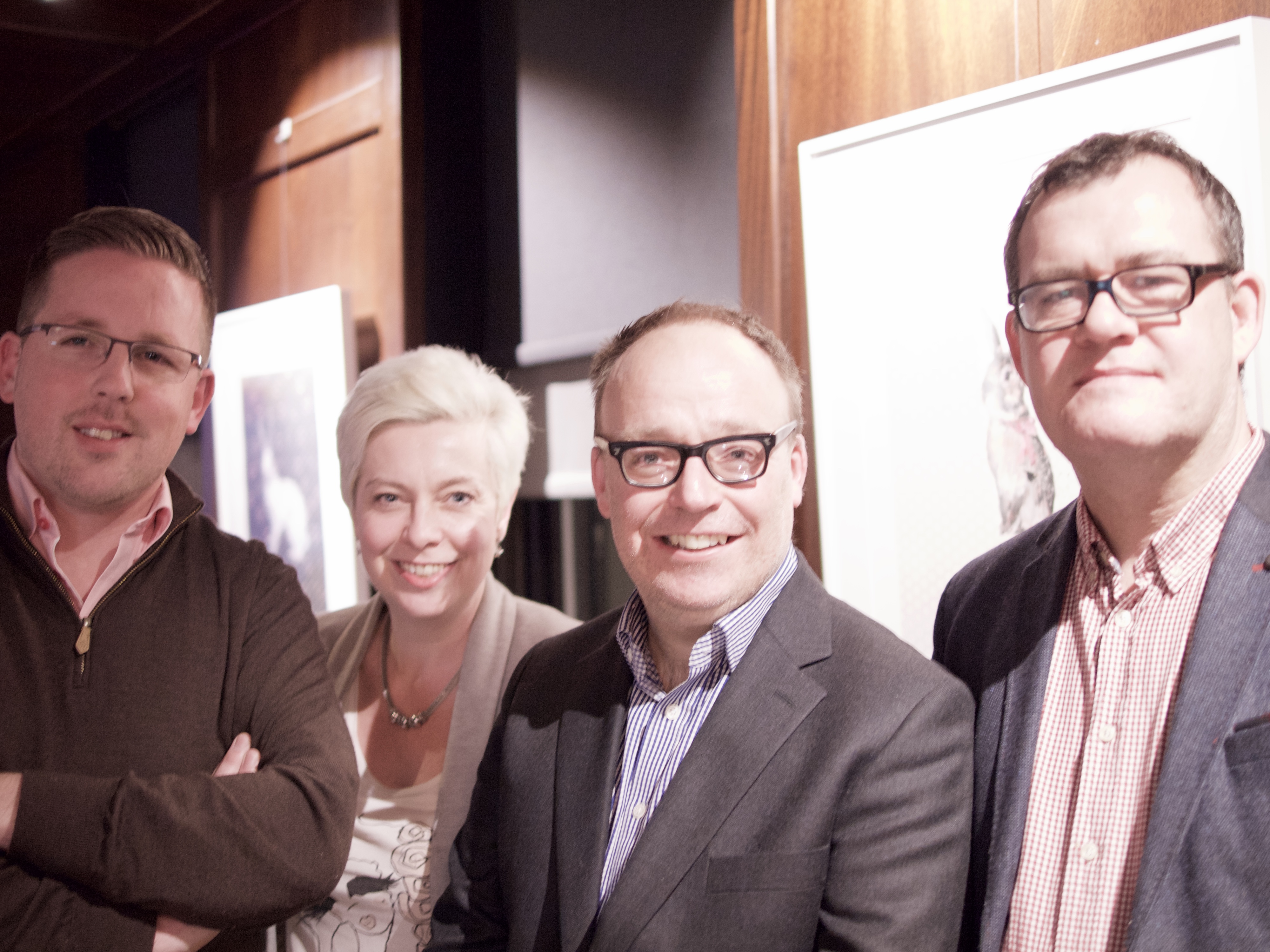
Our panel from left to right: Gareth Cuddy, Sara Lloyd (chair), Mark Dawson and Phil Miles.
Mark Dawson, a self-published author who, since turning his back on the traditional publishing industry, has racked up over two million downloads of his books, sang the praises of the reader e-mail list above all else. With his 65,000-strong mailing list, he can now say with virtual certainty that his new releases will chart instantly in Amazon’s top fifty, even before he begins the marketing process. Crucially, he also regularly surveys his e-mail list (with a free Kindle giveaway, loaded with his books, as an incentive) and asks readers what content they’d like him to create and release next. As such, he has cultivated a “deep” relationship with his audience, to the point where they actively inform his content, and is rewarded with sales that would inspire the envy of any major publisher.
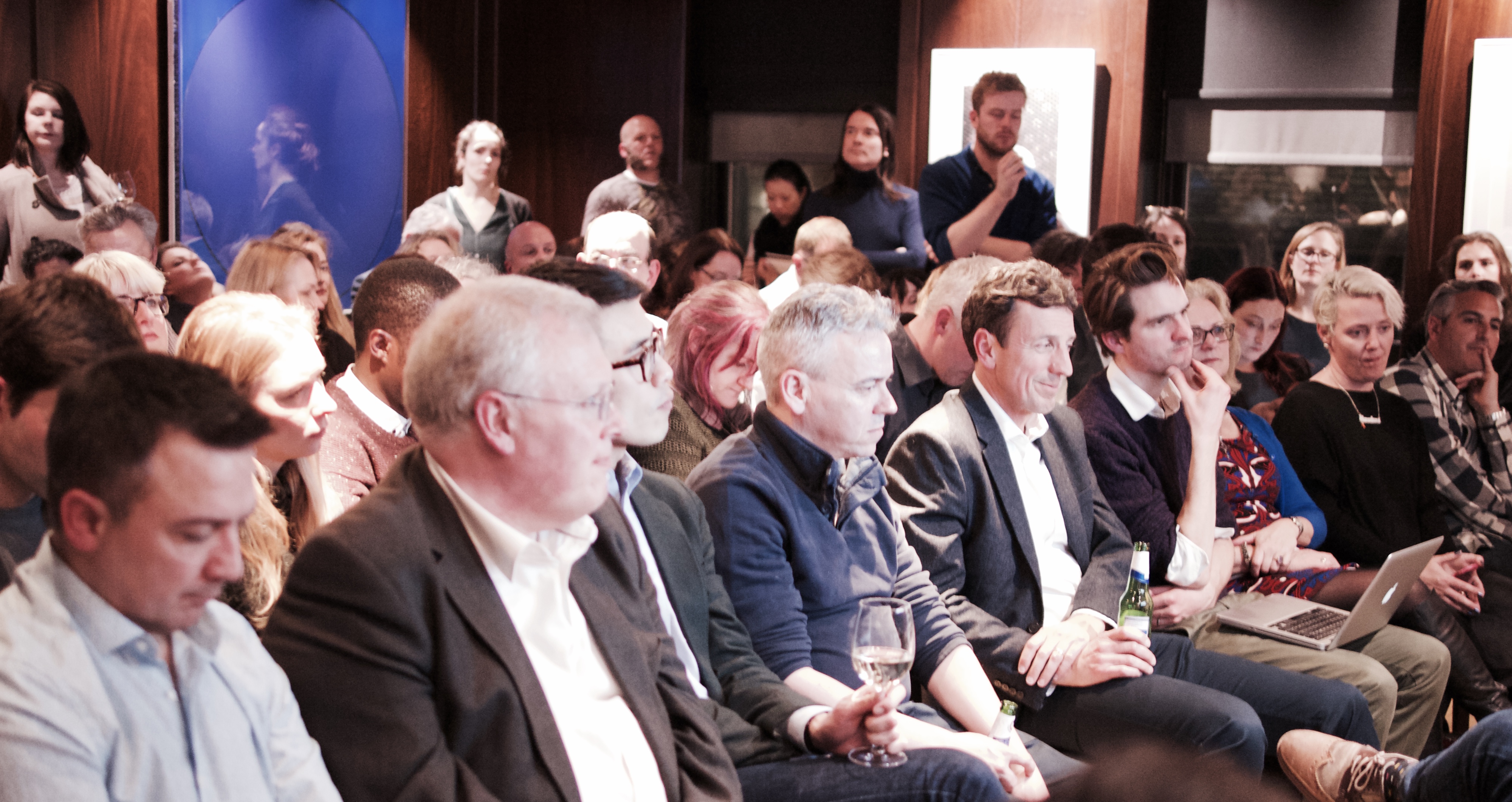
A rapt crowd (secret data nerds...).
Phil Miles, who runs Google’s Doubleclick service in the UK and works directly with brands on data segmentation and implementation, praised Mark’s achievements in cultivating “first party data sets” (or, as he also described them, “gold dust”). Mark’s success, he stressed, was in truly listening to his consumers. If you can build a profile of your audience over time - by asking them what they want and listening to the answers - that will inform how and why you engage with them, and maximise the outcomes when you do. “In the digital space,” he concluded, “you can always listen”, and so there really is no excuse not to (indeed, as Sara pointed out, the added advantage of digital, with its eternal footprint, is that you needn’t necessarily listen in real time).

It was a busy night for networking. Felicia Yap, member, novelist and one of the Guardian's rising stars for 2017, pictured here (in the centre).
In conclusion, reflected Gareth, understanding data is an iterative process. It’s about observing, learning and continually improving, and while no one can predict a hit, smart use of data can certainly “de-risk” any publishing list. As for the publishers who currently find the mere concept of data confusing or intimidating, said Phil, it was worth remembering that, at the end of the day, data is little more than “creating lists”. They just happen to be lists that could entirely revolutionise your business.
If you enjoyed this report and want to keep up with the latest happenings in publishing as well as network with publishers and authors alike keep yourself posted by visiting our events page here. You can join us from £30 a quarter here
More photos can be found on our Facebook Page
Prolifiko, co-founded by Byte the Book members Chris Smith and Bec Evans, has just launched a Kickstarter campaign to turn its prototype writing productivity coaching product and system into an app.
The campaign, which seeks £15,000 to build the product, offers a range of ‘rewards’ to backers including Tash Willcocks-illustrated #finishwhatyoustart notebooks and writing workshops with top tutors.
The culmination of over three years work, Prolifiko is a digital coach which uses a research-backed productivity system to encourage writers to start and stick at their writing projects.
The current iteration of the Prolifiko builds on an earlier version of the product – used and recommended by ManBooker Prize 2016 longlisted author Wyl Menmuir who used the system to track the writing of his debut novel The Many.
Currently available as a free online prototype through prolifiko.com – the coaching product helps writers kickstart their writing habit by taking a 5 day writing challenge, then enables them to continue with a longer project and set their own deadlines.
Already used by hundreds of writers across the world, the prototype uses a small steps methodology to help writers break down their project into achievable steps.
It also incorporates reminders, notifications, video-based support and a system of daily-tracking which helps writers understand and develop their practice over time.
For more information go Prolifiko, the Kickstarter campaign, or contact Chris Smith or Bec Evans.