Byte the Book member Yasmin Standen will curate this year's Midsummer Muswell, an annual event which takes place in Muswell Hill, North London.
Yasmin Standen, agent and publisher at Three Hares Publishing, is thrilled to be curating inaugural literary events to be included in this year’s Midsummer Muswell. “I’ve wanted to organise literary events in the area for some time,” she says. “Most of my neighbours are authors, have publishing links or work in creative industries; I wanted to bring literary events to the local community and to people from further afield.”
Yasmin loves working with authors and nurturing talent. She believes stories are an inherent part of our lives and cultures; sometimes people feel a desire to put pen to paper to share their stories. This starts out as an exciting thought, until they realise just how much work goes into novel writing. It takes time and perseverance to create good stories. Writing skills are honed over time and, eventually, when beautiful writing emerges, it’s a wonderful and all-encompassing feeling. “Writers tend to live in their heads and constantly question their work,” says Yasmin, “so it’s really important to stop the chatter of the mind and believe in yourself!” With this in mind, Yasmin has organised two literary events for Midsummer Muswell.
Details of this year’s events:
Author Confidential – the Secrets to Writing Success
Do you have a novel in you? Would you like to learn how to write a novel? Then come to our panel of expert and experienced authors, who will guide you through the ups and downs of writing a novel.
We have a wonderful panel, featuring two Killer Women writers – Louise Millar and Alison Joseph. Author Fran Smith completes the line-up with Jon Watt of Type & Tell chairing.
Sponsored by Type & Tell
“Type & Tell is delighted to be sponsoring the inaugural literary line up at Midsummer Muswell. At Type & Tell we passionately believe that all writers should have the chance to become authors and with the help of this wonderful panel, we hope to share some of the secrets to achieving literary success.” – Jon Watt (Type & Tell)
Nick Cook's Children's Workshop
Nick Cook, author of the Cloud Riders trilogy, will be putting on an exciting, interactive workshop to teach children about the science of twisters and the art of storytelling. Nick says, “To capture and inspire children's imaginations, my workshops are based around the core subject of my books: twisters, storm chasers and parallel worlds.”
“This is just the beginning,” assures Yasmin. “Muswell Hill is a vibrant literary community and I’m keen to add more events to next year’s Midsummer Muswell, including How to Pitch to an Agent; I’m also already in talks with a major food/lifestyle publisher with a view to having a panel of cookery authors and cooking demonstrations in 2018.”
Midsummer Muswell takes place on Saturday 24th June in Muswell Hill.
Further information and tickets can be found at:
https://muswellife.com/literary-events/
https://muswellife.com/nick-cook-at-midsummer-muswell/
To find out more about Yasmin, have a look at her Hub entry. You can also find out more about Type & Tell in a recent Byte the Book interview with Jon Appleton about using Type & Tell to publish his second novel.
Providing a great lead in to June's debate, The Author as Publisher: Opportunity or Vanity? sponsored by Type & Tell, author Jon Appleton talks to Byte the Book about his decision to self-publish his second novel with Type & Tell.
There used to be a stigma attached to self-publishing (that ‘vanity' label) – do you feel it is now taken more seriously and did that help you with your decision to self-publish?
Absolutely. In spite of statistics showing market growth and a flowering of new imprints, we all know that some books will never find their way on to a traditional list. But that doesn't mean they shouldn't be published. 'A good book is a good book however it's released into the world’ is a mantra you hear more and more. Indie authors are taking themselves more seriously – you hear fewer comments about doing it on the cheap. Your book can look as good and read as well as a Picador or Bloomsbury paperback. So why not aim for some of the success those books may enjoy? I've been gratified, too, to see more and more traditional industry people engaging in events that have ostensibly been arranged for independent authors and publishers – looking for talent, in some cases, but also just being collegiate. The two worlds are coming closer together.
Do you feel you have more control of the process, and is that a good thing?
You can have as much control as you want and are willing to seek and pay for. Editorial, design, production, distribution – none of it is secret information and there's any number of people willing to share it. All of it is hard work, often slow work, with no guarantees, of course. Your book might vanish without trace, but so might any number of traditionally published books, which were acquired at a high price and had marketing spend lavished on them. What you lack is influence – and you probably won't be eligible for prizes or considered for reviews. But you can have another go more easily, I think, if you experience the 'bad track' that Lizzy Kremer wrote about recently. You won't be dropped from a list and you won't be told you can't switch genres, if that's what you feel you want to do. There's freedom in that.
You’ve chosen to write a novella, was that a creative or publishing decision?
It was both. I've long been aware that authors can reach new audiences with short novels or even collections of stories (traditionally avoided by many mainstream publishers), often online at low price points, but in physical editions too. I'm keen to explore that. The annual Quick Reads promotion has released some satisfying, commercially successful titles which look and feel immediate and accessible. (I always want to read them all.) Several of the books include characters from forthcoming major novels which seems such an obvious and astute thing to do. They're a good way to flag up backlist too. Creatively, novellas offer the ultimate challenge – paring away structure and syntax, without sacrificing content. There always seems to be a novella on any major shortlist – Gwendoline Riley on this year's Bailey's list, for example – so I think there's a public awareness that the form is as legitimate and potentially rewarding as any longer work.
Does the fact that you are self-publishing change your writing habits at all?
I think it’s freed me up to stop being so focused on a conventional end goal – aiming for a novel of a certain length, at a certain price point, in a certain retail slot – and to focus more on the work. When I stopped pitching Ready to Love to agents with the conventional three chapters, I reworked the book into four parts, like acts, which brought it to life for me. Each part was about 18,000 words. When I finished crafting and reordering the pieces in London Faces, and reached a natural conclusion, I realised I’d also reached 18,000 words. I think this is a natural length for me. It doesn’t fit in with conventional publishing models but as an indie author I can work with it.
What advice would you give to a debut author about the writing process?
Take yourself seriously. That means allocating time and resources to help build a writing life. If you’re self-publishing, take other professionals seriously – editors, designers, printers, etc. Use their skills to help improve your work and ensure it’s as good as any published book.

London Faces, Going Places is out in June 2017, self-published with Type & Tell.
Sign up for our event on the 19th June at the Groucho and join the debate - Author as Publisher: Opportunity or Vanity? If you're at Hay Festival, join us and Salon for discussion and facilitated networking on how to get the best out of festivals, May 31st. Or book a ticket for our dragons' den style pitching event on the 17th July, sponsored by H. W. Fisher.
Words by Chris Russell,photos by Katrina Hopewell.
May’s Byte the Book tackled the hot topic of audio, a branch of the industry that has seen extraordinary growth in recent years. Videl Bar-Kar, former Audio Publisher at Penguin Random House, chaired a discussion that brought together John Mitchinson, presenter of the Backlisted podcast, Caroline Raphael of Dora Productions, ACast’s Adam Martin and David Roper of Heavy Entertainment.
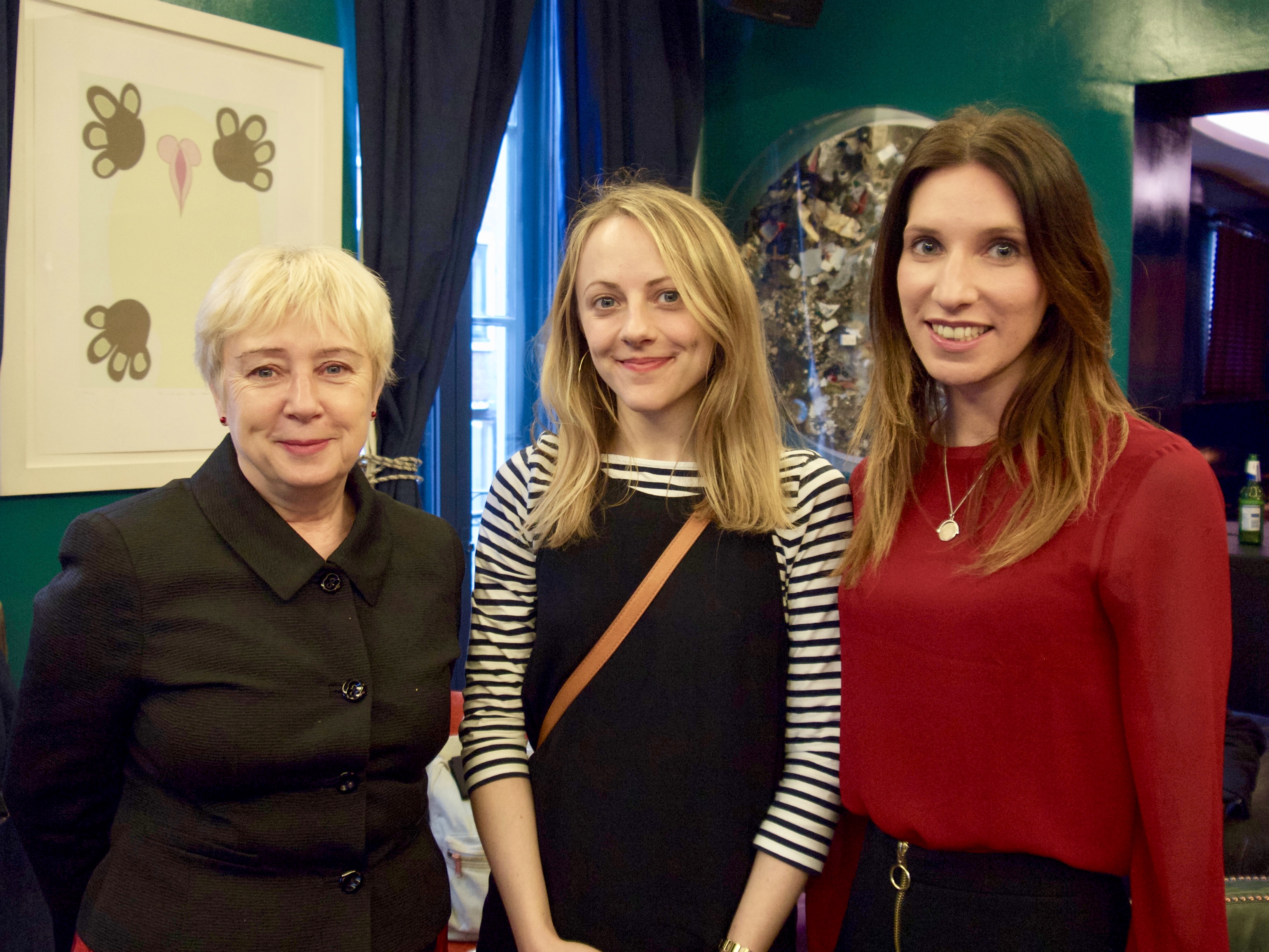
Byte the Book was delighted to support The Reading Agency with this event. Here are the The Reading Agency Team pictured left to right: Sue Wilkinson, Sam Cox and Karen Brodie.
“If you think about it,” began Videl, “audio is the original way of storytelling.” And it’s back with a vengeance. The US audiobook market turned over $1.7 billion last year (the UK figure is estimated to be somewhere around £100 million), and approximately two billion hours of audio were downloaded worldwide throughout 2016, a one hundred percent increase on 2014. So, asked Videl, what’s the secret to the format’s success? “There’s a sense of intimacy to audio,” suggested Adam Martin, whose company ACast provide content-creators with a platform for distributing and monetising podcasts. “It’s the notion of trusted voices within your ear, and losing yourself in a narrative.” He added that the audio world “feels unregulated”, and John Mitchinson agreed. “Podcasts are very pure,” he said, referring to the lack of mainstream gatekeepers that often constrain other types of content. “If you give people the opportunity to make the content they want to make, it will find an audience.”
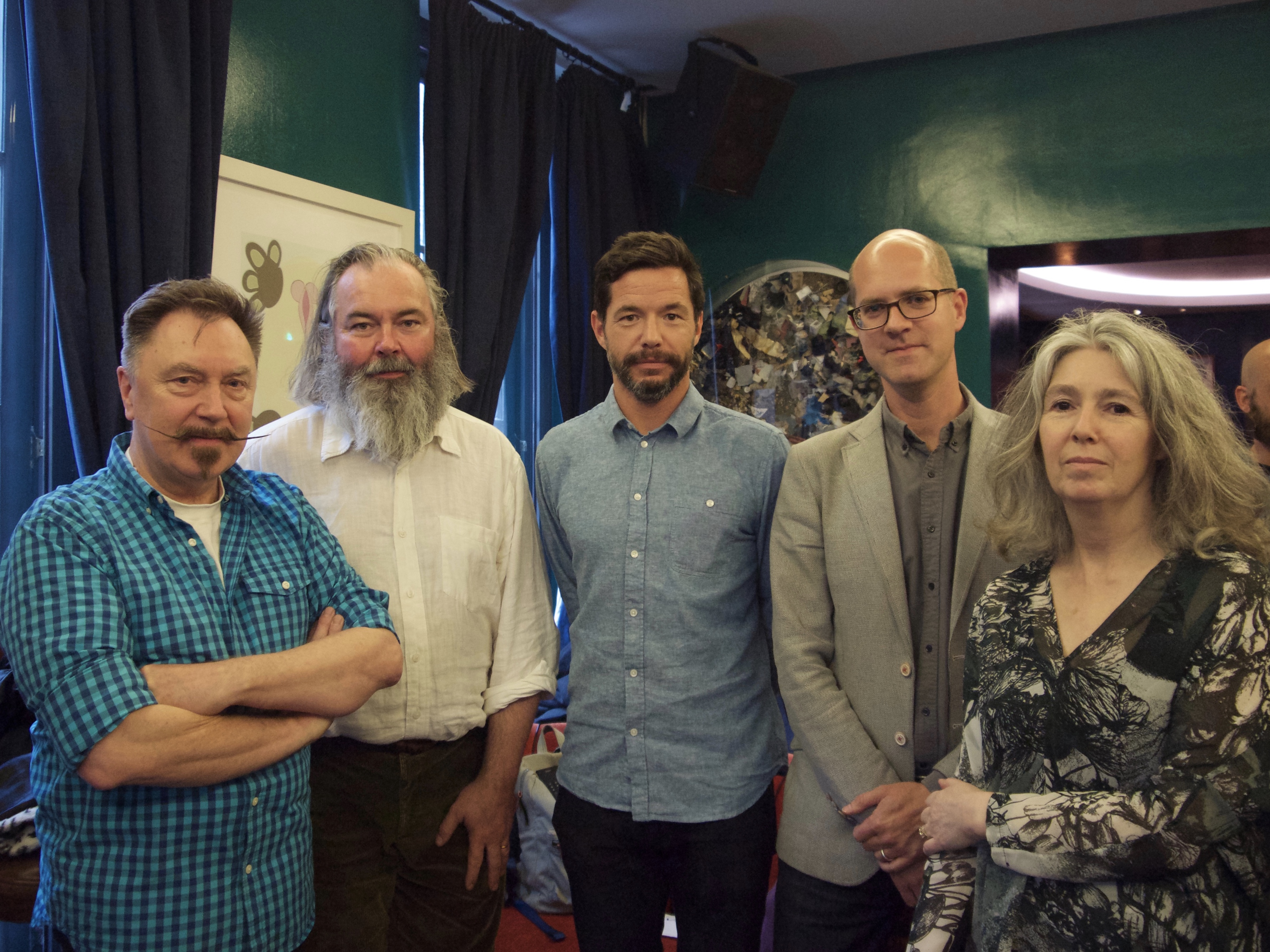
Our panel, from left to right: David Roper, John Mitchinson, Adam Martin, Videl Bar-Kar (Chair) and Caroline Raphael.
Much was made of the ever-evolving definition of audio, and whether we are yet to find the right way of describing it. Adam pointed out that “podcast” is itself an outdated term, tethered to a device - the Apple iPod - that barely anyone uses anymore. But perhaps audio’s indefinable nature is part of its appeal. “I like the fact that podcasts are difficult to define,” said John, adding that this constantly shifting identity gives rise to endless experimentation and innovation. Caroline Raphael, former Commissioning Editor at BBC Radio 4, suggested that, for the consumers themselves, locking down the terminology probably isn’t that important. “From a listener POV,” she said, “it’s all just audio.” In fact, she advised that publishers stop worrying about the definitions, and instead “start thinking about the aesthetics, and go beyond the format”.
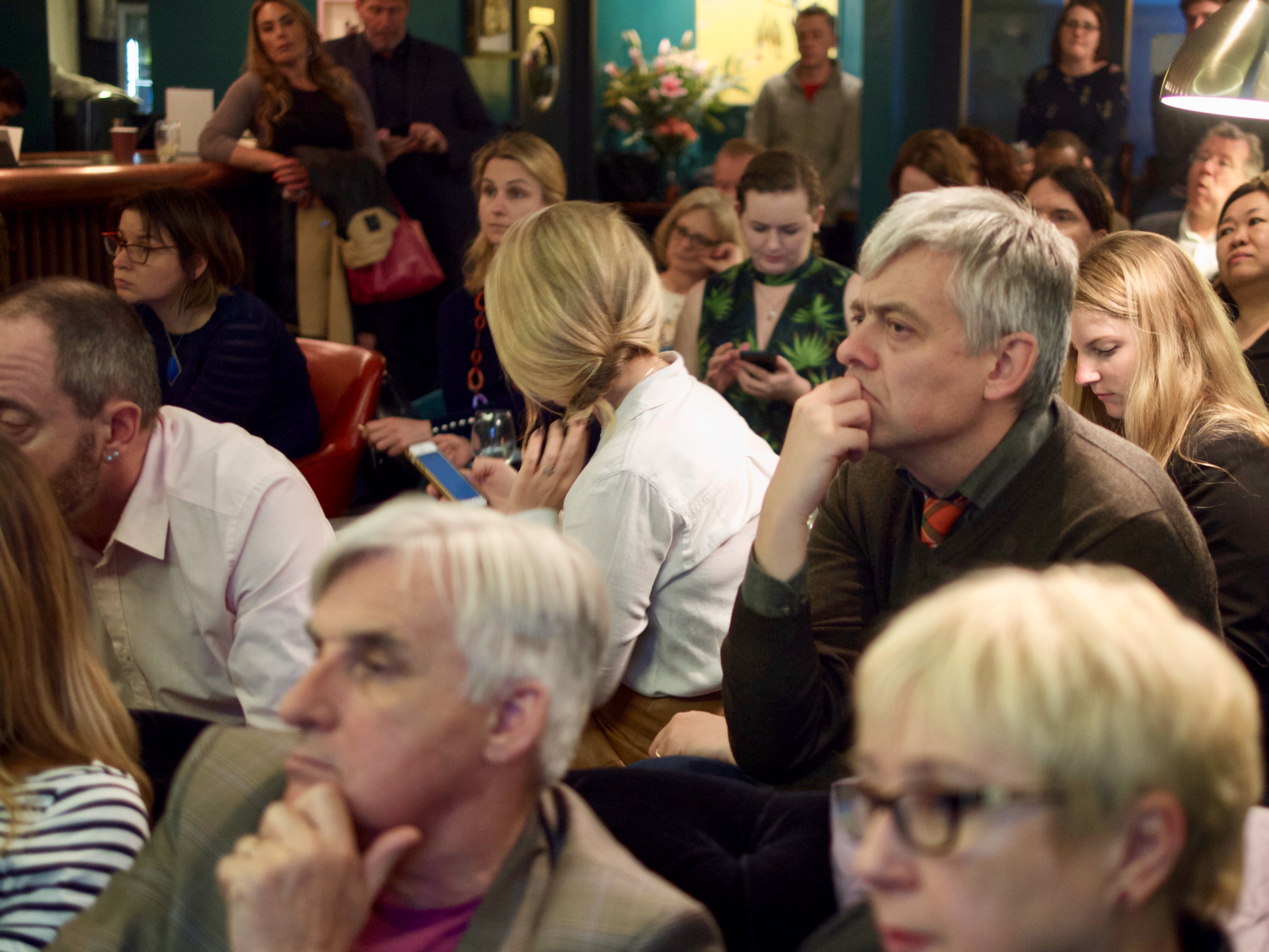
Audio really got the audience involved. #bytethebook made it to the top 3 followed hashtags on twitter on the night.
There’s a perception that the archetypal podcast-listener is a 40-year-old, middle-class male, and while there is still an element of truth to this, as the panel revealed, it’s changing fast. “I work a lot with young YouTubers,” said Heavy Entertainment’s David Roper, and to a generation who have been spoon-fed video since before they could talk, podcasts are an appealingly innovative medium. The astronomical success of series like My Dad Wrote A Porno testifies to this, given that, as Adam stated, “at least thirty percent of the Porno audience had never listened to a podcast before”. Indeed, rather encouragingly, John pointed out that podcasts are one of the few media channels he has in common with his teenage sons (“They even like mine!” he added, with a grin).
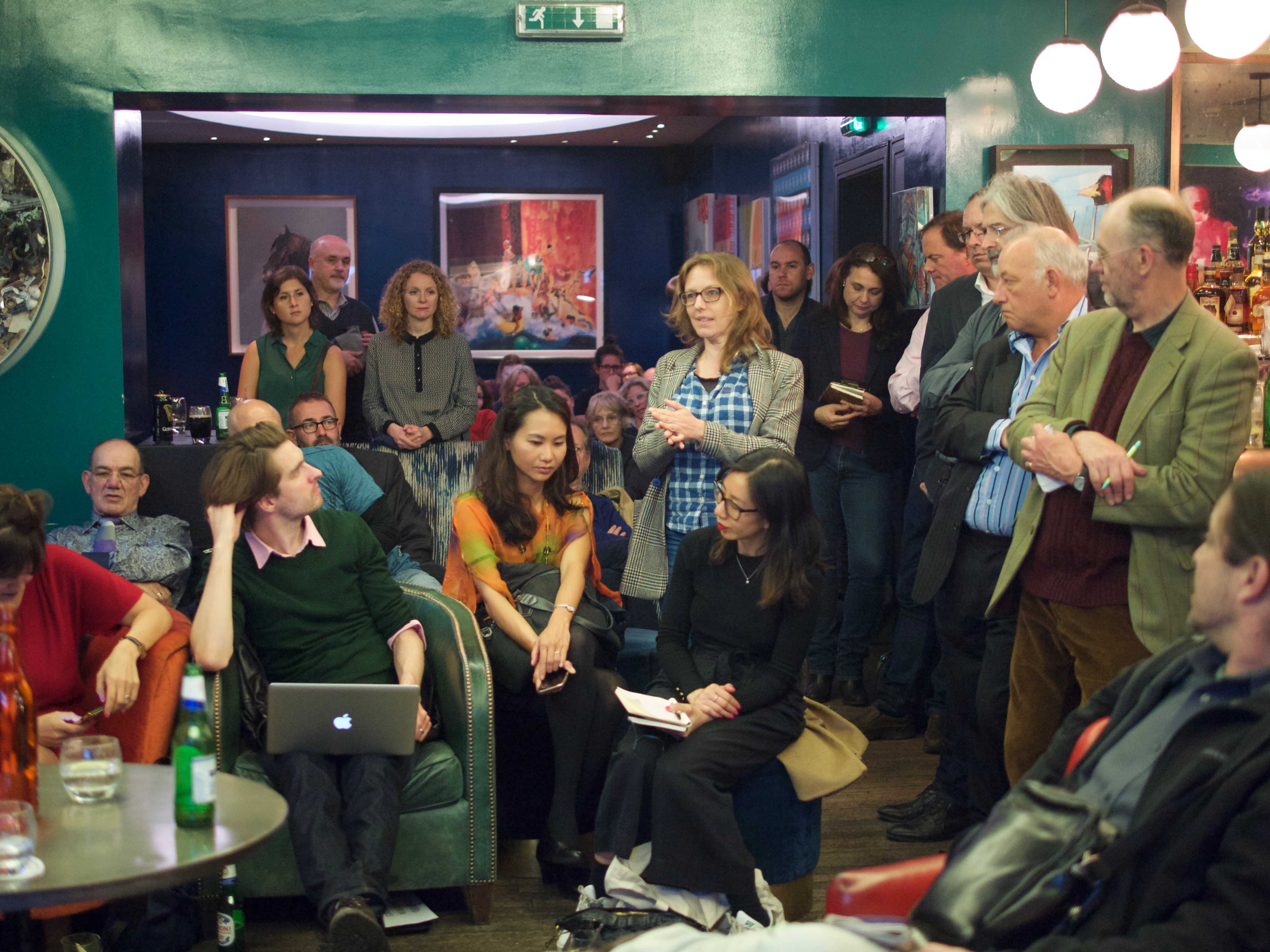
Questions from the audience.
So where is audio headed in the immediate future? “Costs and barriers to entry are low,” said Adam, “so there’s going to be a rush of people trying to jump on that. But they should be cautious and realistic about how many listeners they can attract.” David underlined the perennial importance of personal recommendation between consumers: “The podcast market has been flooded, so how do you discover a good one? Word-of-mouth, of course.” Finally, as John pointed out, it all comes back to one thing: “Publishers are in a good position … they’re sitting on lots of amazing storytelling content.” And audio, like video, eBooks and the good old-fashioned paperback novel, is just another way of getting those stories out there.
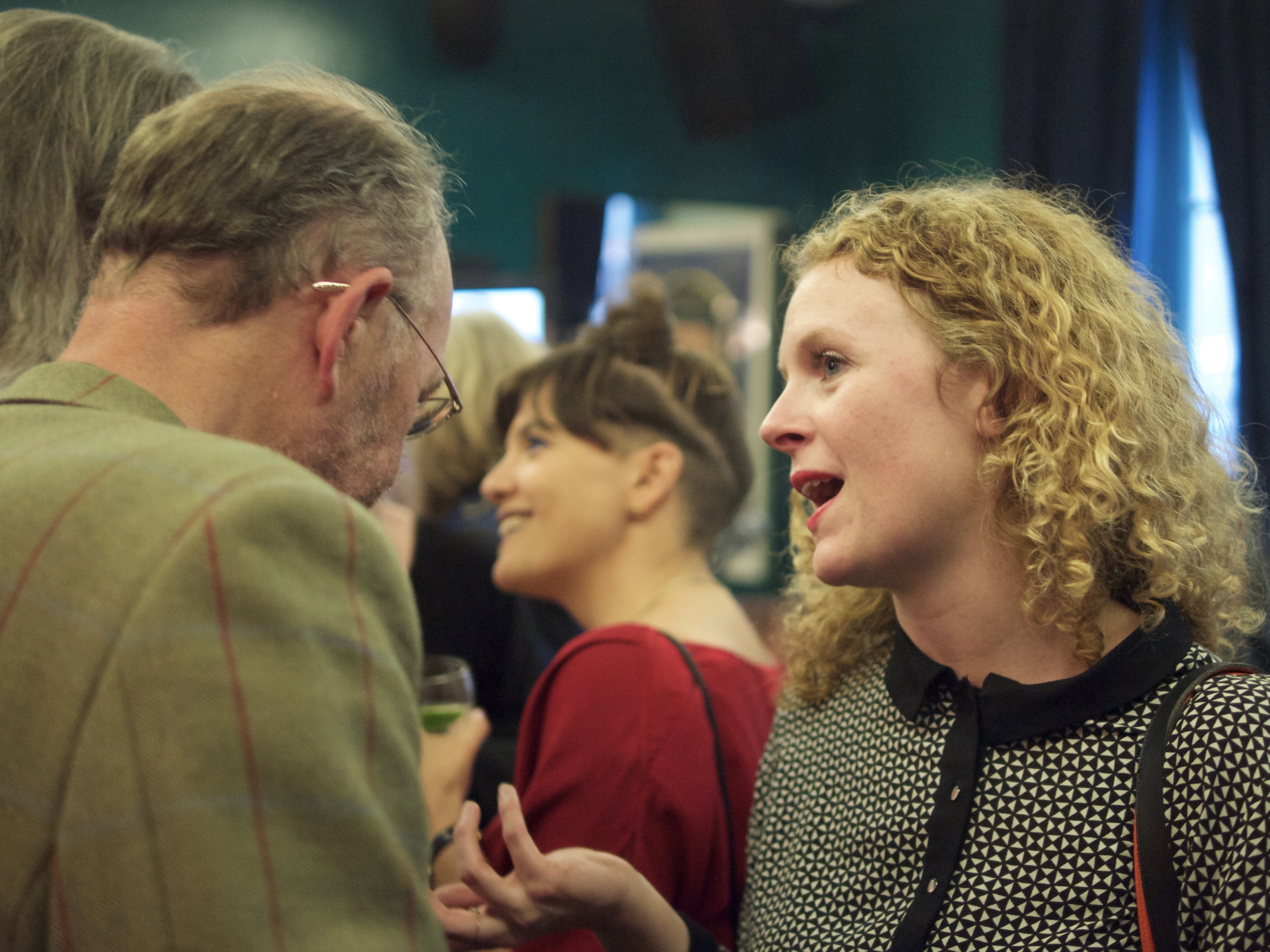
#bytethebook loves networking.
Byte the Book chose this event to sponsor and promote The Reading Agency, the leading charity inspiring people of all ages and all backgrounds to read for pleasure and empowerment. Working with their partners, their aim is to make reading accessible to everyone. Because everything changes when we read. To support the work they do, you can visit their justgiving page. £3 could help 3 children complete the Summer Reading Challenge. £15 could help pay for resources to reach children in disadvantaged areas. £50 could help 5 young people volunteer and inspire children to read.
If you enjoyed this report and want to keep up with the latest happenings in publishing as well as network with publishers and authors alike keep yourself posted by visiting our events page here. You can join us from £30 a quarter here
More photos can be found on our Facebook Page
Throughout Hay Festival (25th May to 4th June 2017) The Book Publicist team are inviting authors and publishers to pick their brains on how to get the right publicity for their non-fiction books.
Based in the heart of the “town of books,” The Book Publicist are one of the UK’s leading non-fiction book PR agencies. They work with some major non-fiction publishers (including FT Publishing, Pearson, Kogan Page, Crown House and Wiley) as well as direct with authors, so are specialists in securing powerful publicity for business, self-development, education, careers and parenting books.
As one of the festival sponsors, The Book Publicist are offering visitors to Hay-on-Wye free sessions with the agency founder, and Byte the Book member, Ella Davidson. Authors are invited to meet for a drink and talk through Ella’s thoughts, ideas and tips on how to secure media coverage and put a book in front of the right audience. She’ll give free advice on media-friendly hooks for their book, good journalists to approach and other tips on how to make a book stand out from the crowd.
The meetings can take place in one of Hay’s many great pubs, or alternatively, at The Book Publicist offices in the heart of Hay where they can also offer a beer, wine and even a seat, guaranteed – which can be something of a rarity during the busy festival!
If you’re interested and would like to book a session, please send details to info@thebookpublicist.co.uk and the team will schedule a suitable meeting slot. The more information you can give about your book and background the better, so Ella can prepare and make sure you leave armed with practical, take-away advice.
For more information on Ella Davidson, have a look at her Byte the Book Hub entry.
Novelist, copywriter and Byte the Book member, Chris Chalmers gives us the low down on his publishing journey, showing just how useful the Byte the Book network can be.
Last week I had my third novel published. Or to be exact, re-published. Five To One, the story of a helicopter crash on Clapham Common and how it affects the lives of those who witness it, came out in 2012. Back then it was an e-book only, the result of winning a debut novel competition run by a digi-publisher.
Once the rights reverted to me, I wanted to get Five To One back on sale, this time as a paperback and e-book. Meanwhile, my modest literary career had moved on, thanks in part to Byte the Book. When speaking on a panel at the Groucho, I was approached by an agent; Valeria at Raimondi & Campbell has been seeking homes for my novels ever since — and that led to another opportunity. Amazon was offering favourable terms to agents who published their clients’ books through their KDP/CreateSpace platforms. The thinking was, by using agents as a filter Amazon would boost the quality of books being self-published on its site by anyone and a dog. In return, we would qualify for inclusion in their sexy Kindle price promotions.
So far we’ve put out two books through Amazon and our J.Mendel Books imprint — and it’s worked well. You soon notice the spike in sales when your novel is part of a month-long 99p promotion. And now with Five To One I’ve taken re-publication as the chance for a revamp: one last spit-and-polish of the text, plus an exquisite new cover design from Mark Ecob at www.mecob.co.uk. He’s another contact I made through BTB. As were Caroline Goldsmith and Karen Ings from Red Button / www.goldsmithpublishingconsultancy.com, who helped with essential editorial and digi-troubleshooting services.
On that subject, I’d be lying if I said the Amazon publishing process is always seamless. Separate creation platforms for your e-book and paperback feels clunky, as does the fact that your paperback proof comes from America. (My first one disappeared en route which didn’t help.) But we’ve made it; Five To One has risen again and I’m thrilled with the end product. So much so, I’m straining at the leash to do it all again with a brand new book.
But first — marketing! I’ve just shot seven 60-second films for a series called Five To ONE-MINUTE MOVIES, which will be up on Facebook, Twitter and my YouTube channel this week. No doubt someone at BTB could have shot them better than I did. They’ll do for now — but if I sell enough copies, I might just feel like splashing out next time…
Five To One by Chris Chalmers is out now. You can find out more about Chris and how to contact him via his Hub entry.
Colum McCann's Letters to a Young Writer is out this month. You can read a few of his tips below. Bloomsbury have offered us some free copies for the first ten people to correctly answer the following question: What should a first line open up? You need to read the article for the answer! Please email your answer and postal address to Vicky.Beddow@bloomsbury.com
Writing Tips From Colomn McCann's Letters to a Young Writer
There are no rules
Or if there are any rules, they are only there to be broken. Embrace these contradictions. To hell with grammar, but only if you know the grammar first. To hell with formality, but only if you have learned what it means to be formal. To hell with plot, but you better at some stage make something happen. To hell with structure, but only if you have thought it through so thoroughly that you can safely walk through your work with your eyes closed.
The great ones break the rules on purpose. They do it in order to remake the language. They say it like nobody has ever said it before.
Your First Line
A first line should open up your rib cage. It should reach in and twist your heart backward. It should suggest that the world will never be the same again. The opening salvo should be active. It should plunge your reader into something urgent, interesting, informative. It should move your story, your poem, your play, forward. It should whisper in your reader’s ear that everything is about to change.
So much of what then follows is based on the tone of the opening cue. Assure us that the world is not static. Give us something concrete to hang on to. Let us know that we’re going somewhere. But take it easy too. Don’t stuff the world into your first page. Achieve a balance. Let the story unfold. Think of it as a doorway. Once you get your readers over the threshold, you can show them around the rest of the house. At the same time, don’t panic if you don’t get it right first time around. Often the opening line won’t be found until you’re halfway through your first draft. You hit page 157 and you suddenly realize, Ah, that’s where I should have begun. So you go back and begin again.
Open elegantly. Open fiercely. Open delicately. Open with surprise. Open with everything at stake.
At least not yet.
Your Last Line
Gogol said that the last line of every story was, “And nothing would ever be the same again.” Nothing in life ever really begins in one single place, and nothing ever truly ends. But stories have at least to pretend to finish. Don’t tie it up too neatly. Don’t try too much. Often the story can end several paragraphs before, so find the place to use your red pencil. Print out several versions of the last sentence and sit with them. Go to your park bench again. Discover silence. Read each version over and over. Go with the one that you feel to be true and a little bit mysterious. Don’t tack on the story’s meaning. Don’t moralize at the end. Don’t preach that final hallelujah. Have faith that your reader has already gone with you on a long journey. They know where they have been. They know what they have learned. They know already that life is dark. You don’t have to flood it with last-minute light.
Try, if possible, to finish in the concrete, with an action, a movement, to carry the reader forward. Never forget that a story begins long before you start it and ends long after you end it. Allow your reader to walk out from your last line and into her own imagination. Find some last-line grace. This is the true gift of writing.
Colum McCann's Letters to a Young Writer is published by Bloomsbury, May 2017.
What can Clays Indie Publishing, a division of Clays, offer independent authors and publishers? We asked Georgina Aldridge of Clays Indie Publishing a series of questions to find out.
Q: Clays has been an integral part of the print and publishing industry for over 200 years. Is this experience part of what makes Clays Indie Publishing a good choice for independent publishers and authors? Can you provide better quality books?
A: Being a part of the industry for so long has definitely helped in our understanding of publishing and how it is changing. Some of the changes we have been at the forefront of (Clays have invested millions into digital presses which have helped us to offer economical short run printing), some of these changes we have survived (e-readers and e-books!) and we work closely with our publishers to continuously improve the services we offer to keep up with the evolution of publishing.
Indie publishers benefit from all of the years of learning and experience as we treat every book going through our factory the same, whether this is from a huge publisher printing millions of books a year, or an author who is trying out their first title independently. The stocked materials we offer will be the same, the way the order is planned onto the system and sent through pre-press is the same, and the process through the factory will be the same. Any improvements we make from working with one publisher have a positive effect on everyone printing with us.
Most people get in touch with us because they have seen our name on the imprint page of a book they love, and want to have their books printed to the same quality. The physical product, the book, housing the content should not be of a lower quality than other books – that would be letting the content down in such a competitive market.
Our books are as high quality as expected by the trade and the many different ways to make your title bespoke sets us apart from other book production methods on offer.
Q: If an author were to choose to self-publish through Clays Indie Publishing, how would you guide them step by step through the process of publishing? On your website you list the steps as metadata, editorial, design, production, distribution and marketing and publicity. What do each of these steps entail? Do authors need to use all of these services or can you choose some and not others? Does an author have one essential contact to help them through or are there many people involved?
A: The services we offer are all completely optional, lots of indie publishers may already have contacts set up, cover designed, typesetting done and distributor organised. And a lot of authors have skills that they put to good use in these areas.
Getting your book out there involves following certain steps and there is a lot to think about, so we have built and are continuing to build a network of people to put authors in touch with in regards to editing, proofreading, cover design, complex typesetting etc.
We also suggest organisations to look into joining such as the Alliance of Independent Authors and Byte the Book who offer invaluable support and advice for indie publishers.
You would have one point of contact at Clays, but that contact would introduce you to the different services you are looking for – again all optional, but we can be in the background if you need anything from us.
Each step of the process is very important, but the first thing is to have a manuscript in the very best state possible. From there, in no particular order, there are some key steps to publishing a book:
Metadata: this involves signing up for your ISBN numbers and entering all the data about your title so it feeds out to online retailers (such as Amazon) and so physical retailers have visibility of the book.
Editorial and proofreading: making sure you have at least one other person looking through your manuscript, preferably a professional editor and then proofreader (maybe even a reading group), to make sure it is in tip-top shape before it goes to print – readers deserve the best you can give them.
Cover design: making sure your book has the best and most appropriate cover possible – it has to appeal to your readers, fit in with the genre, make people pick the book up in the shop but also work at thumbnail level. Cover design really is an art so we would highly recommend using a professional. They will also be able to provide you with a file that is ready for print.
Typesetting: the interior design has to also be top quality, with a decent and readable font, well laid out so it is easy and enjoyable to read. Clays now offer typesetting and e-book creation for text only files, but we also have contacts for more complex typesetting projects.
Production: this is the fun bit! Books are so much less disposable now. People keep their books and treasure them. Since the e-book revolution, printed books have upped their game - cover finishes are more common and well used and beautiful cover designs are expected now, all whilst keeping a competitive RRP price. We can advise publishers on what might work for them with their budget and design, to help them create a beautiful book.
Distribution: you have a fantastic book now but how do you get it to your readers? Some indie publishers distribute themselves or direct sell only; some indie publishers have accounts with distributors; and some indie publishers that work with Clays take advantage of the optional distribution with Gardners that Clays offer. Whatever the method, it is important to think about this early on in the process.
Marketing and PR: we would highly encourage thinking about this at the start of the process even whilst still writing as it is a really major part of getting your book out to readers – a lot of indie publishers successfully market themselves and we would advise taking advantage of the free social media platforms available and creating an author website.
We advise through the process as best we can and introduce authors to services and professionals that we trust to do a fantastic job for them.
Q: Clays Indie Publishing offers short run printing. What are the advantages of this model in comparison to a print on demand model?
A: Short run printing is a very different process to print on demand – instead of a book being ordered, then printed and fulfilled, the books are printed first and stocked so that orders can be fulfilled. Although printing copies upfront holds some risk, you benefit hugely from the economies of scale on your unit price and also the ability to market using the physical copies. You also benefit from all the different options of cover finish, case material and paper choices to be able to make your book stand out and compete on the shelves.
This isn’t to say POD isn’t a good model, it is a great fit for some with its own positives, but short run printing is different and may suit some indie publishers more. We have found the authors who are targeting bookshops tended to prefer having stock. Authors who sell directly (after business conferences, speeches, concerts, school talks) also like to have stock as they then make a good profit margin!
Q: You’ve worked on some really exciting projects like the bilingual books of Parapara Books. Would you agree that it is authors and small publishers who are the driving force of creative new development in the publishing world and is Clays Indie Publishing ready to meet the challenges these new ideas might bring?
A: Indie publishing is an incredibly innovative part of the market and has been pushing the boundaries to the benefit of the whole industry. It has been great to work on some very niche, exciting titles, and work with authors and small publishers who are bringing out current, challenging work. To publish is to contribute to culture, and I know that indie publishers take this contribution very seriously - these are books they care very deeply about and are taking a risk on! We are constantly trying to build our network of professionals and develop our services to be able to offer the quality and bespoke books that compete with trade published books on the bookshelves. We also try to come to Byte the Book every month (come and say hello!) and other industry events to keep up our knowledge on a constantly evolving market ... if we rested on our laurels, we would fall behind!
Q: What has been your favourite project so far and how do you feel Clays Indie Publishing was best placed to help it thrive?
A: I have been lucky enough to work with some lovely authors and publishers so it is really hard to pick just one!
A highlight would be Who’d Have Thought It? by Christine Webber as we met at an event Clays hosted on Indie Publishing, and from there her book was out and looking wonderful (with some lovely spot UV) within a few months. We helped Christine by advising on the process and production options, and putting her in touch with a typesetter (she in turn has helped us find a brilliant proofreader, Helen Baggot, who we now recommend to authors) and the book has sold well through our Gardners distribution scheme. Christine, who has been traditionally published many times for her non-fiction books, has been amazing throughout, especially at marketing and promoting Who’d Have Thought It?. It was lovely to hear her on the radio or in articles talking about her novel, and to see all the brilliant reviews. Her enthusiasm is so infectious, and she was joy to work with.
Another great project was working with The Dome Press on their very first title Life’s A Drag. The founder, David Headley, knows a huge amount about the publishing industry (as he is also the founder of Goldsboro Books and D H H Literary Agency) but it was really fulfilling to be involved advising on production options and on other little parts of the process. It was so exciting when I got my office copy and is on my holiday reading pile for my next trip away. Life’s A Drag is also going to be in a large WH Smith LBGT promotion, and The Dome Press is releasing a new YA title Sleeper which looks brilliant, so very excited to see how they continue to grow.
Q: If you could offer one piece of advice to individuals starting out on their publishing journey, what would it be?
A: Think about your end destination from the word go – it is important to put together a sales and marketing plan for yourself, research the market, wander around bookshops and visualise your book on the shelves and online. How should your cover look? Are most books in your genre a B-format paperback, or should you be thinking about a special edition Demy hardback? We would never advise anyone to leap in with a really big run length unless they had a solid sales, marketing and distribution plan.
And enjoy the control, build a publishing team you trust, take your time and dive into the creative process!
Georgina Aldridge is a Sales Executive at Clays.
You can find out more about Clays Indie Publishing on their website.
Launched on 27th April, Lounge Books is a website for book lovers, aiming to put more books into more hands. With people-powered recommendations, ideas for gifts and selections of the best ebook deals, Lounge Books is sure to fulfil its aims.
Devised by Sam Missingham as she says goodbye to her role at HarperCollins as digital project manager, the website will be curated and run on a tight budget but with a fantastic community of bloggers and an amazing advisory board of authors including Nikesh Shukla, Matt Haig, Nick Harkaway and Jill Mansell, as well as trade figures including agent Julia Kingsford, co-founder of Kingsford Campbell, publishing director at Templar Publishing Lisa Edwards, Profile publisher James Spackman and our very own Byte the Book founder Justine Solomons.
Covering a wide range of genres from romance to science fiction and YA, the site also offers literary gifts and a tab for 'book porn', which simply means books that have that wow factor - amazing designs, illustrations or a tactile feel. If you haven't signed up for the weekly newsletter, I would seriously recommend it. I managed to buy and read The Essex Serpent from Amazon for a mere £2.99 this bank holiday based on a Lounge Books recommendation.
Congratulations Sam, we wish you all the best!
Missingham is contactable at sam@lounge-books.com. Its Twitter handle is @Lounge_Books.
Byte the Book members get in free to the final instalment of Salon London’s ‘Caring, Sharing, Daring’ Spring Series, Thursday 4th May at The Hospital Club.
Mike Childs, Head of Policy and Research at Friends of the Earth will be explaining the 30 doable things we can do to change the world. University of Cambridge’s Dr Finbarr Livesey, author of From Global to Local, will help us get to grips with why our reliance on globalisation and trade as a route to growth could be totally misplaced. And finally, find out why Charles Foster, Oxford Professor and author of the New York Times best seller Being A Beast, lived for three months as a badger.
Doors open 7pm. First speaker on 7:30pm. You can find out more here.
To book your free ticket, please email eloise@salon-london.com quoting your Byte the Book member number.
Salon London's fourth Also Festival runs from 30th June - 2nd July
If you can't make May's event at The Hospital Club, the Also Festival might be for you. Listed in the top UK Festivals by the Sunday Times AND the Guardian, picked by The Independent as the 'place to revel in nature and discuss big ideas', ‘Salon London’s Rural Retreat' brings to life the biggest and boldest ideas from art, science, psychology and philosophy with immersive talks and experiences. Across the programme ALSO seeks to find out more, from the personal to the universe itself.
Partnered with the University of Warwick for 2017, speakers include BBC and ITV historian and presenter, Dr Michael Scott; psychologist Philippa Perry; renegade economist, Kate Raworth; acclaimed philosopher Roman Krznaric and the award-winning author, Helen Oyeyemi.
2017's theme is Truth or Dare as festival-goers of all ages are invited to get involved, with everything from wine tasting to cabaret, immersive theatrical and visual banquets, extreme song lyric bingo, mini beast safari, rave yoga and wild swimming.
The fourth Also Festival takes place from 30th June - 2nd July in the stunning lake-side setting of Park Farm, Warwickshire, within 50 acres of beautiful 'Capability' Brown landscaped grounds, all open for festival-goers to explore, swim and relax in.
Weekend tickets with camping start at just £120. You can find out more on the Also Festival website.
Byte the Book is very proud to have Helen Bagnall, co-founder of Salon London and Salon North, as one of our members. You can see our own Justine Solomons partying at a previous Also Festival in the picture above.
New Byte The Book Member Jacquelyn Guderley couldn't wait to tell us about her latest venture, Salomé.
Salomé is a literary magazine for emerging female writers. Salomé gives anyone who identifies as a female writer the platform, confidence and experience to get their work published, in a world where approximately 75% of all published literature is written by men. That's irrespective of the fact that, for example, 80% of employees at Pan MacMillan are female.
How we're different
We are different from the other magazines out there. We exist primarily to publish the work of emerging female writers; that is, any woman who is new to the world of publishing, probably never having had a piece published before. Our core mission is two-fold: to publish women's work and to support a community of female writers. We do this in a number of ways, including: giving all the writers who submit writing comprehensive feedback - currently a page of feedback from our reading panel; writing a blog; and, running Salomé's Salon, Q&A Masterclasses by female published writers on how to get published as well as anything our audience are interested in.
Oh, and I should mention: we pay our writers and artists but don't charge for submissions. I haven't come across another magazine for women doing the same.
How it's going
We know we make a difference. I launched our business just 9 weeks ago. 11 weeks ago was when the idea first came to me. 10 weeks ago was when I assembled the twelve woman strong steering committee, all of whom are writers in their own right (many belong to the Write Like A Grrrl community, which was part of the inspiration for the magazine - it gave me the confidence so I thought I'd pass it on). 9 weeks ago we opened submissions. 2 weeks ago we launched with Salomé Digital, Salomé print and a launch party of 70 men and women interested in the world of female literature.
The feedback has been incredible. Tweets, emails, women telling me that we've increased their confidence already, some women are getting published for the first time ever.
Over to you
Submissions for our next issue, due out in July are open now and close on June 9th. Entries can be fiction, non-fiction, flash fiction or poetry. More details on our submission criteria can be found here. To submit your work, you can do so through our website.
Additionally, we are looking for:
- Artists - we feature beautiful, female-created artwork with our beautiful writing
- Designers - to contribute to design work
- Published female authors to lead our Salomé's Salon - for you if you want to sell some of your books and help women trying to get published
Lastly, we can pay our writers because we sell our magazine.
You can buy Salomé Digital for £3.50 for an issue; £13 for a Year's Subscription; or a limited first edition of Salomé Print for £13.50 (inc. P&P), signed by the founder (me!).
Share the news! We're shaking up the world of publishing for women.
For more information have a look at Jacquelyn's Hub entry or visit the Salomé website.