Members get a 25% discount for the Self-Publishing Masterclass on the 23rd September 2017, Saw Swee Hock Centre, London School of Economics
Sponsored by IngramSpark, the Self-Publishing Masterclass is a full day event that will guide authors through the entire self-publishing process, from first draft to publication date. Led by highly experienced and well-known self-publishing professionals, including Byte the Book member, Ben Cameron, the Self-Publishing Masterclass will be an invaluable day for any author interested in publishing their book.
With sessions on Editing, Book Production, Publicity and Marketing, Printing and Distribution, the day should teach you all you need to know to self-publish. Alongside Ben Cameron, the speakers are: Author, Editor and Mentor, Roz Morris; Vine Leaves Press Founder, Author, Publisher and Designer, Jessica Bell; IngramSpark Director, Robin Cutler.
For more information see the Self-Publishing Masterclass website. Tickets cost £95. Byte the Book members get a 25% discount. Please contact info@bytethebook.com for the 25% discount code before booking.
Words by Chris Russell,photos by Katrina Hopewell.
At Byte the Book’s annual pitching event, sponsored by HW Fisher, four budding entrepreneurs were offered the chance to pitch their book businesses to a panel of industry experts, in front of a live audience. Paul Freedman of Four Elements LLP chaired, while the panel comprised Graham Goodkind, Founder and Chairman of Frank PR, Mary Keane-Dawson of MKD Consultants and the Arts Council’s Emma Langley.
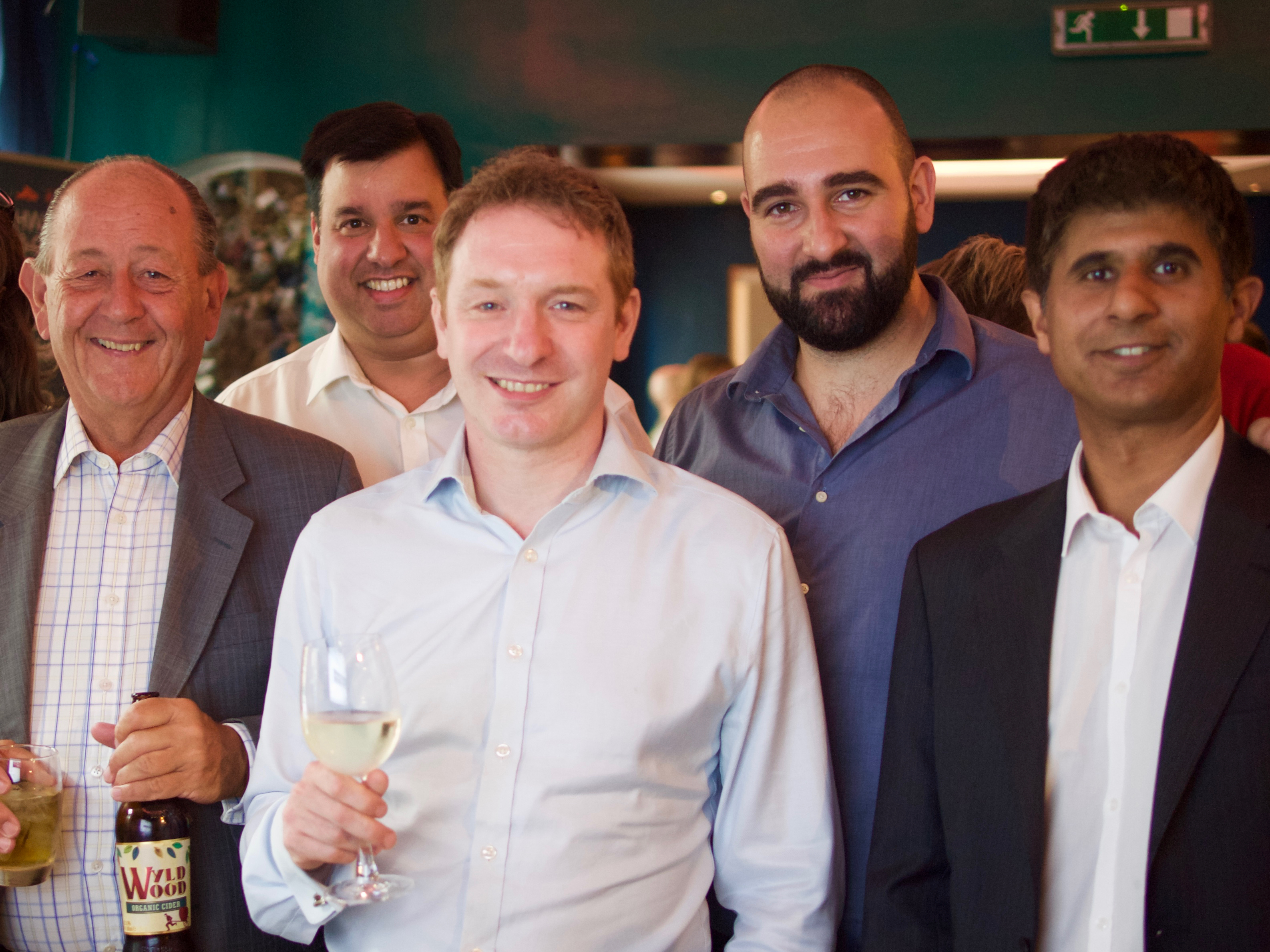
Our sponsors, HW Fisher (from left to right): Barry Kernon, Andrew Subramaniam, Andy Levett, Chris Pitsillides and Ajay Jassal.
Prior to the pitching itself, the panel spent some time discussing whether there was one "special" ingredient to a successful investment. Paul revealed that he likes to be able to “look the founder in the eye” and assess whether they’re “the sort of person who’ll give you a run for your money”. Or, to put it another way, an excellent CEO can make an average business idea successful, but it doesn’t tend to work the other way round. Mary stressed that an entrepreneur must know exactly what they want from their business—do they crave global dominance, for instance, or aim to remain local?—and added that, at the end of the day, quality of service and product will always win out.
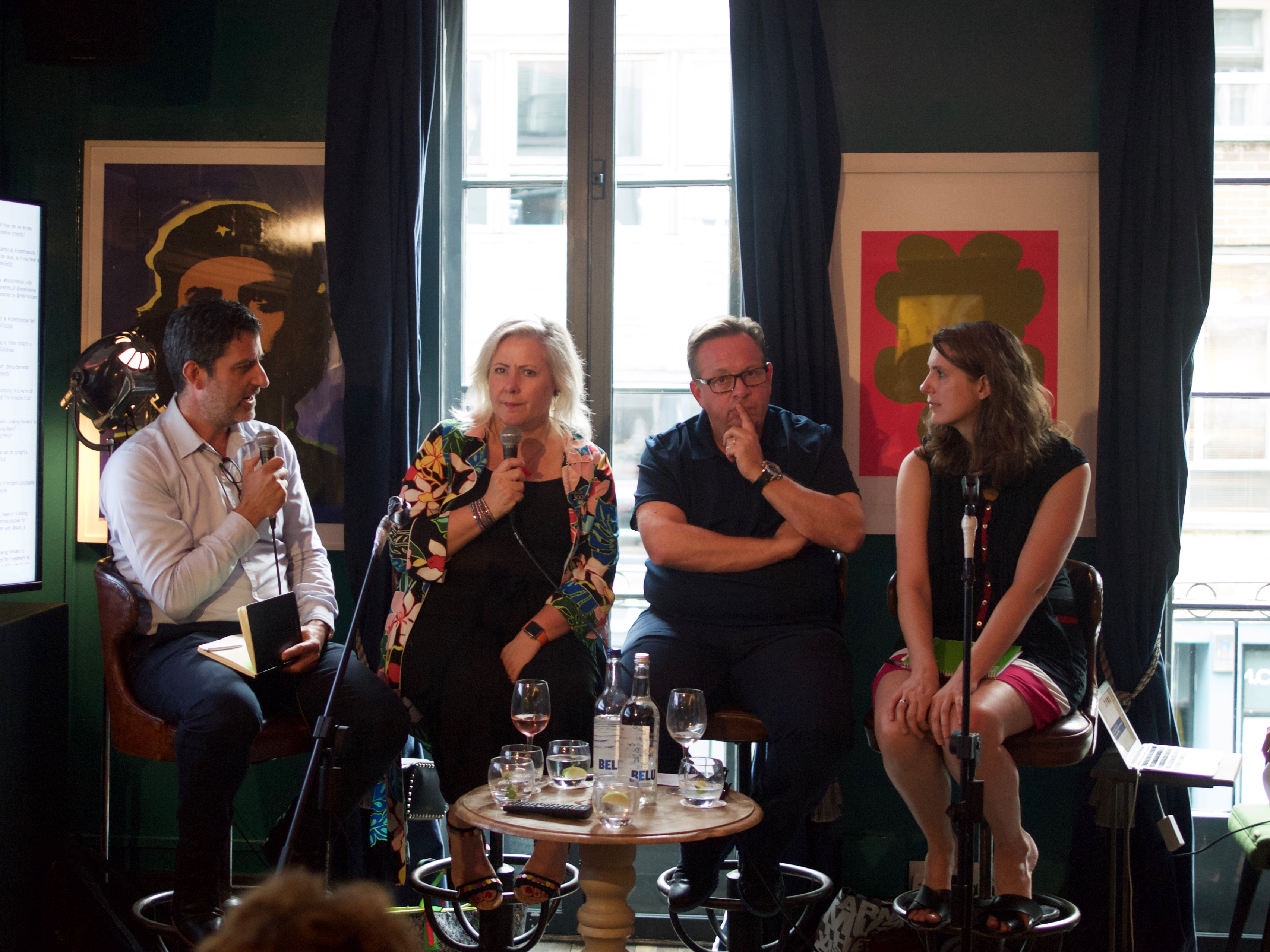
Our panel of judges (from left to right): Paul Freedman (Chair), Mary Keane Dawson, Graham Goodkind and Emma Langley.
Having a strong team is important, said Graham, as is a robust strategy, a novel concept and a first-mover advantage, but these elements often pale in comparison to a far more cryptic one: timing. He explained that he’s seen many brilliant ideas fall by the wayside because they simply arrived too early (Facebook being a golden example of a business that landed at exactly the right time), and concluded that “winners get their timing spot on”. Finally, Emma came at the question from an Arts Council standpoint, revealing that while cultural and social impact is obviously of huge importance to her when considering pitches, it’s a myth that the Arts Council have no interest in commercial potential. “Even not-for-profits need to make money,” she said.
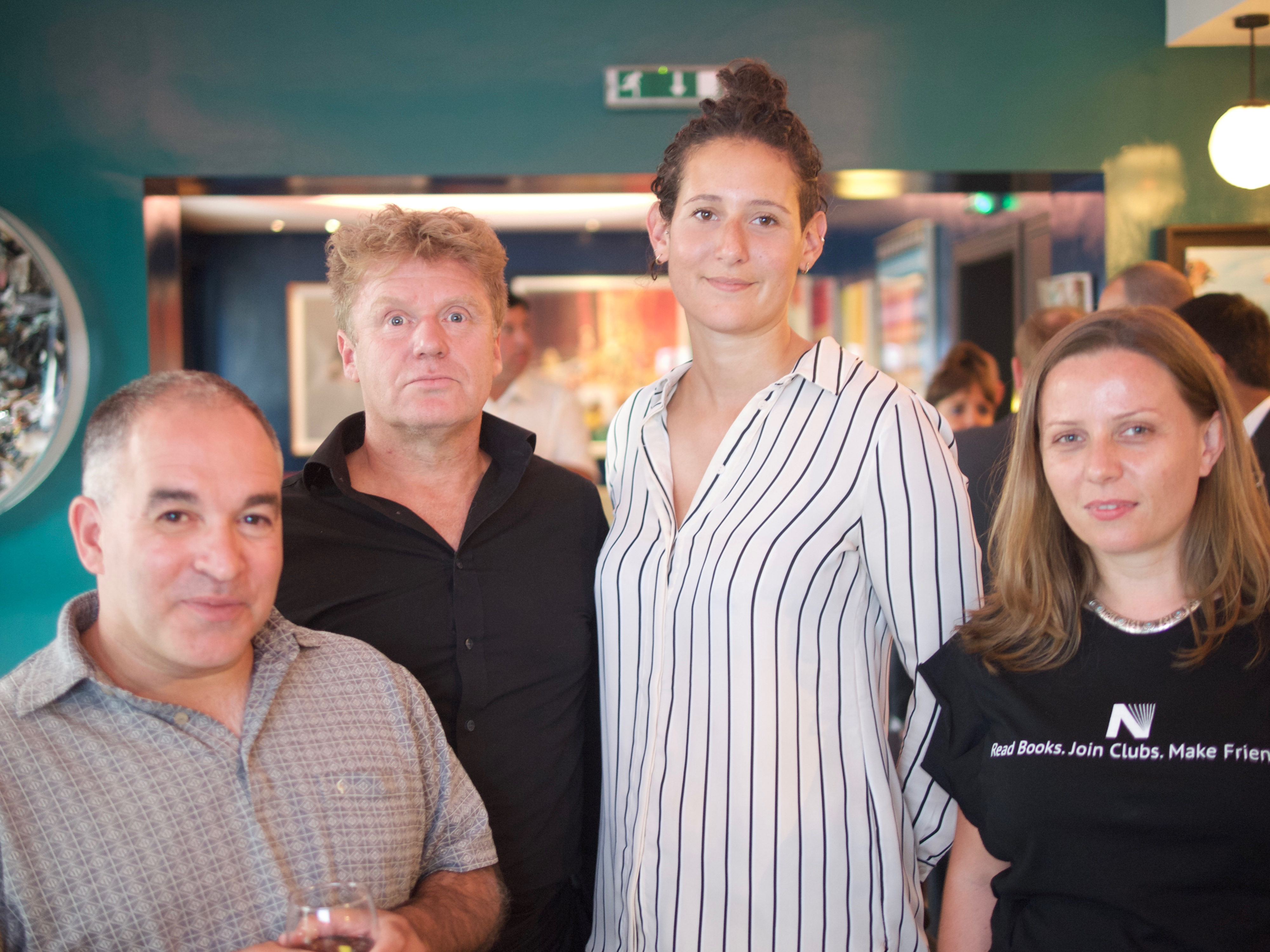
Our brave pitchers (from left to right): Neil Marcus, Daniel Morrell, Jacquelyn Guderley and Candide Kirk.
The floor then opened to the pitching entrepreneurs, who each had five minutes to present their ideas. Daniel Morrell began proceedings by introducing Chant Music, an app-based tech initiative which allows users to contribute to the “chants” of their favourite artists, and in doing so help fund pro-social initiatives around the world. Next up was Jacquelyn Guderley, pitching her literary magazine for emerging female writers, Salomé. The magazine is different from its competitors in three important ways, she explained. Firstly, it’s the only magazine of its kind to exist in both digital and print; secondly, the editorial team offer a full page of feedback on all submissions (accepted or otherwise); and thirdly, they pay all their writers (“Not even the Guardian do that!” noted Jacquelyn).
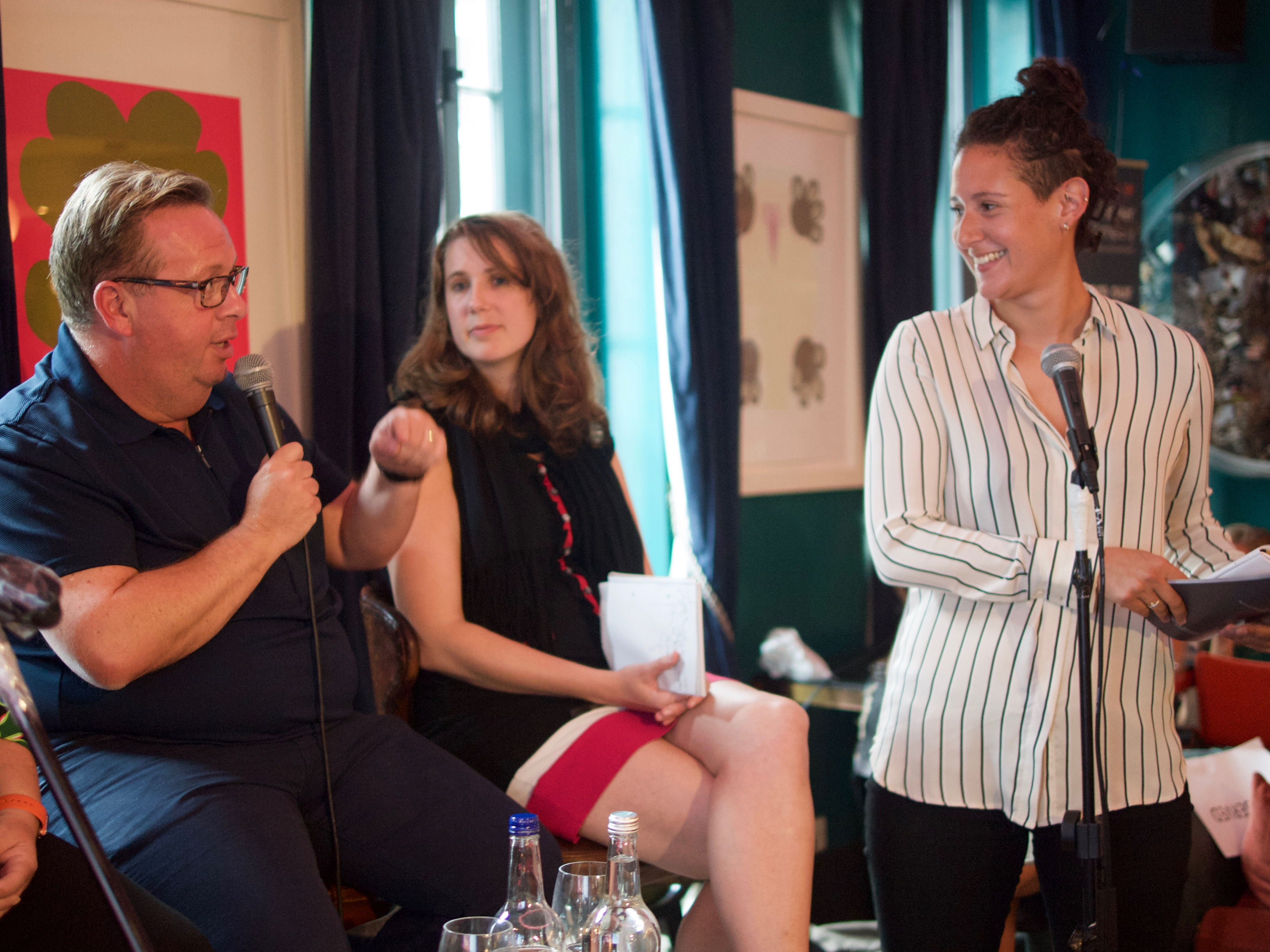
Jacquelyn pitching Salomé.
Candide Kirk then pitched her innovative app Novellic, a digital platform that helps people discover, create, join and manage book clubs. The app, which is currently experiencing month-on-month user growth of 300%, is monetised through affiliate book sales and live events, as well as by working directly with publishers on analytics and trends, mined from Novellic’s user data. Finally, the convivial Neil Marcus presented his entertainment business, The Stable, which is essentially a collective of experienced theatre professionals working on a wide portfolio of new musicals for regional touring. Musicals, which have recently become “cool” again, are notoriously difficult to make money from (around 70% of shows fail to break even), but the portfolio nature of The Stable spreads the risk, greatly increasing the likelihood of investor profits.
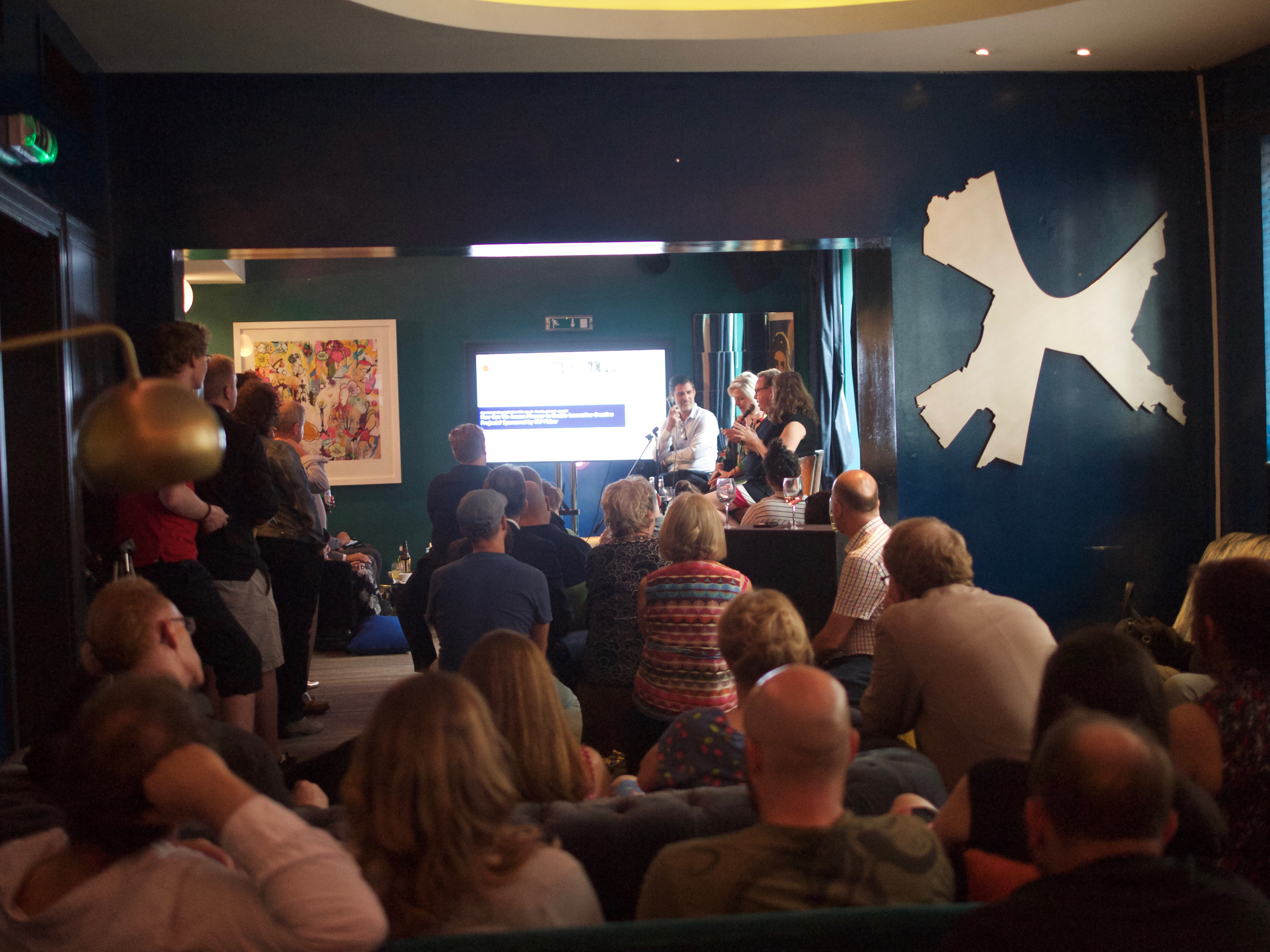
Our eager audience in the Soho Room at the Groucho.
All four pitches attracted praise from the panel. Paul said that, were he investing for real, he’d pick The Stable, which in his eyes had the clearest route to return. Mary chose Salomé, which she felt benefitted from a real opportunity of scale. Emma, who again came at things from an Arts Council perspective, praised Novellic, as she saw in it the potential for huge public benefit. Finally, Graham highlighted the fact that different businesses offered different benefits—for an impact investment that “makes a difference”, he would favour Salomé or Chant Music, but he felt that The Stable offered the highest chance of return.
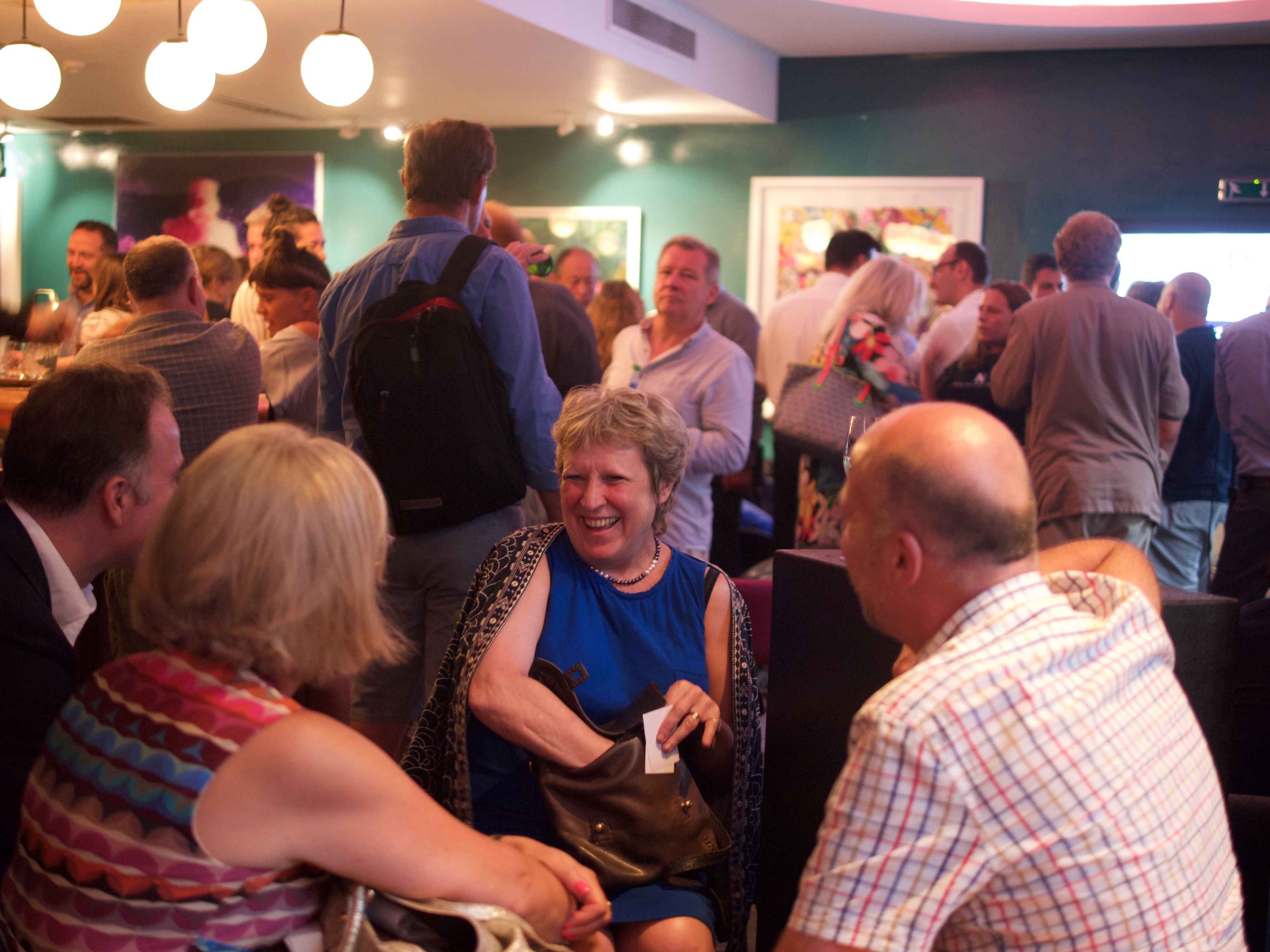
And, of course, there's always time for networking at Byte the Book.
A definite highlight of the night was when Neil Marcus was asked why he was restricting himself to musicals, and he replied, quite simply: “It’s my passion.” Because if there’s one thing a new business needs, it’s passion by the truck-load.
If you enjoyed this report and want to keep up with the latest happenings in publishing as well as network with publishers and authors alike keep yourself posted by visiting our events page here. You can join us from £30 a quarter here
More photos can be found on our Facebook Page
Ambient Literature explain their project to Byte the Book and call out for London based volunteers
Over the next 6 months, the Ambient Literature project will be publicly releasing three new works of smartphone-based literature and we’d like your help in evaluating the works and telling us something about how they are received.
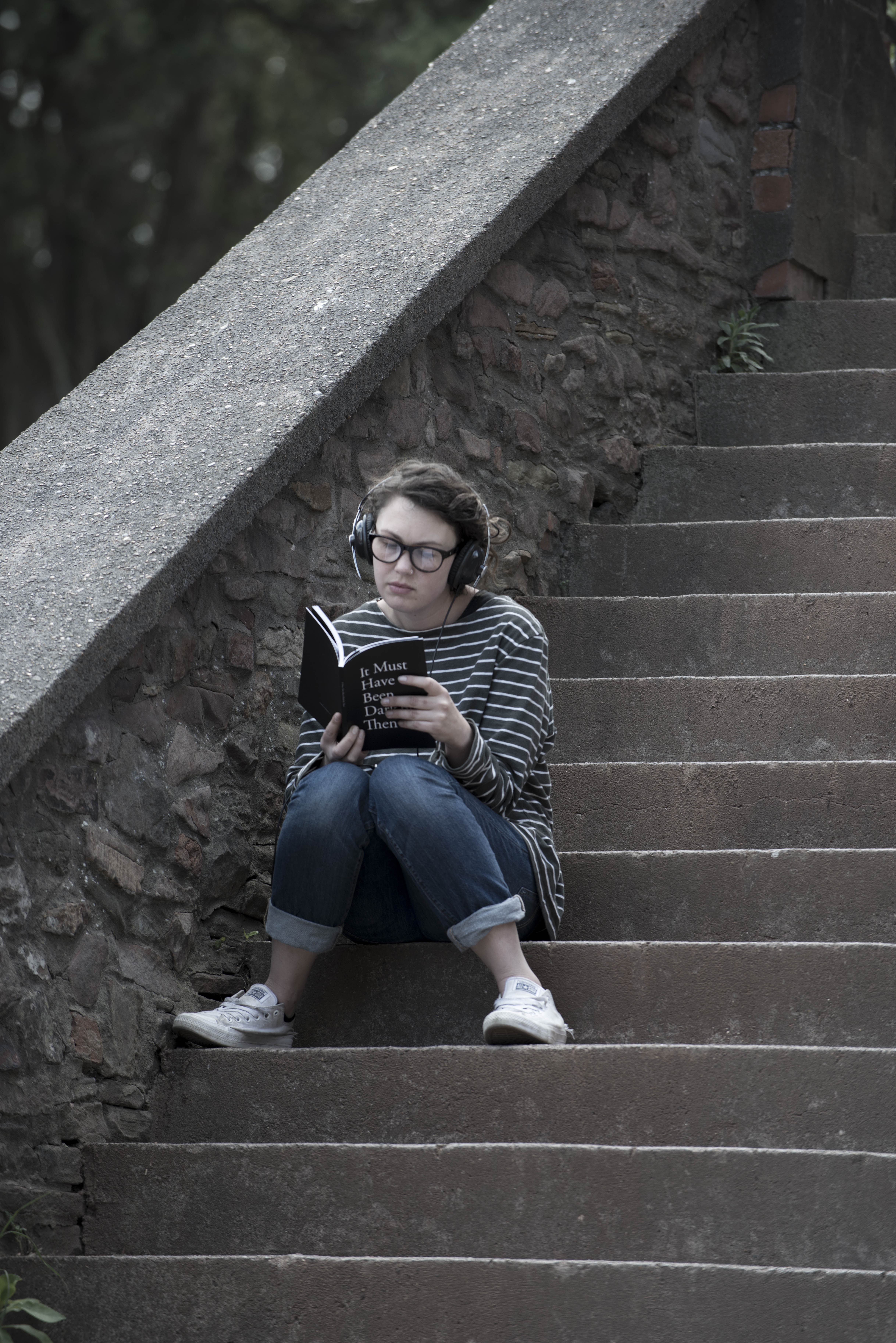 Ambient Literature is exploring the way in which literature is changing as we come to be surrounded with digital devices and the flood of information that accompanies them. A two year partnership between UWE Bristol, Bath Spa University and the University of Birmingham, the project is designed to explore the locational and technological future of the book and address how literature can play a role in navigating our contemporary culture of information. The ubiquity of smartphones presents an opportunity for writers and publishers to think about how the affordances of these new technologies can impact how stories are told and received. More than just a conduit for content delivery, smartphones offer the opportunity to open up books and literature to new ways of engaging readers. Working with technologies that are able to understand the context of readers—where they are, what’s going on around them, what they are doing—it becomes possible for authors to create works which respond to the situations in which they are read. What if the world all around you could be the stage for a story?
Centred around the commissioning of three original works of literature from three different authors—Duncan Speakman, James Attlee, and Kate Pullinger—the Ambient Literature project is creating and studying new works of digital literature that are contextually situated, and respond to the reader as a participant of sorts. We’re excited to have just released the first of our commissions, Duncan Speakman’s It Must Have Been Dark By Then (you can still book your place to experience it at the British Library, where it is running through to the 8th of July). In September we’ll be releasing a brand new work by James Attlee, followed by work by Kate Pullinger in November. As a form of practice-based research, by working with writers we’re exploring how these new forms of literature function and what they say about the future of reading and the book.
We’re currently looking for London based volunteers to participate in a study about the reception of new forms of electronic literature. You’ll be asked to experience each work on your own schedule and tell us what you think. If you’re interested in taking part in our research, complete this form and we’ll be in touch about how to help us shape the future of literature.
Funded through a grant from the Arts and Humanities Research Council, the Ambient Literature project focuses on developing emergent forms of literary practice that allow authors to create compelling, contextually driven experiences for readers.
Rebekah Lattin-Rawstrone reviews When Your Life Depends On It co-written by Byte the Book member, Brad Borkan and David Hirzel.
Antarctic exploration of the early 1900s, before radio communications and technical modern equipment, has been deemed the heroic age. Explorers like Scott, Shackleton, Amundsen and Mawson faced an extreme and isolated environment. Their decision making abilities, and those of their teams, were pivotal; life depended upon the choices they made.
Brad Borkan and David Hirzel use these decisions and the lessons learned from them, to provide inspiration for modern decision-making and leadership both personally and professionally.
In some ways, it sounds like a strange idea. How can such a wonderfully bleak, cold environment offer any parity with the world of today? But the stories of these expeditions are not only riveting and well-told, they contain the key strategies needed for all decision making.
In the end When Your Life Depends On It gives you exciting tales of adventure alongside a healthy dose of advice about how to prepare for and achieve your own goals. Alongside having a clear purpose, one of the central strategies is flexibility: if something goes wrong and your original goal can no longer be achieved, what else can you achieve in the circumstances?
I really enjoyed the book. Though it won’t be for everyone - not everyone likes to imagine they are stuck down an ice crevice with only a rope to help them, or facing a solo 35 mile hike with Antarctic winds, no tent and only three biscuits to sustain them - if you like exploration and adventure and you want to revisit your decision making process, this is the perfect book for you. It includes a foreword by noted Antarctic historian, Dr. David M. Wilson and a list of recommended reading if you catch the Antarctic history bug, which you probably will once the book has asked you to imagine yourself stepping onto the frozen tundras of the Antarctic, moving simply to keep your clothes from freezing.
You can find out more about ordering the book through Amazon and other retailers here.
Words by Chris Russell,photos by Katrina Hopewell.
On a sweltering midsummer’s evening, the panel at June’s Byte the Book sought to answer one perennial question: does self-publishing represent opportunity, or vanity? Type & Tell’s Jon Watt chaired the event, which pit indie-publishing sensation Joanna Penn against literary agent Euan Thorneycroft, of AM Heath.

Our panel from left to right: Euan Thorneycroft, Joanna Penn and Jon Watt (chair) of Type & Tell who were our sponsors for the night.
Under the name JF Penn, Joanna has published multiple NYT and USA Today bestsellers, racking up over half a million sales across 83 countries. Ditching an unfulfilling job in the corporate sector back in 2006, she navigated the choppy waters of self-publishing for a few years before striking gold when the Kindle finally went international in 2011. Describing herself as an “independent author” rather than a self-published one - “self-publishing” implies a one-woman show, she explained, whereas she employs a whole team of experts - she has since written 23 books and built a hugely profitable business over which she has complete control. She admitted that, when she started out, there was a tangible conflict between traditional and self-publishing, but that has largely evaporated. “Self-publishers used to be quite combative,” she explained, “mainly due to being new to the industry, and a little insecure … but that’s all changed. It’s an ecosystem now, with all sorts of creatives putting their work out there in different ways.”

The panel in full flow. It was the perfect weather for a hot debate.
Euan agreed, reminding the audience that, when the Kindle first landed, sensationalists were desperate to declare the “death” of the traditional industry at the hands of self-publishing. But that hasn’t happened. In fact, he added, digital sales have recently plateaued for most publishers, which may suggest that eBooks have reached their zenith. Joanna countered this, however, pointing out that while this may be true for the “digitally mature” markets (USA, UK, Canada and Australia), it is not the case for emerging markets such as the Middle East and India, where the vast majority of people read on their phones. “Every year,” she said, “my traffic from outside the USA and UK goes up. Fifteen per cent of my podcast listeners, for instance, live in China.”

Our audience enjoying some serious discussion.
Perhaps the most important takeaway of the evening was this: writers finally have the freedom to forge their own path through the industry, whether that’s through publishing independently, traditionally or via a hybrid of the two. Not all genres lend themselves to self-publishing, explained Euan, pointing out that while crime, thrillers and romance thrive online, literary fiction struggles. Joanna agreed wholeheartedly. “I love business,” she declared, “but not all writers do. If you don’t want to spend your afternoons poring over data, you probably shouldn’t be publishing independently.” Most importantly, she said, writers must define what success means to them. “If you don’t decide what your definition of success is,” she concluded, “you will never be successful.”

Byte the Book always has time for networking; here's Justine at the centre of the hub.
As for the question of whether or not self-publishing could still be described as “vanity” in the modern era, both panellists had interesting takes. “Nobody uses the term ‘vanity publishing’ anymore,” said Euan, “it’s outdated.” Joanna, meanwhile, turned the entire argument on its head. “Independent authors just want lots of people around the world reading our work. We don’t really care whether our books are on the shelf in Waterstones. Isn’t it more vain to want a Penguin logo on your spine?” Now there’s an interesting topic for tomorrow’s water-cooler…
This event was sponsored by Type and Tell. The Type and Tell platform enables authors to create, publish, print and sell high-quality books, providing them with 100% author royalties, professional care and global distribution. You can read more about Jon Appleton's experience self publishing with Type and Tell here. If you have any questions about their service please take a look at their site or get in touch with their country Manager Jon Watt, his details are in our Hub here.
If you enjoyed this report and want to keep up with the latest happenings in publishing as well as network with publishers and authors alike keep yourself posted by visiting our events page here. You can join us from £30 a quarter here
More photos can be found on our Facebook Page
Byte the Book member Nicole Johnston is a Freelance Communications, Policy and Writing Consultant. Here she offers authors some tips on how to get their message through the digital ‘noise’.
We live in exciting times. Never before has there been such a lot of opportunities to communicate with so many. The digital technology revolution that’s occurred over recent decades has been astounding. Perhaps most relevant to authors is social media and its capacity to connect huge numbers of people, to cross geographical and even cultural boundaries and to permit the sharing of information and content almost instantaneously. This is all literally at our fingertips.
However, with every silver lining there can be a cloud. The potential cloud for those of us trying to take advantage of this massive increase in the capacity to communicate is to wade through the scams, spam and rubbish in mega quantities existing alongside the gems. Those we want to communicate with face the same challenges.
Five tips for authors:
- Target your audience. Unless you have specifically decided to go out to the general public this is critical. Identify your audience, the people you want to speak to, and what they will want to hear from you. None of your connections want to be copied into your general marketing posts.
- Be clear and consistent. Nobody appreciates long, rambling marketing pieces. Tell them what they want to know clearly and consistently. Then get to the bit where you tell them what you’d like them to do. Some call it a call to action. If you want your audience to read it – say that! If you want them to buy it – say that. If you want them to represent it – say that!
- Use simple language. The last decade has seen a strong push for simple English for good reasons. You have about eight seconds to capture their interest. They are not going to spend time trying to decipher what you are trying to say. Your use of language might be terribly clever but none of us want our readers to feel stupid.
- Make it real. This is where authors have the advantage. We know people want stories they can relate to or that resonate with them. Make it professional and slick if that’s the image you are trying to portray but humanise it. A simple way to do this is to discuss your motivations for the piece you are sending out. It often connects you with your readers in a way that facts and figures won’t. A health warning here - don’t make it up! With so much rubbish out there in the ether, people can see ‘fake’ from a mile off and it will instantly put them off.
- Make it stand out. Are you funny? Have you had unusual experiences or a unique upbringing? If it’s appropriate to use, it could help you catch your readers’ attention. Controversy works as well however not everyone agrees that all publicity is good publicity. You don’t want to do damage to your reputation or brand.
If you want some help making this happen a communications person will be able to help.
For more information on Nicole or to contact her direct, have a look at her Byte the Book Hub entry here.
Writer friends and Byte the Book members Emily Midorikawa and Emma Claire Sweeney are the authors of A Secret Sisterhood: The hidden friendships of Austen, Brontë, Eliot and Woolf published by Aurum Press in the UK and Houghton Mifflin Harcourt in the USA, out 1st June. This is their first non-fiction project and their article shares with us their journey through the non-fiction book proposal process.
Back in 2014, when we launched our literary website, SomethingRhymed.com, we wanted to uncover female writer friends of the past and we set ourselves a target to publish a blog post about one pair each month.
We had assumed that this would prove a challenge since very little had been written about these relationships. We knew all about Byron and Shelley, Hemingway and Fitzgerald but struggled to name the female writers to whom Austen and Eliot had turned for support.
But, with help from the suggestions of our readers, we came across so many fascinating stories of female solidarity that we have kept the site going all these years. The more we became interested in some of these friendships the deeper we delved, and readers of SomethingRhymed.com encouraged us that our discoveries warranted exploration in a full-length book.
Having experienced the long gestation period from initial idea to publication of a novel, we were attracted to the idea of selling a non-fiction book on just sample chapters and proposal.
But the process of writing the proposal proved far more arduous than we had predicted. On the last count it had gone through 25 drafts. This is perhaps unsurprising, since we had never read a book proposal until we found ourselves needing to write one.
Our first port of call was writer friends who’d already been commissioned to write non-fiction books. They kindly sent us copies of their successful proposals, and our agents also showed us some comparable examples. The vast differences leapt out at us, so we ended up picking and choosing the elements that would work best for our project.
Our proposal for A Secret Sisterhood: The hidden friendships of Austen, Brontë, Eliot and Woolf ended up comprising the following sections, which we hope might prove a useful guide for those of you considering a non-fiction proposal:
Synopsis
500 words in which we summarised the idea for the book.
List of Contents
Including hyperlinked page numbers for the convenience of editors.
Chapter plan
- A paragraph that outlines the book’s projected word count, along with a breakdown of the chapter lengths
- The working title of each chapter
- A one line italicized summary of each chapter’s contents, making it sound as marketable as possible
- A 300-word account of the expected contents of each chapter
- We included photographs throughout, which proved a good starting point when our editor asked us for images to include in the plate section.
Sample Chapter(s)
For UK submissions we included one full sample chapter but for the US we were advised to include at least two.
Why Now?
We included 500 words on why the time was ripe for a book on this subject. We had a lot to talk about since Jane Austen, the Brontë sisters, George Eliot and Virginia Woolf all had anniversaries coming up. But this section may well be shorter in other proposals.
Competition and Market
250 words on the market we saw for this book and what made it similar and different from other books on the subject.
Comparable Titles
We spent a lot of time thinking about this since it would affect how the book was positioned. We didn’t want it to be mistaken for an academic book when we wanted to write accessible yet well-researched mass-market non-fiction. Top tip: ask your agent to look up the Nielsen book sales figures for your proposed comparable titles. We were surprised to find that books we’d seen everywhere hadn’t always done so well, and there was also a marked contrast in the US and UK markets.
Sources
A paragraph or two on where you will find the materials to complete your book. We had only conducted the secondary research in advance of submitting the proposal, but we already knew that the original research would take us to several county records offices and museums across the country, and that we would need to visit archives in the USA.
Delivery
Think carefully about this. The date we came up with was exactly the date on which we had to deliver the manuscript and there was absolutely no wriggle room.
Publicity Ideas
Time put into this section will save time later. The five main ideas we came up with here are all things we are now doing to promote the book.
Why Us?
A couple of paragraphs about why we were best placed to write this book.
Biographies
About 150 words on each of us, highlighting our most significant writing achievements and our relevant experience as academic researchers and bloggers.
Between the two of us, our agents and their assistants, a lot of people had input into the document before it went out on submission. But publishers turned out not to be keen on our original idea to include fourteen pairs of writer friends with one chapter devoted to each. Editors complained that some of the writers weren't sufficiently well known.
We began to wonder whether all of the work we had ploughed into the proposal had been worth the effort. But we chivvied each other on, and returned to the proposal, this time including only four celebrated writers and their literary friends. Three chapters would be dedicated to each pair, allowing for greater depth.
We look back and feel so thankful that we went for depth over breadth. And yet we also feel regretful that we weren't able to shine a light on some of the neglected writers we'd included in the original proposal - especially writers of colour and writers with disabilities. In the process of attempting to publish the silenced stories of female literary friendships, some stories remain untold. We can only hope that soon the industry will lend an ear.
Have a look at their Byte the Book Hub entries to find out more about Emma and Emily. You can also read our review of A Secret Sisterhood here and you can buy the book here. We’ve also reviewed Emma Claire Sweeney’s Owl Song At Dawn. Do have a look here.
'Film the House', one of whose many sponsors are the wonderful ALCS, call for submissions for their Short Film and Script Competition.
The Competition
We’d like to invite student and independent filmmakers from across the UK to take part in this parliamentary based competition, which aims to further advance creativity in the UK and to raise awareness about the importance of Intellectual Property among parliamentarians and those in the creative industries.
The competition is open to student and independent filmmakers and script writers of all ages.
How to Enter
To enter your film or script and for the terms and conditions please visit:
Entries must be received by 31 July 2017
Competition entries will be initially judged by your local MP and then submitted to a national industry judging panel of experts for the final decision.
Shortlisted entrants will be invited to a winners' event at the House of Commons in October 2017, where they’ll be given the opportunity to meet key industry representatives and, for successful entrants, the prizes will range from equipment to professional advice and work experience, to a screening of the winning film.
The Categories
There are two categories:
- 1 Best short film
- 2 Best script
Copyright for Creators
The creative industries are one of the United Kingdom’s success stories and have consistently outpaced growth of the UK economy as a whole. It is essential that creators know their rights and that parliamentarians can knowledgably consider them when debating any new legislation that impacts intellectual property and the rights of creators.
The UK film industry generated revenues in excess of £4.1 billion in 2015, the second largest market of its kind in the world.
Film the House is a parliamentary film competition sponsored by Lord Clement-Jones, Nigel Adams MP and Kevin Barron MP.
Film the House is supported by: 21st Century Fox; ALCS; BBFC; BFI; BSAC; Industry; Trust; Into Film; Luther Pendragon; NBC Universal; The Motion Picture Association; Warner Bros. Entertainment; Sky; Viacom; Visual Data Ltd; Writers’ Guild of Great Britain
Children's author, publisher and Byte the Book member Heather Maisner takes us through her journey into self-publishing.
I am a children’s author with over 35 books, published by various publishers including Walker Books, OUP, MacMillan and Hachette, translated and sold around the world. I became author/publisher a few years ago, after I met Kate Barnard, Consultant in Paediatric Dentistry at Chelsea & Westminster Hospital.
Kate told me that almost one-third of five year olds and half of eight year olds have fillings or missing teeth caused by decay, and the most common cause of hospital admission in primary school children each year is dental decay and infection; 26,000 children aged five-nine needed emergency dental surgery last year.
Kate wanted an inexpensive book that would make children realize the importance of brushing their teeth, available to as many children and parents as possible, including people on low income and those who didn’t go into bookshops.
So I wrote Dinosaur Douglas and the Beastly Bugs, a fun, rhyming story, illustrated by artist, street painter and first-time illustrator Alex Godwin.
Why did I choose to self-publish this book?
Having worked in publishing as editor and commissioning editor of children’s and adult books, I was aware that no publisher would commission a book about teeth, written in rhyme, with an unknown illustrator. Most picture books are beautifully produced hardbacks with international appeal; they become paperbacks once they have proved to sell well as hardbacks.
Publishers usually send picture books abroad for printing because it’s less expensive. I wanted to keep the project local. A friendly Hammersmith printer advised me on format, paper quality, spine, cover and print-run, keeping costs to a minimum.
With the aim of getting the book into all local nurseries and reception classes, I approached local businesses for sponsorship. A dentist, chemist, architect, hardware store and others were interested. An estate agent challenged me, “If you are doing this for the local community, why isn’t the council backing you?”
I had already approached the council, without success. Now I had one more try. My proposal bounced from one councillor’s office to another and finally landed on the Senior Public Health Officer’s desk – and I received a phone call.
After several months of negotiation, Hammersmith & Fulham council purchased over 5,500 copies of Dinosaur Douglas and the Beastly Bugs to give to children across the borough. Doncaster City Council is now adding 3,500 copies to their oral health packs.
Marketing has been the most demanding and costly area of self-publishing. I spent too much time and money hiring stands at Childcare Expo, Nursery World Show, the Ideal Home and dental conferences. I visited schools, libraries, bookshops, exhibitions; and the Bologna Children’s Book Fair in search of foreign co-publishers. Distribution has been similarly demanding.
A traditional publishing house takes care of these areas for its authors, although a new book has to compete for time and budget with all titles on the publisher’s list.
Has self-publishing been worth it?
Financially, no: marketing and distribution on a small scale is expensive and time-consuming. Amazon and Gardeners take 60% of the RRP, while the P&P still has to be paid. But in terms of satisfaction, definitely yes.
A traditional publishing house sends out annual royalty statements but authors have no idea who is reading their books. To date, over 10,000 copies of Dinosaur Douglas Books have been sold, and I have a growing database of readers.
There are now three Dinosaur Douglas health-related books, and a fourth will be published this year. The books have been reviewed in The Sun, The Mail on Sunday, Baby London, Teach Early Years and other journals. Last month a review in The British Dental Journal stated :
“Dinosaur Douglas and the Beastly Bugs is definitely the best children's book we have read about the importance of brushing your teeth.”
This year Dinosaur Douglas is a finalist in the Early Years Excellence Awards.
Self-publishing has introduced me to a whole new way of life and a host of inspirational people through networking events, such as Byte the Book.
As an author, I still find time to write but there is also the excited feeling of anticipation each day as I switch on the computer and, hopefully, discover a new sale or a review. You can’t beat that feeling.
You can read more about Heather on our Hub and you buy any of the Dinosaur Douglas books on the Dinosaur Douglas website. Heather Maisner’s latest book is 20th Century Russia: Century of Upheaval, published by Franklin Watts/Hachette, to tie in with the centenary of the Russian Revolution.
Byte the Book members, Emily Midorikawa and Emma Claire Sweeney have been interested in literary female friendship for some time. Not believing that the famous male literary friendships, like Coleridge and Wordsworth or F. Scott Fitzgerald and Ernest Hemingway, had no female counterparts, A Secret Sisterhood is the culmination of a journey begun in 2014 with Emily and Emma’s Something Rhymed project which celebrates a whole host of different female author pairings.
The idea of Something Rhymed and A Secret Sisterhood is to unveil and celebrate female literary friendships. A Secret Sisterhood looks at four celebrated writers, Jane Austen, Charlotte Brontë, George Eliot and Virginia Woolf, and uncovers the female literary friendships that have previously been obscured or misunderstood by biographers. Where letters were destroyed to maintain propriety—as in the case of Austen’s friendship with Anne Sharp, whose lower social standing made her a friend Austen’s family would rather have you forget—Emily and Emma delve into secondary sources to create a picture of these relationships that allows the reader to imagine being in their shoes.
Not only are they providing new avenues of scholarship, Emily and Emma are also keen to recreate the sense of what it was to live in these earlier times of uncomfortable carriage rides and a general belief that women’s creative energies belonged in the domestic sphere and most importantly in childbirth. The image of the female writer as social outcast is one Margaret Atwood speaks of in her introduction to the book, and one which A Secret Sisterhood does much to challenge.
We may think of Austen and Charlotte Brontë as homely creatures, but Austen was happy to talk literature with her niece’s governess and Charlotte Brontë held adventurer and feminist Mary Taylor as one of her dearest friends and critics. It’s hard to imagine George Eliot being sentimental and yet her friendship with Harriet Beecher Stowe, despite various differences of belief, reveals a softer edge to her character. Similarly, the famously barbed and suicidal Virginia Woolf, through her difficult relationship with Katherine Mansfield (which is usually written off as embittered rivalry), is seen to be someone who deeply valued the challenge and inspiration Katherine brought to her work.
A Secret Sisterhood allowed me to walk alongside these famous writers, imagining their thoughts and feelings, sensing the pressure of the cobbles beneath their feet. A Secret Sisterhood is an earnest manifesto for female literary friendship, using the past to remind us that women writers are still fighting to be taken as seriously as their male counterparts and one way to win that fight is to work together.
A Secret Sisterhood is out on 1st June, published by Aurum Press an imprint of The Quarto Group. You can preorder the book here. The US edition, published by Houghton Mifflin Harcourt with a slightly different title (A Secret Sisterhood: The Literary Friendships of Jane Austen, Charlotte Brontë, George Eliot, and Virginia Woolf) will be out on 17 October.
You can look at the Hub entries of Emily and Emma to find out more about them and you can follow their continued journey into female literary friendship at Something Rhymed.