Words by Chris Russell, photos by Nicole Kavanaugh.
The opening Byte The Book of 2016 pitted Justo Hidalgo, co-founder of Spanish start-up 24Symbols, against literary agent Meg Davis in an attempt to throw some light on the contentious topic of subscription services in the publishing industry. The discussion was chaired by Adam Freudenheim, MD of Pushkin Press.
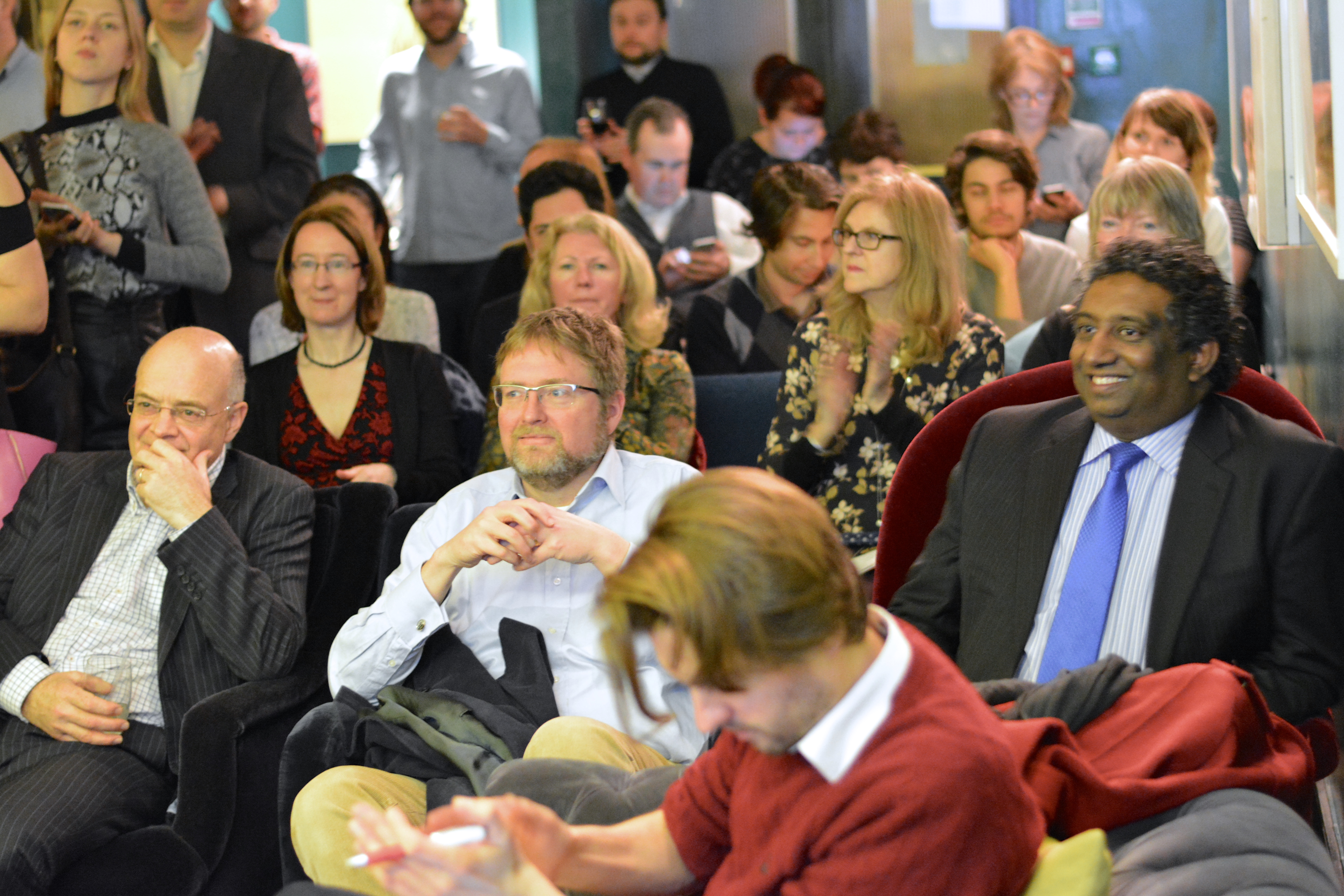
Typefi sponsored our first event of 2016. Our writer-in-residence with pen in hand is in red sitting in front of Typefi and they are from right to left, Chandi Perera, Jason Mitchell and Toby Waller.
24Symbols, a subscription service that enables users to read digital books on the web, has enjoyed steady success since launching in 2011. Once dubbed “Spotify for eBooks”, the company has thrived in its native Spain, while other services, such as Oyster, have fallen by the wayside. Co-founder Justo Hidalgo believes this is partly due to their tendency to look outside of the publishing industry for support and inspiration. “When we’re deciding how to compete,” he explained, “we don’t look at our competitors, such as Amazon. We look at Angry Birds”.
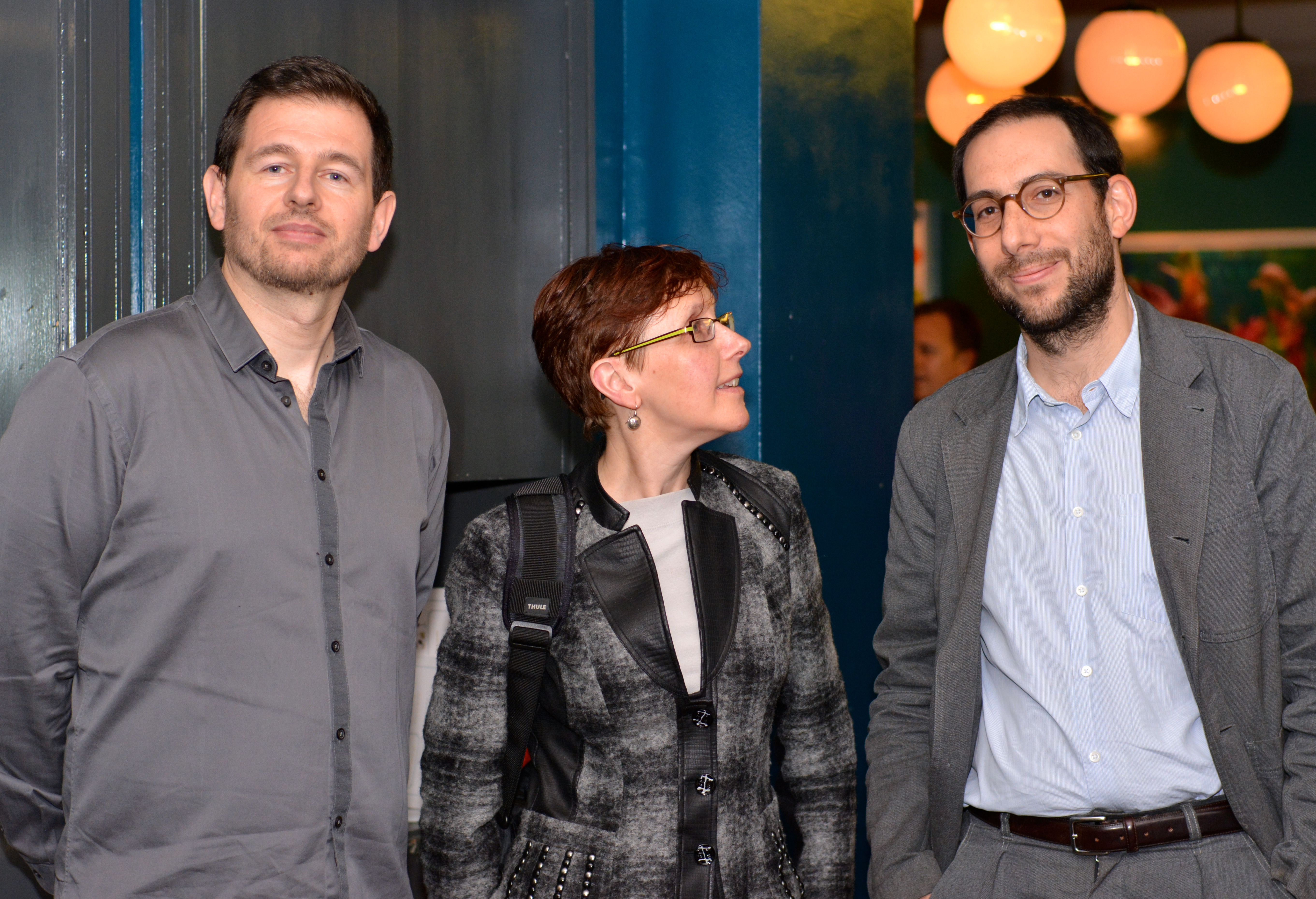
Our speakers from left to right, Justo Hidalgo, Meg Davis and Adam Freudenheim
Literary agent Meg Davis agreed that 24Symbols was a great idea, but was less than optimistic about the impact of subscription services on the industry as a whole. The vast majority of writers, she explained, will lose money, as they generally do when a new right is introduced to the marketplace. She also questioned the scalability of 24Symbols, suggesting that, despite the popularity of Netflix and Spotify, most readers have no idea that subscription services even exist in the publishing world.
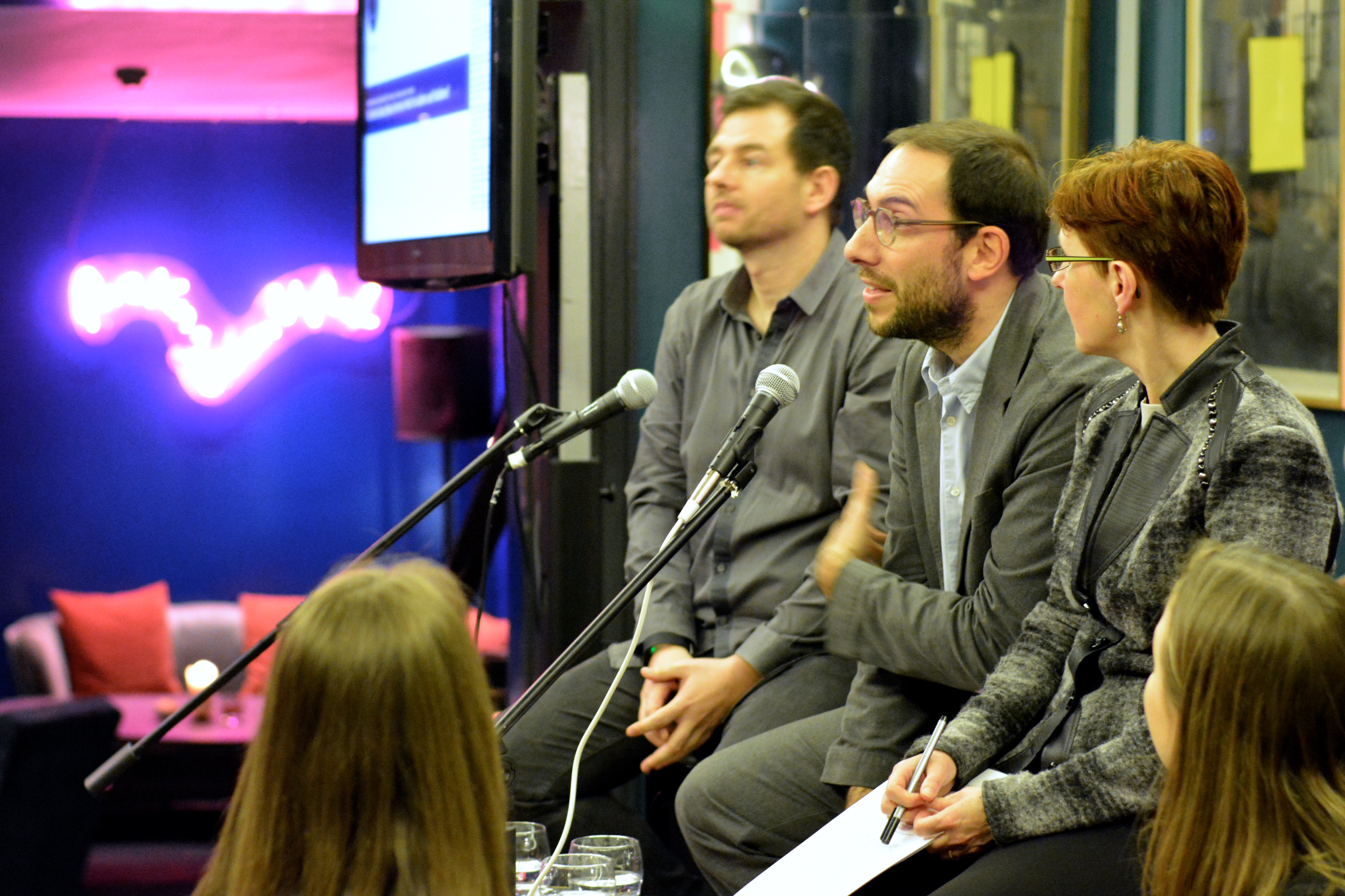
The speakers in full flow in our gorgeous new venue in the Soho Bar at The Groucho Club.
24Symbols, however, are diligent about attracting new customers. They’ve partnered with mobile carriers, who send bulk text messages to their users offering subscription at a discounted rate; similarly, Justo praised a mobile partner in Germany who had taken a promotional bus town to town, recruiting new subscribers in their thousands. Once customers are onboard, 24Symbols gather as much data as they can - which books people read, what time of day they read, how fast they read - and employ a discoverability service to tailor content to their users’ preferences. When you don’t have the funds to offer all the best-selling titles, added Justo, you have to find out which books your audience want, and work from there.
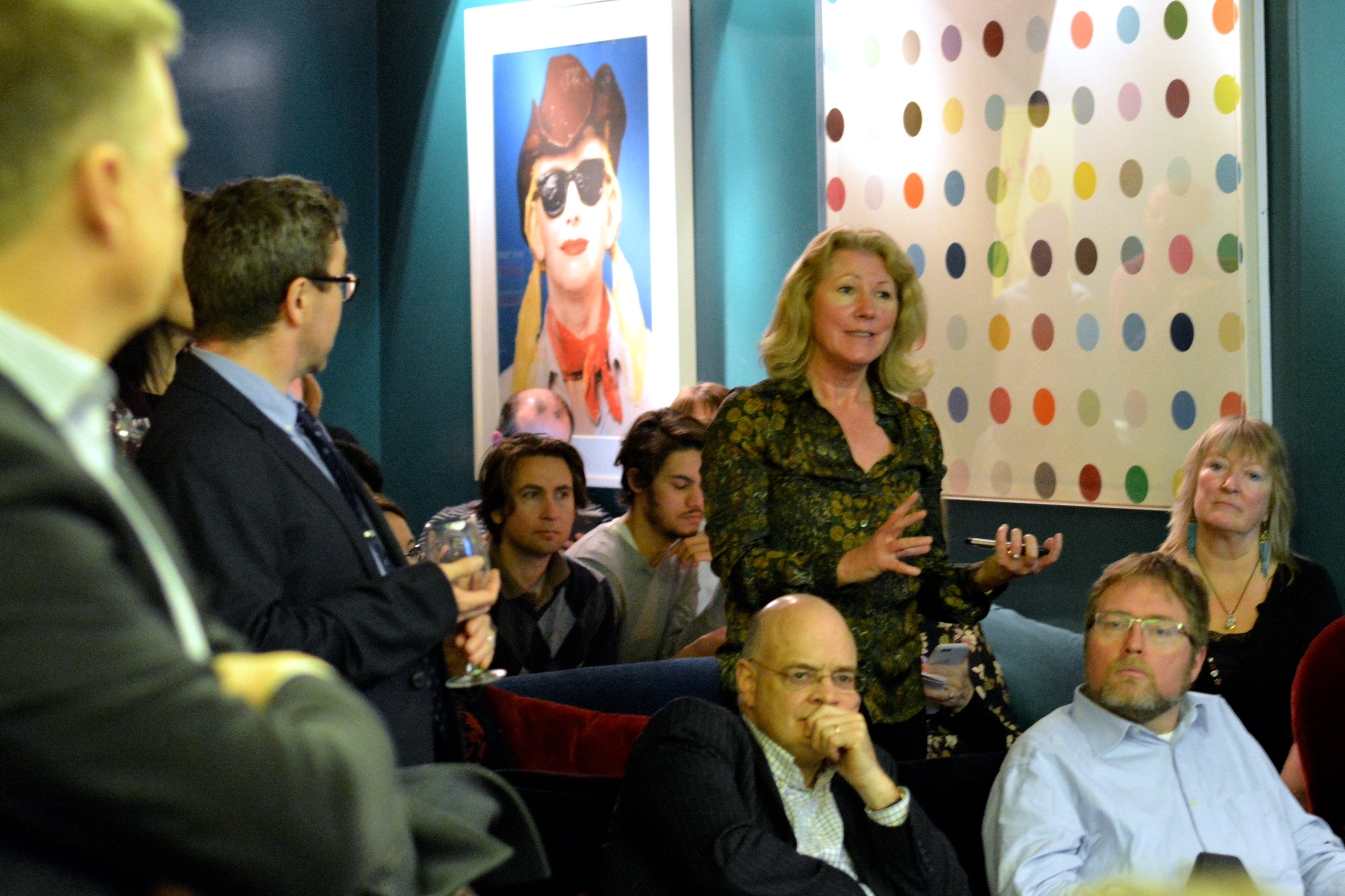
Yvonne Barlow of Hookline Books with her question to the panel.
When questions opened to the floor, one audience member suggested that digital subscription services are simply the contemporary equivalent of book clubs, and it was odd that so many industry players were suspicious of them. But Meg was quick to quash the comparison. “The difference is that book clubs were run on a model that actually worked,” she argued, “and digital has changed all revenue models”. Subscription might be beneficial for the JK Rowlings of this world - who have already taken over the planet - but it will leave mid-list authors scrambling for every penny, if they aren’t already.
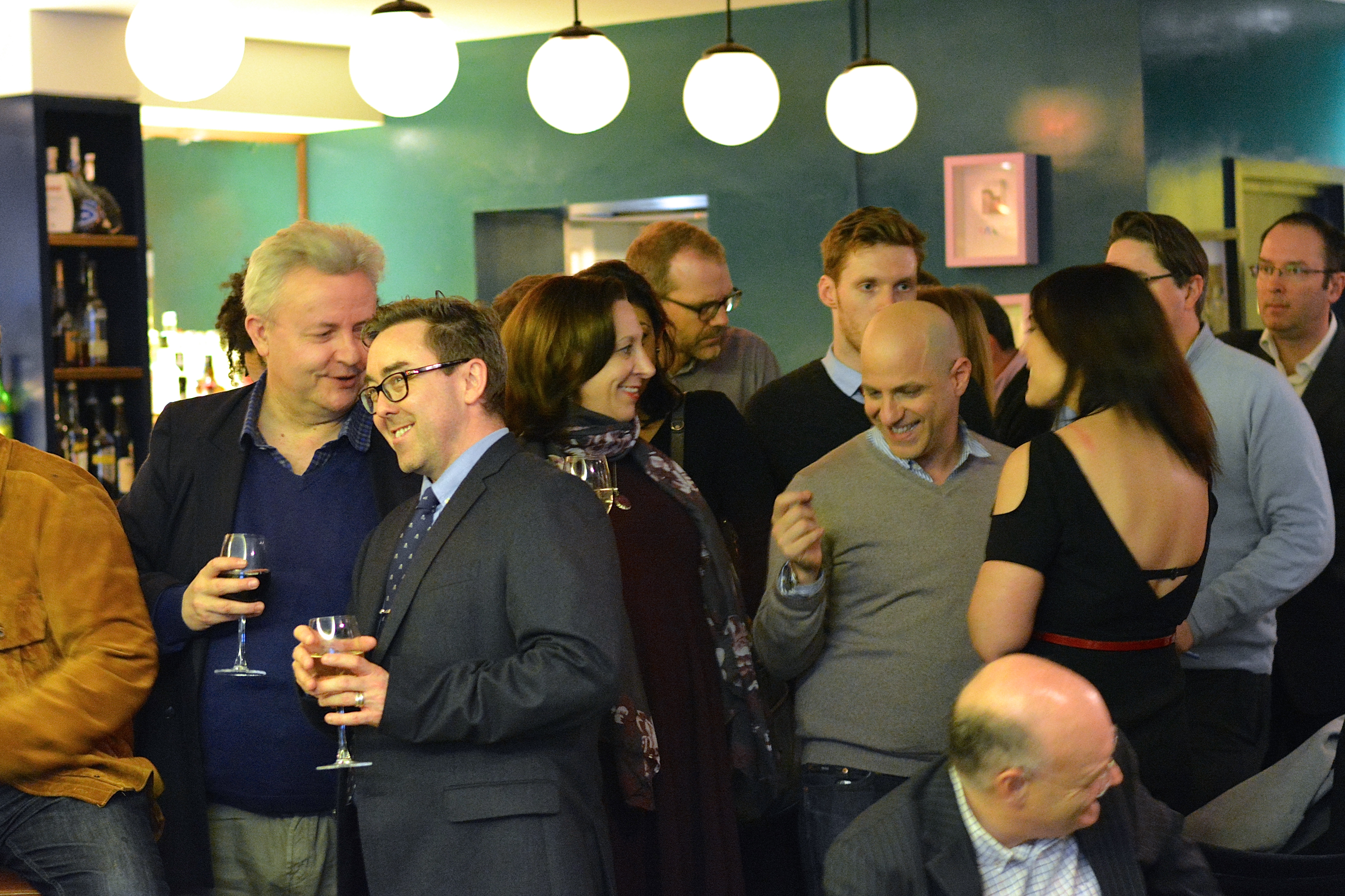
But really Byte the Book is all about the networking.
In response, Justo pointed out that Spotify had been around for six years before it made any kind of dent on the music business. “Industry disruption,” he explained, “takes effort and time”, and 24Symbols, it seems, are playing the long game.
Now that’s a lesson just about everyone in publishing can get on board with.
If you enjoyed this report and want to keep up with the latest happenings in publishing as well as network with publishers and authors alike keep yourself posted by visiting our Events page here. Members of Byte the Book get in free to The Groucho Club events and you can join us for just £75 a year here.
More photos can be found on our Facebook page.
We loved Futurebook this year, we learnt and networked loads. Well done everyone at the Bookseller! Byte Consultancy's Hermione Ireland has written a report on key learnings from the event.
A lively and engaging day at Futurebook last week. Lots of interesting case studies from across the big publishers and the start ups, and lessons crossing over from academic to trade publishers. The author continued to be of main interest to the trade, with the reader coming in a close second – Michael Tamblyn of Kobo gave a very funny ‘manifesto’ about not stalking your reader. And technology has finally become an integral part of the day…… Trending heavily on Twitter as comments were exchanged.
Top takeaways
- Mobile – publishers have got to get better at understanding and servicing this channel. 2016: 70% of the world’s population will have smart phones, now 71% sleep with phones by bed, 3% fall asleep with them in their hands
- Look after your data, and your authors’ and your customers’. New obsession with data - several years behind everyone else arguably.
- Don’t stalk your readers – give them the amount of interaction they want.
- Self-publishing beginning to be respectable as far as the big publishers are concerned.
- Bricks & mortar retail not dead (in the UK – obviously not what Barnes & Noble are saying in the US this week). Faber and HC mentioned Waterstones particularly – premium service.
- Digital – explore the world around the book. It’s not about print versus ebook any more
- Personalisation a big theme – lots of different sorts
- Immersive experiences especially live, or live and mobile
- Rise of audio, and Audible
- Marketing and retail partnerships – even Pottermore are doing these now.
- The Bookseller are finally concentrating at book tech as something they have to look at
Keynotes
Faber – they’re about events and beautiful books. Digital is about building a bridge between their readers and authors. They won one of the Futurebook awards for their Members site.
Pottermore – bizarrely have only recently started analysing their customer base. Has had significant impact as their core audience is 20s and female not child/teen and male/female. They’ve removed gamification and made the interaction more mature – more info about the whole wizarding world. This audience wants mobile content. They’ve obviously felt they needed Apple’s customer base as they’ve finally created enhanced ebooks with Apple having done everything on their own before (‘because they didn’t need anyone else’ – no longer rings true). Also now working with Amazon and Audible.
Akala (pictured) - rapper and poet, social entrepreneur. He doesn’t need a publisher – has 150-200 live events a year and has his own customer base. He asked if publishing was doing everything it could to collaborate with new technology to reach new audiences and better satisfy the existing ones.
Harper Collins - committed to everything published also being released on audio, ideally simultaneously. Focusing on technology and authors – wanting to support start-ups while keeping authors at the centre. Very concerned about the threat of Amazon – thinks their new publishing even damages their existing business. Doing international publishing when they can. Also emails at scale, building communities. Publishing’s rights systems are outmoded – not flexible and wouldn’t have allowed them to do the deal with Judith Kerr on the Mog title with Sainsbury's deal.
Sessions:
Content unbound
- Publishers are doing more research and iterating with digital in a way they’ve never done in print.
- Not easy to build direct to consumer businesses (says This is Your Cookbook). They did lots of focus groups and had to make it easy. TIYC are partnering with the Times and Not on the High Street.
- Build an audience with your content and look at sponsorship as well as subscription as business model
Lessons from academic publishing
- Open Access is gaining momentum. Springer Nature (Mac Ed) down to the university presses are all about collaboration and open access. There is so much content in the system so it’s a great way to publish it. But lots of differences in the market.
- The customer is at the centre, not a cliche - different relationship tier as their authors/researchers are also their customers. Like Blurb….
- Sage are streaming video – students engage and question their environment more when looking at video compared to listening to their tutors. Using it for higher ed – counselling, education and media studies. Good for Zappar. As they say – context is queen.
- Education is not a world for mobile.
- Academic Book of the Future – working on Booc, Book as open online content, a live book.
- Trade should learn from academic – they’ve done digital well already. They have direct channels to their customers, they don’t rely on Apple and Amazon (don’t even touch them).
It has just been fantastic to have Derek Farrell in the Byte the Book network and we were really pleased when another one of our members, Chris McVeigh of Fahrenheit Press decided to publish his book, Death Of A Diva
A year ago, I had a completed manuscript for a book, Death of a Diva, dreams of being published, and a dread that I was about to spend the rest of my life sending out the manuscript and having it rejected.
Today, I’m a published author. Death of a Diva has been an Amazon Bestseller*; it is published by Fahrenheit Press, a new publisher who place focus on marketing new crime books to ensure maximum visibility, maximum sales and maximum returns for both the publisher and the author.
And the difference between then and now was Byte The Book.
A friend of mine, who had several published novels under her belt, invited me to the Byte Marketing Bootcamp for Authors, and it changed my life. That day, and at successive Byte meetings, I met other members at all levels of the book business: Book designers, fellow writers, editors, agents, marketing experts, digital strategists and a host of people specialising in aspects of the self- or e-pub world. I gained the first inkling that I could achieve my dreams.
Justine Solomons’ advice to me that first day was: “Network, talk to people, help each other out, have fun, oh, and set your sites high…”
I would heartily recommend Byte membership to anyone passionate about publishing, regardless of whether they are beginners or experienced. Having recently been the former, though, here are my top tips for getting the most out of your membership:
Enjoy the process: Have you ever dated? Remember how every time you went out hunting for THE ONE, you’d end up alone, eating kebabs in a night bus shelter**? Now, remember how, when you went out with friends for a quick drink, you would end up laughing all night with someone who might be the One?*** This is a networking group. It’ll give you the opportunity to meet lots of people – some will be very you, others will be not for you, but this doesn’t matter as everyone knows someone. Publishing is a small world, so be courteous and consider everyone.
Stick around: The Byte The Book panel sessions, regardless of topic, are always enlightening, fun and – if the right panel gets debating – can be close to a publishing death match. But they’re not the raison d’etre of Byte The Book. That happens after the panels, when you mix and mingle with the other attendees. Don’t run flailing into the night when the panel discussion is over, as that is when the real fun begins…
Play nice: You have a goal, a dream, an objective. You must have, otherwise you wouldn’t be joining a networking group. But hammering people over the head with your goal, your dream, your current project gets old really fast. Ask people about their work and co-operate; ask yourself not just “how can this person help me achieve my goals,” but “do I have any skills, abilities, or knowledge that this person could use?” At the least, you make an acquaintance, but you could make a good friend and contact for life.
Talk to people: Folks, I am entirely familiar with the agony of a room full of strangers. It’s my biggest nightmare, but your goal ain’t gonna happen if you don’t speak to people. So, if you’re an extrovert, play nice: bring those introverts into the fold. We may be quiet, but we may also have just the skillset you need.
And if you’re an introvert? Take a deep breath, have a drink, and dive in! Byte is full of nice people, so you will eventually end up having a whale of a time, at which point – because nothing succeeds like success - everyone will want to hang with you anyway. Confidence (or pseudo-confidence!) is key.
Don’t be afraid of appearing gauche: Another big nightmare is of looking stupid, odd, or just ridiculous. This is a somewhat problematic issue for someone who spends their time with made-up people, creating dramas out of nothing.
But you know what’s worse than appearing gauche? Being the schmuck who – as my mum used to say – “tries to be the big ‘I-Am’”. Point of this one: If you’re unsure about something then ask! People love to talk about their specialist subject or what they’re up to. Your desire to learn will get them talking. Talking will get other people engaged in the debate, and… Do you see how this works?
Stay in touch: Exchange business cards, Twitter handles, website addresses, and follow up within a couple of days to say “Hey, it was great to meet you.” And if you’re one of those introverted, scared of a room full of strangers people (like me)? Touch base with those people you got on with before the next Byte, and arrange to meet them so you’ll have some people to hang with at the event (but do not spend the night with them; they are contacts, not security blankets).
And finally:
Be Realistic: Byte is just one option in your toolkit; it will introduce you to people who may help you achieve your goal – whether it’s publication, building your support business, or finding new clients – but it’s unlikely to be everything all the time. Which is fine, because like life, my daily commute, and most people on Reality TV, this is all about the journey, which brings me back, I think, to where we started.
Welcome to Byte. Now Go: network, talk to people, help each other out, have fun. Oh, and set your sights high…
Derek's book, Death of a Diva, published by Fahrenheit Press is available to buy here.
You can join Byte the Book here, or sign up as a non-member for our next event here.
*In the Gay & Lesbian Mystery category, so I don’t think Paula Hawkins is losing too much sleep, but it’s a dream come true for me.
**No? Just me, so…
*** I met my husband this way. Twenty-Five years later, he’s living with an author. I think this pleases him no end, but suspect he misses having home-cooked dinners. But these things don’t write themselves, you know.
.
Words by Jantien Abma, photos by Danny Lyle.
November's Byte the Boook saw us gathered in The Groucho Club for the last time in 2015, and for the last time in the Gennaro Room to listen to Midas PR’s Chris McCrudden share his expertise on social media for authors.
Byte the Book will be starting afresh in the new year, on 25th January in the Soho Bar, another of The Groucho Club’s inviting event spaces, more suited to accommodating our ever-growing group of attendees.

A great mix of members and new faces were present at the event sponsored by City University, an institution which boasts one of the most varied selections of writing courses around.
Chris kicked off his presentation by identifying an attitude that he feels stunts the marketing progress of many authors, one built on the idea that social media exists in a space inaccessible to the work-driven author. While he conceded that social media isn’t the be-all end-all to becoming a successful author, Chris did assert that to not get involved would put you at a disadvantage. He explained that a social media presence essentially translates what one does as a writer into a more public sphere. While it is a lot of work to get it all up and running, it is often rewarding work.

Chris McCrudden, head of Technology and New Media at Midas PR has also written a book called Digital and Social Media for Authors.
Without further ado, Chris launched into a series of practical tips for authors. In no particular order:
- If you’re on Twitter, look at your analytics regularly to see what is working and what isn’t.
- If you want to make a point, illustrate it. GIFs and images are known to generate higher engagement on Twitter and Facebook.
- Know that, as an author, you are uniquely blessed on social media. You possess imaginative empathy - you have the ability to imagine yourself as somebody else, i.e. your audience. Since social media is really all about putting something out there geared at getting a reaction from people, you have an advantage already.
- Know that your claim to knowledge is your hook. You’ve looked very deeply into the heart of something so others don’t need to. Make them want to access your knowledge.
- Don’t let ‘My book is out today, please buy it’ be your first tweet.
- Know your audience. It is incumbent on you to find the audience that naturally exists for your book. You need to be where you’re welcome. Take the current rise of YouTuber books - they are successful because they come with so large a ready-made audience that they are marketing platforms in their own right. Publishers will ask a) is this author popular and b) does this author already come with an audience? Build one and your future self will thank you.
- Portray yourself as an author, not a struggling writer. Spend money on a well-designed book cover and website. Use professional typesetting and proofreading services.
- Market yourself truthfully. You can trick somebody into buying your book, but not into reading it. You want people to be your readers for life.
- Look to authors who do social media well, like Ian Rankin and Joanne Harris.
Chris ended his well-received presentation by urging the authors in the room to use social media - to create the beginning of a mutually fulfilling relationship between themselves and their readers, if nothing else. Questions that followed Chris’s talk included one from an author published several times, who had a difficult relationship with social media. What advice did he have for authors to whom social media is counter-intuitive?

An author member of the audience asking Chris a question.
Chris’s practical advice to this was to identify the platforms and activities that one felt the least antagonistic towards, and focus solely on these. If you feel like there’s too much going on that you can’t keep up with, you’re probably attempting too much. Also try to return to your natural mode of communication - once you realise you can communicate in whichever register feels right to you, things will get easier.

After the presentation, the party atmosphere returned as the group resumed networking.
If you enjoyed this report and want to keep up with the latest happenings in publishing as well as network with publishers and authors alike keep yourself posted by visiting our Events page here. Members of Byte the Book get in free to The Groucho Club events and you can join us for just £75 a year here.
More photos can be found on our Facebook page.
Buy this book.
Review by Tracey Sinclair.
Do you want to pen a best seller? An award winning play? An Oscar nominated script? Then, suggests mega selling writer Elizabeth Gilbert, you might very well be smothering your creativity in its crib. Instead of aiming to be a successful writer, she says the important thing is simply to be a writer - to commit yourself to creative living, regardless of the financial rewards. (I'm using 'writer' here as a shortcut for any creative endeavour - Gilbert's church of creativity is a broad and inclusive one).
In an era where self help books promise you success if you only believe in yourself, follow your dreams and think positive thoughts, Gilbert's take is remarkably refreshing and, for all her spiritual beliefs about ideas-as-energy, practical and down to earth. You might never make money from your writing. People might hate your novel. No one might buy your screenplay. Gilbert's take is: that's not important. What matters is that you do the work, and you keep on doing it: the results are the 'big magic' of the title, the reward is in the creativity itself. She admits she herself got lucky - and she talks frankly about the pitfalls of success as well as the frustrations of failure - but when she says that she'd still be writing if she was fitting it in around her waitressing job (as she did for several books before she hit the big time) you actually believe her.
If you fantasise about quitting the day job to write, you might think this sounds too depressing, like someone stamping on your dreams, but in fact it's the opposite. It's liberating to uncouple your writing from financial success and peer approval, to find worth in the work itself. Stop seeing yourself as a failure because you're still waiting for your big break, and instead celebrate the fact that you're still showing up at the table. Free yourself from the tyranny of perfection and artistic worth - even of originality. Follow where your curiosity leads and just create stuff - even if it's trivial, or silly, or you can't possibly imagine anyone ever paying money for it. And by taking the pressure off, you might well find that you achieve things you hadn't thought possible.
Tracey Sinclair is a freelance editor, writer and indie author. Her latest book, A Vampire in Edinburgh and can be purchased here.
Words by Chris Russell photos by Daniel Solomons
The sold-out return of Byte The Book proved to be one of its most thought-provoking and boisterous nights yet. Chair Lisa Edwards led a three-strong panel - Canelo’s Michael Bhaskar, Unbound’s Dan Kieran and Chris McVeigh from Fahrenheit Press - in a spirited debate on the rise of the ‘new publishers’, complete with fighting talk, double whiskies and the inevitable digs at David Cameron.

A very full house for our September Byte the Book
All three panelists started their publishing companies in a bid to reinvent what they see as a “broken” industry model. Dan Kieran lamented the fact that publishers, while in reality being little more than “service providers”, have over time managed to acquire all the money and power, and this inequality is ultimately unsustainable. Unbound - an innovative, writer-run crowdfunding platform that counts the Booker-longlisted The Wake in its number - is poised to redress that balance, returning the power to “the only people who really matter: the authors and the readers”. Readers, Dan added, are a spectacularly underused resource in the publishing world. Back in 2010 when Unbound began their journey, they simply “asked readers what they wanted”, and the very fact that this was considered radical by mainstream publishers spoke volumes about the state of the industry.
 The New Publishers Panel, Michael Bhaskar, Lisa Edwards (Chair), Chris McVeigh and Dan Kieran
So what, exactly, is different about these budding independent companies? The first and most important point is royalty split. All three publishers split their royalties 50/50 with authors, generally rising to 60/40 when sales milestones are reached. Canelo’s Michael Bhaskar explained that this was a much fairer way of running a book business, fairness being a founding value of the Canelo philosophy. Meanwhile, said Dan, Unbound are all about “capturing fanbases”; they help authors find and nurture a core group of readers that, in theory, will continue to buy their books for as long as the authors keep writing them. Chris McVeigh’s Fahrenheit, on the other hand, put marketing and sales at the very centre of their remit. “Every book we publish will be a hit,” proclaimed Chris, “because we know how to market them”. A man of his word, Chris vowed to publish his royalty statements on Twitter, adding that if any of his releases bring in less than £1500 a month in writer royalties, he’ll consider those books a failure.

It was good to hear some friendly debate between the panelists
Ideas about what matters most to small publishers certainly differed amongst the panel. “Editing is at the heart of what we do,” stated Michael, who himself comes from an editorial background. Chris was instantly dismissive of this idea, responding with: “If the story moves me, I couldn’t care less whether every comma is in the right place”. Lisa instantly leapt to the defence of editors, for whom comma rearrangement is of course the smallest of many vital duties, but it was clear from the twinkle in Chris’ eye that his conversational hand grenade had had its desired effect. Publishing is heaving with age-old assumptions, and the plucky independents are here to call them out, one by one.

Another shot of the audience, listening to the discussion
Contrary to some people’s expectations about the priorities of smaller imprints, much of the evening focussed on the importance of turning a profit. “We’re all about the sustainability of authors’ income,” said Dan, who revealed that Unbound have paid out hundreds of thousands of pounds in royalties to their writers. Chris quipped that he was “mainly in it for the money and the groupies”, and he was only half-joking. “Fahrenheit isn’t a ‘philosophy’,” he said, “it’s a money-making machine. I want authors to get paid”.
 Of course when all is said and done Byte the Book is mainly about the networking
And whether you’re a giant industry leader or a publishing minnow, you’d be hard-pressed to argue with that.
If you enjoyed this report and want to keep up with the latest happenings in publishing as well as network with publishers and authors alike keep yourself posted by visiting our Events page here. Members of Byte the Book get in free to The Groucho Club events and you can join us for just £75 a year here.
More photos can be found on our Facebook page.
We were intrigued to learn that City University are launching a new short course focusing on writing Children's Fiction. Here are some more details:
Take the Children’s Fiction Workshop with award-winning author, Sophia Bennett.
Learn how to improve your craft and make your work stand out with City’s new 10-week short course launching October 2015.
The Children’s Fiction Workshop is an intermediate fiction-writing course for students who are already working on stories for children or young adults, and who want to improve their writing skills. The course will examine the UK children’s fiction market today, and the techniques required to make your work stand out. There will be opportunities to share your own writing and participate in critiquing workshops with the other members of the group.
You will learn from examples of some of the best current writers in each age group and gain an insight into what agents and publishers are looking for. By the end of this course you will have a better idea of your writing strengths, what to work on, and which support networks can help you reach your writing goals.
For more information see http://www.city.ac.uk/courses/short-courses/childrens-fiction-workshop
Words by Jantien Abma photos by Danny Lyle.
July’s Byte the Book had us all gathered to watch a discussion on accessing finance for innovative publishing projects, in association with charity World Reader. David Mansfield, angel investor, former CEO of Capital Radio and ex-board member for Ingenious Media chaired the discussion. His panel included Nenad Marovac (Founder and Managing Partner of DN Capital), Alison Boyle (Partnership Manager for Literature at The Arts Council) and Asi Sharabi (Co-Founder of LostMyName).

Hermione Ireland, UK Trustee of Worldreader, our nominated charity for July's Byte the Book
David begun by asking the panelists about the world of funding. He started with Alison and ACE’s monetary support; asking her simply, ‘how can we get your money?’

From right to left, our chair David Mansfield, with Nenad Marovac (DN Capital), Alison Boyle (The Arts Council), and Asi Sharabi (LostMyName)
Alison responded with a thorough list of ACE’s funding streams including strategic funds, which can supply anywhere from a thousand to a hundred thousand pounds per project to fill recognised gaps in the UK’s arts spectrum.

The first to pitch, Rutger Bruining of Story Terrace
Next we heard from Asi of LostMyName, who, having negotiated the highest amount of funding for the lowest percentage of equity, is statistically the most successful person ever to have appeared on Dragon’s Den. Calling himself and his team ‘accidental publishers’, Asi outlined his company’s trajectory from its beginnings as a ‘commercial pet project’ to its current status as a 45 person strong company that recently received 9 million from their series A funding round. Asi asserted that for all startups, the crucial things to be proven are growth, scalability and return on investment.

Next up was John Pettigrew from Futureproofs, pictured here being questioned by our chair
LostMyName went to early seed funders having sold 25,000 books in their first year with £400,000 revenue. His main piece of advice for those seeking funding is to not attempt the venture capital funding route until you have proven your business model.

Michael Kowalski of Contentment was the third to pitch
The final panelist to be interviewed was Nenad, the man behind the decision to fund music discovery app Shazam and publishing startup Reedsy. Nenad succinctly listed five key points that he considers when approached by a startup. The first is whether there is a team behind the project with relevant sector expertise, or evidence of people who are quick and clever despite being inexperienced. Second is the market, which should be big enough to be attractive to DN Capital’s partner investors. Next comes the product, which should demonstrably be a product that people want. Fourth on the list is velocity, or whether the product has traction and is taking off. Finally, and after giving careful consideration to the above four factors, Nenad considers the price. If you have the team, market, product and velocity, the price it all comes at matters least.

Sarah Towle of Time Traveler Tours and Tales concludes the pitching
The evening continued with short pitches from the founders of four publishing startups, Rutger Bruining from Story Terrace, a company that produces professionally written biographies for the public; John Pettigrew from Futureproofs, a collaborative workflow tool for editors; Michael Kowalski from Contentment, a platform for mobile publishing and Sarah Towle from Time Traveler Tours and Tales, an app that aims to make history interesting for kids. The panel, along with members of the audience, responded to each pitch with questions regarding revenue, functionality and demand. On the whole, the pitches were received well, with what appeared to be some vested interest. We adjourned for drinks with genuine excitement for the future of startups and innovation within the publishing world.

Entrepreneurial networking at the Groucho Club
If you enjoyed this report and want to keep up with the latest happenings in publishing as well as network with publishers and authors alike keep yourself posted by visiting our Events page here. Members of Byte the Book get in free to The Groucho Club events and you can join us for just £75 a year here.
Great to hear another lovely testimonial from a Byte the Book member. Julia Laflin describes how she used Byte the Book's pool of resources and network of excellent members to get motivated to self publish her book and get it to #51 on the Kindle chart.
It all started under the stars on a Greek island with a dinner conversation about creativity. I told fellow guest, Zoe Cunningham, I wanted to explore the e-publishing route for my first fiction venture and Zoe, an inaugural Byte The Book member, offered to introduce me to Justine Solomons.
I joined Byte The Book immediately I returned to England and attended every event I could at The Ivy and The Groucho Club, bent on absorbing all I could learn from the panel debates, the speakers and other Byte The Book members.
At first it was a little overwhelming – so many people from different aspects of the book world to meet – writers, authors representing a diverse range of genres, scriptwriters, film makers, designers, publishers, editors, agents and then digital wizards, website designers, marketeers, print on demand outfits, copyright bodies and publishing departments of companies. Serious stuff but fun too and with so much goodwill in evidence and willingness to collaborate from all the attendees.
I’d written the first draft of a novella, a format that I knew would never work for a traditional publisher. I planned to test the ebook process with it before deciding what to do with my novel-in-waiting - waiting to be finished someday soon that is.
There’s a lot to consider when you are a novice and I was guilty of dithering a bit when I got the kick up the arse I needed. I heard Mark Dawson speak about his success with Amazon at a Byte The Book evening. This lovely guy had a structure for writing and promoting his thrillers that I could relate to – a clear strategy. Then I met Victoria Innell from Kindle and told her I working out the best way to e-publish my novella, possibly with KDP. She said, ‘Just do it. Just stick it up there!’
It was all action after that. I found an editor and a cover designer that were fabulous fits for me via Reedsy, a service recommended from another Byte The Book author. Spending time formatting did not appeal to me so I used Red Button on Justine’s recommendation.
At the time of writing The House At Roc Noir has been in the Kindle store for a week and with a soft launch to friends it has reached 51 in the top 100 paid holiday reads. With the story set in Corsica I need exposure to the summer holiday market fast so I’ve focused on gaining some media interviews and reviews in short-lead time and online media. I’ve plenty more to do to reach out to new readers but I wouldn’t have any readers at all if it wasn’t for that chance conversation and all the tips that I’ve picked up from the Byte The Book community. Thank you!
Words by Chris Russell, photos by Daniel Solomons.
For May’s Byte The Book, Tate Publishing’s Jacky Klein chaired an event discussing the role of book design and illustration in the digital age. The panel comprised Andrew Sanigar (Commissioning Editor at Thames & Hudson), Mark Ecob (Creative Director at Mecob Design Ltd) and Tom Bonnick (Business Development Manager at Nosy Crow).

Ken Jones from CircularFLO giving a thumbs up to sponsoring our event.
The discussion began with some thoughts on the secret to outstanding design in the publishing industry. Mark recommended that designers actually read the book they’re working on, stating that while this may seem like “Book Design 101”, people would be surprised how often it’s not adhered to. Designers must really “get” the book, he said, and make an effort to fully understand its “voice, heart and soul”. The industry’s best visual minds, he added, are able to expertly marry creative concerns with practical ones, being sensitive not only to the tone and character of the story but also to the deadlines, limitations and logistical quirks of the project.

Our panel from right to left, Andrew Sanigar, Tom Bonnick, Chair Jacky Klein and Mark Ecob
Andrew suggested that the art of great book design is in creating an experience, not simply a printed object, and so the entire package needs to be carefully considered - from the paper and the binding to the cover and the formatting. He underlined that a book is far more than simply a bundle of information, and the future of the book industry depends on recognising and embracing this. Tom, meanwhile, hammered home the mantra “Know your reader”, an especially apt principle for his company, Nosy Crow, who as a children’s publisher often need to understand the age of their readers to the precise year.

The audience was in good spirits at the close of a sunny day
Tom went on to discuss the growing app industry, which is particularly buoyant in children’s publishing. Occasionally, he explained, publishers are guilty of creating apps that are really just glorified eBooks, but “story apps”, as he calls them, must be justified in their own right. In other words, added Andrew, if design isn’t fundamental to a book, it probably won’t warrant a reincarnation in app form (especially considering the audiences for books and apps don’t necessarily overlap).

The talk was accompanied by excellent visual case studies
Overall, there was enormous optimism for the ongoing role of design in publishing. “The industry is in rude health at the moment”, concluded Mark, “and I have very high hopes for the future”. People are far more visually literate than they used to be and, in pushing up standards and challenging publishers to constantly innovate, this can only be a good thing.

Good spirits continued into the networking section of the evening at the Groucho Club.
If you enjoyed this report and want to keep up with the latest happenings in publishing as well as network with publishers and authors alike join us at for our networking at The Summer Digital Book Party. Members of Byte the Book get in half price. You can join us for just £75 a year here.